The National Guitar Museum’s ‘Guitar: The Instrument That Rocked The World’ Opens at the Exploreum
The Gulf Coast Exploreum is hosting Guitar: The Instrument That Rocked The World, a traveling National Guitar Museum exhibit pairing history and.
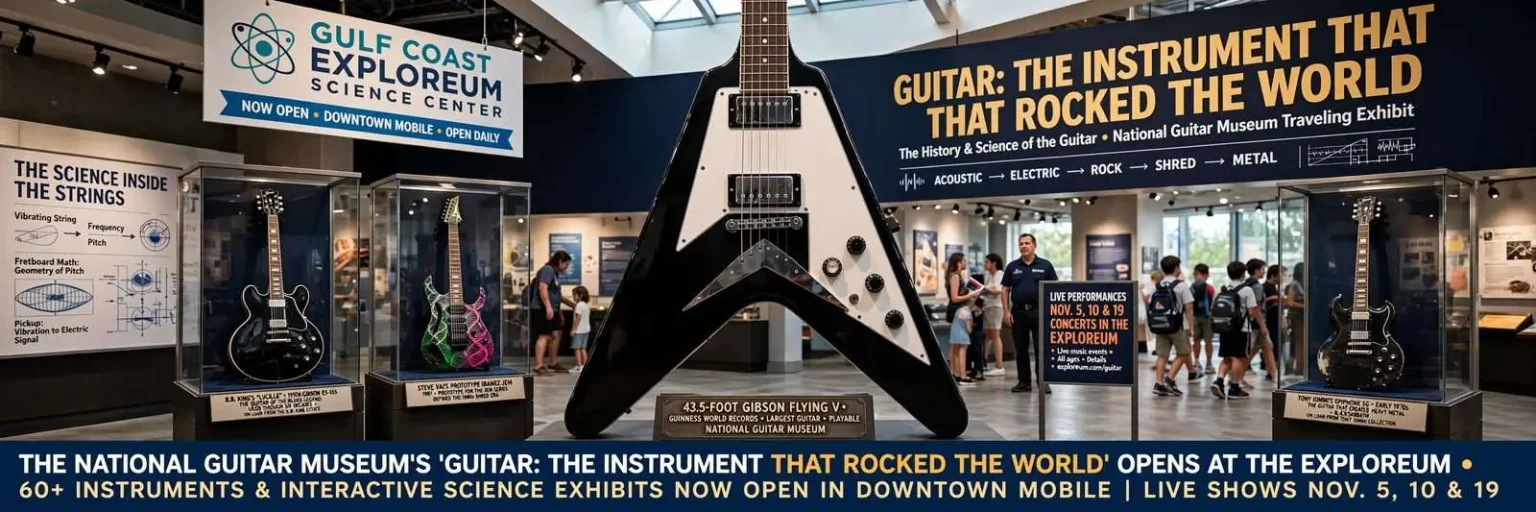
The Gulf Coast Exploreum Science Center is hosting Guitar: The Instrument That Rocked The World, a traveling exhibit from the National Guitar Museum that pairs the history and science of the guitar with a stunning collection of instruments.
Exploreum marketing director Josh Holland walked through the show before its opening, and the tour made the scale of the production clear: dozens of display cases, a wall of guitar history and one instrument so large it holds a world record.
The exhibit grew from a casual comment to collector Harvey Newquist that his home looked like a museum. Research revealed no museum dedicated solely to the guitar anywhere in the world, and the National Guitar Museum was born as a traveling exhibition searching for a permanent home. Holland would love to see that home in Mobile.
Setting up took nearly two years of planning and, once the crates arrived, under two weeks of assembly — about 60 display cases, each with roughly 16 parts, plus a 43.5-foot playable Gibson Flying V certified by Guinness World Records. Highlights include B.B. King’s “Lucille,” Steve Vai’s prototype Ibanez Jem and Tony Iommi’s Epiphone SG. Related events include live performances Nov. 5, 10 and 19.
A museum with no walls — yet
The National Guitar Museum occupies a peculiar place among American institutions: it is a museum without a building. Its founders set out to honor the world’s most popular instrument, discovered that no museum anywhere was devoted solely to the guitar and chose to exist instead as a traveling exhibition that moves from science center to science center while the search for a permanent home continues.
The origin story fits the instrument. Harvey Newquist’s home collection prompted a visitor’s observation that the house looked like a museum, and the follow-up research — checking whether any institution anywhere covered the guitar alone — turned up nothing. What began as a quip became a mission, and the mission became crates of exhibit components crossing the country to venues like the Exploreum.
That traveling model explains the logistics Holland described. Nearly two years of planning preceded the installation, and when the crates arrived in Mobile, assembly took just under two weeks: about 60 display cases, each arriving in roughly 16 parts, fitted together into the finished show. The scale is closer to a touring stage production than a typical museum installation.
The centerpiece is impossible to miss — a 43.5-foot playable Gibson Flying V, certified by Guinness World Records as the largest of its kind. Built at true-scale proportions of the iconic 1958 body design, the instrument is playable in the literal sense: strings, frets and all, at a size that turns the guitar into an exhibit visitors can stand inside the shadow of.
The instruments that headline the show
Around the record-setter, the exhibit’s collection does what no general museum has done: it puts the guitar’s lineage in one room. Among the headline instruments are B.B. King’s “Lucille,” the guitar synonymous with the blues king’s six-decade career; Steve Vai’s prototype Ibanez Jem, the instrument that defined the virtuosic “shred” era of the 1980s; and Tony Iommi’s Epiphone SG, the guitar associated with the heavy riffs that founded heavy metal in Birmingham, England.
Each guitar in the collection carries a story about where the instrument went next — the blues that became rock, the technical arms race of the shred years, the down-tuned heaviness that built metal. For visitors, the cases function as a walk-through history of American and British popular music, told through wood, wire and amplification.
The exhibit’s pairing of history with science is what makes it a fit for a science center rather than a music hall. The guitar is, at bottom, a physics lesson: vibrating strings, resonating bodies, the mathematics of fret spacing and the electronic transformation of string vibration into signal. The show builds those lessons into its displays, giving students a hands-on path from the instrument they know to the acoustics they don’t.
For the Exploreum, the exhibit extends the downtown Mobile science center’s mission of interactive learning into popular culture — the rare touring show that can draw both the school group studying sound waves and the adult who grew up on the records those guitars made.
The science inside the strings
Visitors who come for the famous instruments will find the science woven throughout the show. The guitar’s story is an engineering story: how a vibrating string’s frequency determines pitch, how the fretboard’s geometry encodes that mathematics into finger positions, how an acoustic body amplifies vibration into air and how the electric guitar’s pickups convert it all into a signal that an amplifier can shape into anything from clean chime to distortion.
Those principles scale up neatly to the exhibit’s giant Flying V, where the relationships between string length, tension and pitch become visible at 43.5 feet. A lesson that fits on a classroom whiteboard plays out at architectural scale, and the record-certified instrument gives the Exploreum’s educators a prop no textbook can match.
The exhibit also traces the technology timeline — the acoustic era, the arrival of electrification, the solid-body innovations that made rock and roll possible and the effects and electronics that followed. Each generation of the instrument solved a problem its players posed, and the display cases walk visitors through the solutions one era at a time.
For younger visitors, the show doubles as an introduction to music itself. Exhibits built around interactivity let guests feel vibration, test resonance and hear the difference between designs — the kind of tactile learning the Exploreum’s floors are built around.
What the show means for downtown Mobile
Attracting a touring exhibition of this size is a competitive business among science centers, and the Exploreum’s booking reflects the institution’s standing on the Gulf Coast tourism circuit. Downtown Mobile’s museum district — anchored by the Exploreum on Government Street — draws school groups from across the region and tourists who pair the center with the city’s historic attractions.
An exhibit with guitar-power behind it widens that audience. The subject crosses generations and genres in a way few touring shows manage: the grandparents in the audience know B.B. King’s work firsthand, their children know Iommi’s riffs and their grandchildren know the instrument from video games and viral players. Marketing director Josh Holland’s walk-through previewed a show built to serve all of them at once.
The Exploreum’s leadership has also made clear the exhibit carries a local aspiration. Holland would love to see Mobile become the permanent home the National Guitar Museum is searching for — a museum-without-walls finding, at last, a building. Mobile’s history as a Gulf Coast port city with a deep musical tradition makes the pitch more than a long shot; it is the kind of cultural anchor cities court and rarely land.
Whether that future arrives, the traveling show’s stop gives Mobile first claim to the story: for the run of the exhibit, the most complete guitar exhibition anywhere is on Government Street.
Live music on the calendar
The exhibit’s run is not confined to the gallery floor. Related events include live performances scheduled for Nov. 5, 10 and 19, extending the guitar theme onto a stage and giving the Exploreum’s visitors reasons to return across the exhibit’s run.
Programming of that kind follows the pattern that successful touring exhibits use to hold attendance: a core show that draws the opening crowds, supplemented by events that pull in the audiences a static display cannot reach. A guitar exhibition with live performances attached turns the science center into a venue — and gives local players and music educators reasons to build class trips and evenings around the run.
Inside the installation
The behind-the-scenes numbers tell visitors what to expect before they walk in. Sixty display cases means sixty stations of story: individual instruments, artifacts, graphics and interactive elements, each housed in its own case and arranged into the show’s flow. With roughly 16 parts per case, the assembly job ran to nearly a thousand components before the first visitor bought a ticket.
Touring exhibits live and die on that choreography. Crates arrive on trucks on a scheduled sequence, and a venue’s crew works through the build in the window between shows — here, just under two weeks from crates to complete. The Exploreum’s staff spent the planning period — nearly two years in the making — preparing the floor, the traffic flow and the programs that surround the exhibit’s run.
The payoff is a show that feels permanent during its stay. Visitors moving through the cases encounter the guitar’s history in sequence and its science in the interactive stations between them, with the giant Flying V anchoring the space and the famous instruments — “Lucille,” the Jem prototype, Iommi’s SG — spaced along the route as the milestones they are.
Why the guitar lends itself to a museum
Of all the instruments in popular music, the guitar is the one whose story can carry a museum. It is centuries old in its acoustic forms and barely a century old in its electric ones; it spans folk, blues, country, jazz, rock, metal and pop; and it is the instrument millions of people have owned, however badly they played it. A museum dedicated to the guitar is, in a sense, a museum dedicated to its visitors’ own lives.
That universality is what the National Guitar Museum’s founders counted on when research confirmed no such institution existed. The traveling exhibition model let the museum exist before the building did — testing the content market by market, case by case, while the search for a permanent home continued.
The model also explains the show’s portability of ambition. Wherever it lands, the exhibit arrives complete: the cases, the collection, the record-certified centerpiece and the programming plan that comes with live performance dates like Mobile’s Nov. 5, 10 and 19 shows.
Planning a visit
Visitors to the Exploreum will find Guitar: The Instrument That Rocked The World integrated with the science center’s regular offerings, and the exhibit’s subject matter gives families an unusual advantage: it is a show that interests every generation at once. The history draws the music fans, the science draws the students and the sheer spectacle of a 43.5-foot guitar draws everyone in the building.
The related live performances on Nov. 5, 10 and 19 give the run a rhythm — gallery visit first, then a reason to come back for music in the building. Details for each event accompany the exhibit’s presentation at the center.
For educators across the Gulf Coast, the show arrives ready-made for field trips: sound, vibration, frequency and resonance are standard science curriculum, and the exhibit delivers them through an instrument students already care about. The Exploreum’s school-year calendar makes the timing deliberate.
And for Mobile, the run is an audition. The National Guitar Museum remains a traveling institution searching for the city that will give it walls. Holland’s hope — that the home turns out to be Mobile — starts with the crowds the show draws on Government Street. The instrument that rocked the world is, for now, rocking downtown, one display case and one world-record Flying V at a time.