The New Bruce Willis Movie “Red” Takes Place in Mobile — Sort Of
The new Bruce Willis film Red sends its hero through Mobile and Pensacola on screen, though the Gulf Coast scenes were shot in Louisiana.
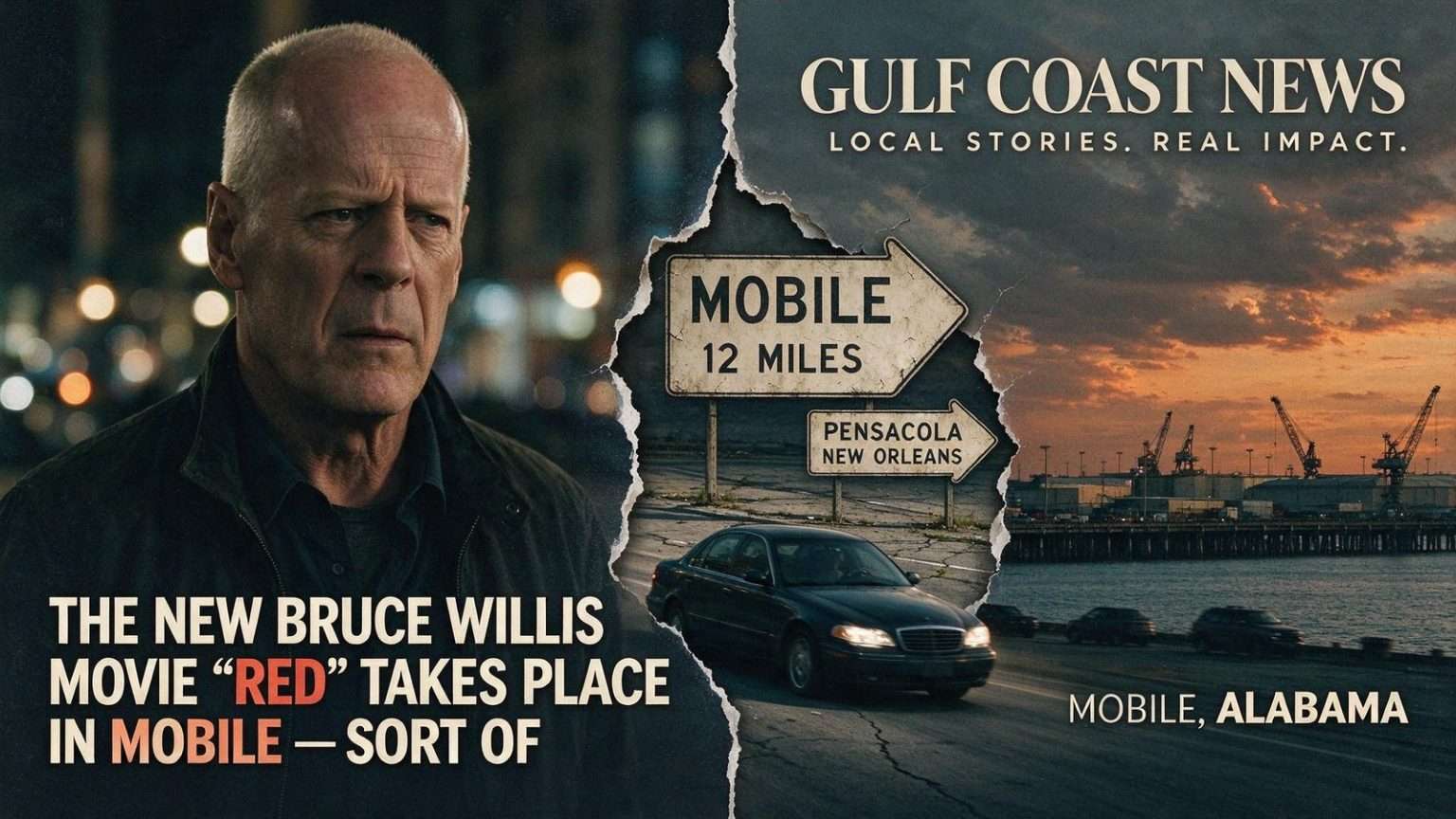
Moviegoers watching the new action comedy “Red” this fall will spot some familiar geography in the story, even if none of it was shot anywhere near here. The film, which follows a retired black-ops agent pulled back into the game, sends its characters through a series of Gulf Coast locales — including Mobile — that local viewers will recognize even as the fine print of the production tells a more complicated story about where the movie actually got made.
The film stars Bruce Willis alongside Morgan Freeman, Helen Mirren, Richard Dreyfuss, John Malkovich and Ernest Borgnine, a cast assembled from some of the most recognizable names in movies across several generations. Willis leads the ensemble as an ex-CIA agent on the run whose travels take him through Mobile, Pensacola and New Orleans, among other stops, with the screenplay using the Gulf South’s cities, highways and backroads as the backdrop for a cross-country chase. The title itself is an old intelligence-world designation — “Red” stands for Retired, Extremely Dangerous — and the story turns on what happens when a man with that label becomes a target.
The Gulf Coast connection runs deeper than the itinerary. “Red” is based on a comic by Huntsville native Cully Hamner, an Alabama artist whose work on the original limited series gave Hollywood the source material. For Alabama comics readers, that credit is the most significant part of the movie’s arrival: a creator with deep roots in the state seeing his work adapted into a major studio release with an all-star cast.
Filmed Across the State Line
As has become routine with big-budget productions, most of the footage standing in for Mobile and the delta was actually filmed across the state line in Harahan and New Orleans, Louisiana. The pattern will be familiar to anyone who follows location shooting: Louisiana’s aggressive film incentives have made the New Orleans area the default production hub for the region, and productions that call for Gulf Coast settings routinely shoot there rather than on the Alabama locations the script names. The result is that Mobile appears in the story but not, for the most part, in the photography — a stand-in arrangement that works at the level of general geography but that sharp-eyed locals will notice.
That gap between where a story goes and where a movie shoots has become one of the defining economics of modern filmmaking. Louisiana’s tax credit program helped rebuild a production infrastructure in the New Orleans area — crews, stages, equipment houses — that makes it practical to shoot an entire regional chase there. Alabama’s communities, including Mobile, have worked to attract productions of their own, but stories like “Red” illustrate the recurring outcome: the Gulf Coast appears on screen, while the payrolls and the stage work land in Louisiana.
A Comic Book Beginning in Huntsville
Hamner’s path from Huntsville to Hollywood adaptation is worth noting for what it says about the medium. “Red” began as a compact comic series — a tight, action-driven story about an aging operative — and its translation to the screen followed the now-standard route by which comics properties move into film. The adaptation expanded the story considerably, adding the ensemble cast and the broader comic tone that the marketing emphasizes, but the core premise and much of the sensibility trace back to the Alabama artist’s original pages.
For the region’s comics community, the film’s release is a reminder that the writers and artists behind major adaptations come from everywhere, including Alabama. Huntsville, better known for rockets and aerospace engineering than for comic books, produced a creator whose work ended up on movie screens worldwide, and the “based on the comic by” credit that runs through the film’s advertising carries his name. Aspiring artists in the state watching the movie will see that path is real.
Dreyfuss Remembers Filming on the Gulf
The Gulf Coast connection does not end with the locations or the source material. In a recent interview, Richard Dreyfuss recalled his earlier experience shooting on the Gulf — including “Close Encounters of the Third Kind,” parts of which were filmed in Mobile. The 1977 science fiction landmark used the Mobile area as one of its filming locations, tying the city to one of the most celebrated movies of its era and giving Dreyfuss a personal history with the region that predates “Red” by more than three decades.
His review of the region’s climate was blunt. “Hot, hot, hot — hotter than hell,” he said, remembering bugs on his porch that, he joked, had never been discovered before. The quote has circulated among Gulf Coast film buffs as an unvarnished celebrity take on a Mobile summer, and it captures something every local resident already knows: the Gulf Coast in production season tests crews and cast alike, with heat and humidity that no northern actor arrives fully prepared for.
That Dreyfuss remembered the experience at all, decades later and while promoting a new film, says something about how location shoots imprint on the people who work them. Actors spend weeks embedded in a place — living in local housing, eating in local restaurants, working long days in local weather — and for a performer of Dreyfuss’s generation, the Mobile stretch of “Close Encounters” remained a vivid professional memory.
What “Red” Means for Local Film Fans
For Mobile audiences, “Red” offers a layered experience. The story names their city; the cast is heavyweight; the source artist is an Alabama native; and one of the stars carries a personal history with the area going back to a classic film. The catch — that the cameras mostly rolled in Louisiana — is a familiar frustration, but it does not erase the regional identity of the picture. The Gulf Coast is a character in the movie’s geography even if the delta’s stand-in locations did the on-screen work.
The film’s release also lands amid an ongoing conversation about production in Alabama. Cities like Mobile have marketed themselves as locations, and the state has periodically weighed stronger incentives to compete with Louisiana’s program. Every movie like “Red” — one that borrows the region’s geography while filming elsewhere — becomes part of the case for building the crews, stages and credit structures that would let the next such project actually shoot here.
Until then, local moviegoers can enjoy the particular pleasure of watching Hollywood chase scenes unfold through cities they know, spotting which coastline shots ring true and which were conjured across the state line. “Red” gives them that opportunity with an unusually strong cast, an Alabama comic artist’s name in the credits, and a star’s fond, sweaty memories of the last time Mobile stood in for the movies.
The Cast and the Comic Tone
Much of the film’s appeal rests on its casting. Bruce Willis anchors the picture as the retired operative whose quiet life is interrupted, with Morgan Freeman, Helen Mirren, John Malkovich and Ernest Borgnine filling out the roster of former operatives and associates whose paths cross his. The premise — old agents, presumed past their prime, proving considerably more dangerous than anyone expected — gives the ensemble room to play both comedy and action, and the movie leans into the joke of watching legendary performers handle heavy weaponry. Richard Dreyfuss appears as well, adding another familiar face to a lineup that spans decades of movie history.
The tone walks the line between spy thriller and farce. The comic source material was leaner and more hard-edged; the film broadens it into ensemble comedy-action, a direction the casting makes credible. Audiences who know the comic will recognize the premise and the central character’s situation, while audiences coming in cold get a self-contained story about retired spies, old grudges and one very bad week that begins with a quiet man watching his past catch up with him.
That journey structure is what puts the Gulf Coast in the film. A story about a man moving from city to city, staying ahead of pursuers, needs real geography to feel grounded, and the route through Mobile, Pensacola and New Orleans gives the chase a recognizable Southern spine. Each stop along the way carries its own texture — coastal highways, small motels, local color — and the film uses the audience’s sense of these places even when the actual shooting happened elsewhere.
Mobile’s Movie History Beyond the Stand-Ins
The Dreyfuss anecdote points to a film history in Mobile that runs deeper than most residents realize. “Close Encounters of the Third Kind” was one of the biggest productions of its decade, and the fact that parts of it were filmed in and around Mobile remains a point of local pride and a recurring answer to the question of what has ever been shot here. The city’s landscapes — the delta, the port, the older neighborhoods — have appeared on screen in various projects over the years, even as the big-budget productions keep choosing Louisiana’s incentives.
The contrast between those two facts defines the region’s film story: genuine cinematic history, and a recurring pattern of near-misses on modern productions. “Red” fits squarely into that pattern. Its characters visit Mobile in the story; its cameras worked in Harahan and New Orleans; and Alabama viewers get to watch their coastline played by a neighbor’s. The production economics are straightforward, but the cultural effect is subtle — the region appears in the national imagination as a movie setting while remaining underused as a movie workplace.
For now, the movie offers Gulf Coast audiences several pleasures at once: a big-cast action comedy, a story that routes its hero through Mobile, the credit of a Huntsville-born comic artist, and a star’s decades-old memories of sweltering through “Close Encounters” on the Gulf. Whether the next film with Mobile in its script also brings its cameras is the question the region’s film advocates keep asking — and every stand-in production like this one sharpens the point.