
The Origin of Hayley’s Bar: A Pink Dauphin Street Institution Since 1991
The Origin of Hayley's Bar: A Pink Dauphin Street Institution Since 1991 — local South Alabama news from southalnews.com.
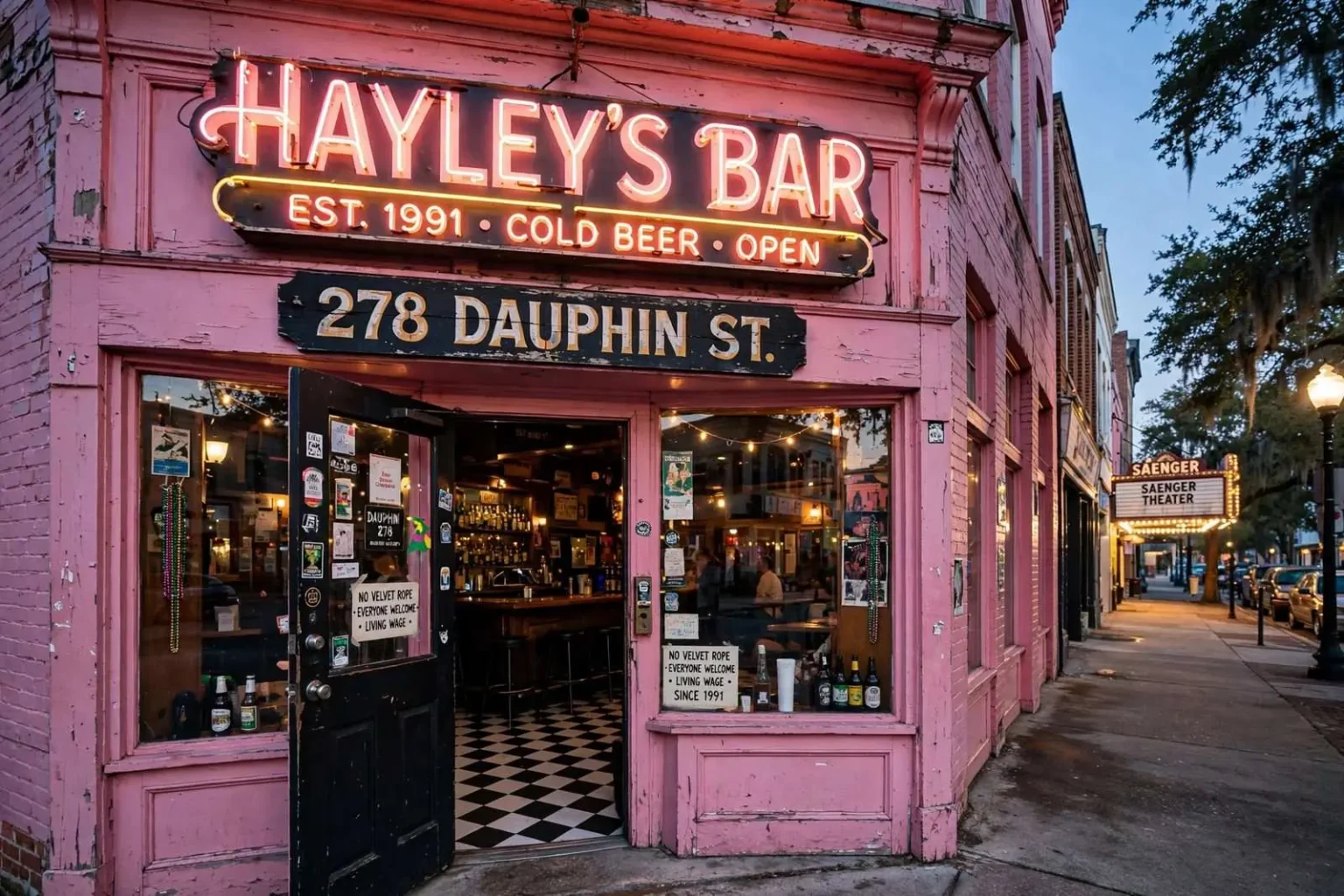
The pink dive bar at 278 Dauphin St. started with founder Hayley Maulsby’s experience working hip Lower East Side bars in New York City, including The Village Idiot. She brought that no-frills concept home to the Gulf Coast and opened Hayley’s Bar in downtown Mobile in 1991 — a model that has now worked for more than a quarter century, outlasting bars that opened with more money, more polish and far less staying power.
The New York years gave Maulsby her template. The Lower East Side bars she worked — informal, unpretentious rooms where the drink was the point and the decor barely mattered — stood in contrast to the velvet-rope establishments of the era. When she came south, she carried that sensibility with her, along with a conviction that a bar could be cheap, honest and busy all at once.
Downtown Mobile in 1991 was a very different landscape. The Dauphin Street entertainment district that today fills the historic corridor with weekend crowds was then a collection of a few stubborn businesses holding out between empty storefronts, and opening a bar downtown was widely considered a gamble. Maulsby took it anyway, betting that the neighborhood’s historic architecture and its proximity to the city’s courts, offices and conventions could sustain a serious nightlife.
A Bar With Standards
Hayley combined low prices with quality, using canned colas instead of a soda gun so drinks never went flat, and the bar was among the first downtown to serve beer in bottles. The details sound small, but in a bar business where shortcuts are standard, they became the establishment’s signature: drinks made the same way every night, from products that didn’t degrade in a hose on the wall.
She recalls being told she was crazy to open downtown; months later, some of those doubters asked for jobs. The reversal was an early sign of what the bar would become — a place whose success was obvious from the sidewalk on any weekend night, and whose standard-setting forced other operators to pay attention.
Co-owner Delane Bond later partnered with Hayley to keep the business thriving. The partnership preserved the founding formula while adding the operational muscle that keeps a bar running through a quarter century of Mardi Gras seasons, summer slowdowns and the churn of a downtown that changed around it.
Employees stay loyal because the owners pay a living wage, and devoted customers love the everyone-is-welcome attitude. In an industry known for turnover, Hayley’s staff retention became part of its reputation — bartenders who stayed for years knew the regulars’ orders, their histories and their names, which in turn gave customers a reason to keep coming back.
Generations of regulars have graduated, married and started families around the bar’s black-and-white checkered floor. The checkered pattern became the bar’s visual signature — instantly recognizable to anyone who has spent a Mardi Gras weekend or a post-show night on Dauphin Street — and the rituals that happen on it have accumulated over more than 25 years of operation.
That longevity gives Hayley’s a role few businesses claim: a constant across the decades as downtown Mobile rebuilt itself. Customers who first walked in as college students now bring their children’s babysitters’ phone numbers, and the bar has watched a generation of Mobilians move through its room on the way to the rest of their lives.
A Downtown Mainstay
Hayley’s helped push surrounding bars to raise their own drink standards and has watched Dauphin evolve toward a mini Bourbon Street alongside restaurants, The Saenger Theater and the CLA. The corridor’s transformation — from a strip with a handful of bars to a destination drawing visitors from across the Gulf Coast — happened around the bar, and partly because of the standards it set.
The Saenger Theater’s restoration brought a steady calendar of touring acts to the block, and the Center for the Living Arts added gallery openings and cultural events that put foot traffic on Dauphin Street beyond the weekend bar rush. Each new anchor fed the others, and the bars that survived the lean years — Hayley’s chief among them — were positioned to catch every wave of growth that followed.
Mardi Gras turns the street into the center of Mobile’s celebration culture. Hayley’s position on Dauphin places it directly on the parade routes and in the middle of the season’s foot traffic, when the checkered floor fills with riders, revelers and out-of-towners experiencing Mobile’s carnival for the first time. For a bar built on regulars, the season brings a brief annual inversion — strangers at the rail, and the regulars holding court in the corners they’ve kept for decades.
The dive-bar label, which the bar wears comfortably, describes an approach rather than a condition. The room is not polished because it doesn’t need to be: the drinks are right, the prices are fair and the welcome is unconditional. That combination has outlasted a series of trends that swept through the bar business — the themed lounges, the cocktail reinventions, the upscale remodels — none of which displaced the basic proposition that Maulsby carried from the Lower East Side.
The living-wage policy deserves particular note in an industry where staff wages often depend on the night’s receipts. Bars that pay reliably tend to keep the same bartenders for years, and experience compounds: a veteran bartender mixes faster, catches problems earlier and gives a room its personality. At Hayley’s, the staff’s tenure is part of what customers are buying when they order a drink.
The everyone-is-welcome attitude has also defined the bar through eras when downtown nightspots were often divided by crowd, dress code and cover charge. Hayley’s took the opposite approach — no velvet rope, no door policy — and found that the mix itself became the draw. Students, lawyers, musicians, construction crews and tourists have shared the same checkered floor for decades, which is rarer in a bar district than it should be.
Twenty-Five Years and Counting
More than 25 years on, the bar remains a consistent, welcoming landmark of the Azalea City. Businesses on Dauphin Street have opened and closed in waves since 1991 — dozens of them in the time Hayley’s has been pouring — and survival of that length in a nightlife district is itself an achievement few owners reach.
The bar’s endurance owes something to its refusal to chase the market. Where competitors renovated, rebranded or repositioned with each trend, Hayley’s adjusted at the margins and kept the core exactly where it started: canned colas, bottled beer, low prices and an open door. Customers reward that kind of consistency with the kind of loyalty that carries a business through recessions, hurricanes and the long road-construction summers of a changing downtown.
The pink exterior has become a wayfinding point for the street — the color visible from blocks away, familiar to anyone who has ever given directions on Dauphin. In a corridor that has rebranded itself repeatedly, the bar’s unchanging face is part of its charm, and part of its value to the block: a landmark that has outlasted everything around it.
Regulars describe the bar in the terms that matter to them: the drink tastes the same on a Tuesday as it does on Mardi Gras, the bartender remembers what you ordered last month, and nobody checks your credentials at the door. Those are the details that reviews and rankings rarely capture, and the ones that decide whether a bar becomes an institution or a memory. Hayley’s crossed that line years ago, and the steady line of first-timers arriving behind the regulars suggests it will stay crossed.
Maulsby’s journey from New York’s Lower East Side to a Dauphin Street corner is, in miniature, the story of downtown Mobile’s revival — outsiders and locals betting on a historic district before the investment arrived, and building institutions steady enough to prove the bet was sound. The Village Idiot’s lesson — that a bar succeeds on what happens behind the bar, not on what hangs on the walls — turned out to transplant perfectly to the Gulf Coast.
The bar’s history also tracks the changing role of women in the industry. In 1991, a woman owning and running her own bar in downtown Mobile was uncommon enough to draw commentary, and Maulsby’s success opened a path that other female owners in the district have followed since. The standard she set — quality drinks, fair pay, no pretense — has been quoted by more than one operator in the years since.
Delane Bond’s partnership ensured that the founding vision survived its founder’s gradual step back from daily operations. Businesses built around a single personality often fade when that personality departs; Hayley’s avoided that fate by institutionalizing the standards early — the products, the pricing, the pay and the welcome — so that the bar’s identity lives in its routines rather than in any one person’s presence.
The customers who graduated, married and started families around that checkered floor are now scattered across the metropolitan area, but the bar’s pull endures. Return visits are part of its rhythm: Mobilians who moved away stop in when they’re home, former regulars bring new spouses, and each Mardi Gras delivers a fresh crop of first-timers to be shown where the good nights happen.
More than a quarter century after a New York bartender was told she was crazy to open on a sleepy Dauphin Street, the block is one of the busiest entertainment districts on the Gulf Coast, and the pink dive bar in the middle of it is still doing things the way she always did: cheap drinks made right, poured for anyone who walks in. The doubters, meanwhile, are long gone — some of them, patrons like to note, after asking for jobs.