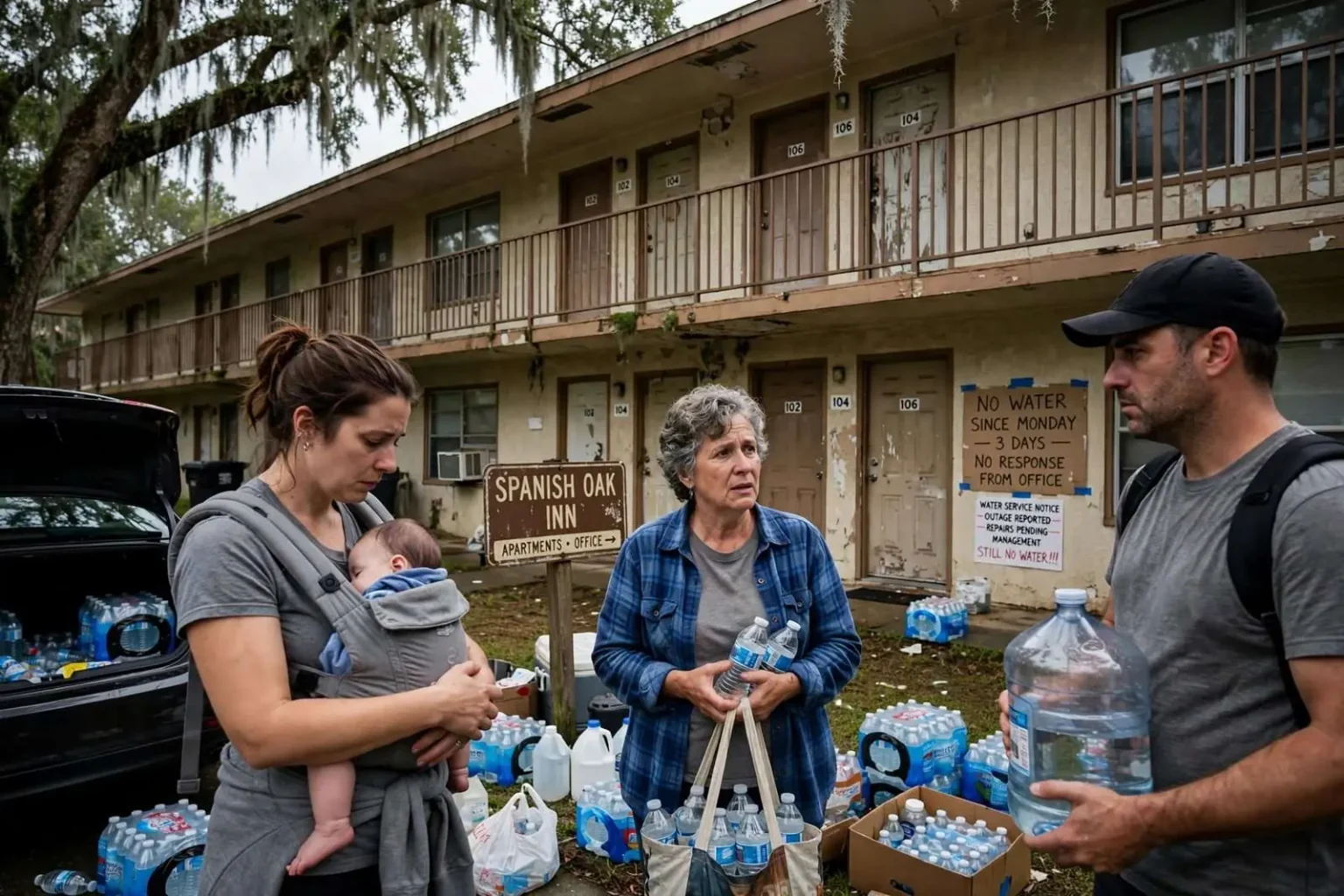
More than six residents at the Spanish Oak Inn apartment complex in Theodore reached out for help this week after they say the complex went without running water from Monday until Wednesday afternoon.
Residents said water service returned while a visitor was at the property Wednesday, but they described the water as still cold and appearing dirty. Every resident interviewed asked to remain anonymous, citing concerns about retaliation from management. Theodore sits in the southern part of Mobile County, just west of Mobile, and the apartment complex has long been home to a mix of working families, retirees and renters who depend on stable utility service.
What Residents Say Happened
One resident said tenants were initially given one explanation for the outage but were never able to get clear answers from the front office.
“For about three days now, we’ve been without any water. We were initially told that it was due to a pipe being busted, but obviously we now know that’s not the case. And when anyone tries to call the front office, there is no response,” the resident said.
Residents said the loss of water affected the most basic parts of daily life: bathing, cooking, drinking water, washing dishes, and caring for children and pets. Several described improvising with bottled water from convenience stores, and said they had to choose between working their shifts and finding a place to bathe.
Basic Daily Needs Disrupted
One woman said she and her boyfriend had to leave the complex and stay in an Airbnb during another utility outage. She said they have paid to shower at a truck stop and bought bottled water for themselves and their animals.
“Me and my boyfriend had to go stay in an Airbnb because we were without water and power for at least three days over the weekend. We have to go all the way to the truck stop to take showers — $20 showers for us. And then on top of that, to the stores, we have to get water to boil for us and give to the animals when they’re thirsty,” she said.
Another resident said she has a newborn at home and has also dealt with power outages at the complex. Newborns require sterilizing bottles, doing frequent loads of laundry, and bathing the baby — all of which become nearly impossible without running water.
“We’ve been three days now without water, so it’s been like no lights, no water for me and my family. Other people have lights. I lost all my food last month, had just went grocery shopping. I have a newborn in the house. It’s just difficult, and I don’t think it’s fair,” she said.
A different tenant said she has been sleeping in her car for air conditioning while dealing with the lack of utilities at home. Sleeping in a vehicle is an especially common workaround during Mobile County summers, when interior temperatures can climb dangerously high.
“Still nothing, still no power, still no water. I’m sleeping in my car. I work five days a week. I sleep in my car — just for a little A.C. It’s ridiculous,” she said.
Questions About Payments and Accountability
Residents questioned why tenants who say they have paid their rent and utility bills are the ones suffering through outages.
“People are paying their bills, and then the people who are paying their bills are suffering for it,” one said.
Residents said management told them a payment was made to restore water service, but the check bounced. A call to Mobile County Water about the account and payment did not turn up account-specific details, and requests for comment left with Spanish Oak Inn management went unanswered. When someone visited the property to ask questions in person, the visitor was asked to leave.
Residents also raised concerns about potential evictions. One resident claimed management threatened to “boot” doors while tenants were at work or school. That claim could not be independently verified, and landlords in Alabama are generally required to follow formal eviction procedures rather than physically lock tenants out.
What Alabama Law Requires
Under Alabama’s Uniform Residential Landlord and Tenant Act, landlords generally must provide running water and a reasonable amount of hot water, with limited exceptions. Tenants who believe a landlord has failed to meet those obligations may pursue remedies outlined in the state statute, including written notice and potential legal action. The act also restricts landlords from shutting off utilities as a way of forcing tenants out.
For parents, the outage created another immediate worry: getting children ready for school without running water. Children who arrive at school without being able to brush their teeth, wash their faces or rinse off after recess are at greater risk of running afoul of school dress and hygiene policies.
“And now y’all don’t care that the children got to go to school. How they gonna brush their teeth?” one resident asked.
Another became emotional while describing the conditions: “I can’t do it no more. I just, I can’t. It’s called pain and suffering.”
Where Things Stand
The water is back on, according to residents, but they say the situation is not resolved until service is clean, hot and reliable — and until they receive answers about what led to the outage. Residents say they want management and the property owner to acknowledge the disruption, refund the cost of bottled water and out-of-pocket showers, and commit to a maintenance plan that keeps the water on.
“We need some justice. We need some help,” one resident said. For now, tenants are watching to see whether the restored water stays on and at what temperature, and whether management begins communicating with residents in a way they have not experienced during the outage.
How to Get Help
Tenants in Alabama who believe their landlord has failed to provide essential services can file complaints with the Alabama Attorney General’s office, contact local legal-aid organizations, and in some cases ask a court to order repairs. The Mobile County Bar Association runs a modest-means program that can connect renters with attorneys for limited consultations, and several nonprofit housing agencies in Mobile and Prichard offer tenant-rights workshops each month.
Why Outages Are Common in Older Apartment Stock
Many of the apartment complexes along the Mobile-Tillman’s Corner corridor, including Spanish Oak Inn, were built several decades ago and use plumbing infrastructure that is well past its expected service life. Property owners who defer maintenance on water lines often find themselves dealing with cascading failures that affect multiple buildings at once. Tenants who can document recurring problems are in a stronger position to push for repairs or to pursue remedies under the state landlord-tenant act.
What Long-Term Repairs Look Like
For apartment complexes with aging plumbing, the only durable fix is usually a full or partial repipe, which can cost tens of thousands of dollars per building. Some property owners handle that work in phases, prioritizing the most problematic lines first. Tenants who are able to document recurring outages are often in a stronger position to push for those repairs, both by working with management and by enlisting local code-enforcement inspectors to confirm habitability issues. Until that work happens, intermittent outages of the kind residents described at Spanish Oak Inn are likely to continue.
What a Habitability Complaint Looks Like
Habitability complaints in Alabama generally start with a written notice to the landlord describing the issue, the date it began, and the requested remedy. If the landlord does not respond within a reasonable time — typically seven to fourteen days — the tenant can pursue remedies including rent withholding, repair-and-deduct, or a court order requiring the landlord to make the repairs. Tenants who fear retaliation can ask the court to order the landlord to stop certain actions, and legal-aid attorneys can help prepare the paperwork. Documentation, including photos, videos and text messages with management, is critical to making any of those remedies stick.
How City Inspectors Get Involved
City code-enforcement inspectors in Mobile County can be called in by tenants who believe their apartment is uninhabitable. Inspectors typically look for working plumbing, functioning heating and air conditioning, weather-tight roofs and doors, and compliance with basic safety codes. If an inspector finds violations, the landlord is given a window to fix them, and unresolved violations can lead to fines or, in extreme cases, condemnation of the property. Tenants who are unsure whether their situation rises to that level can request an inspection without committing to any particular course of action.
What to Do If Conditions Don’t Improve
If water and power outages continue at Spanish Oak Inn or other apartment complexes in the area, tenants have several options beyond waiting for management to act. They can file a habitability complaint with the city, contact the Mobile County Health Department, or seek legal advice through local legal-aid organizations. They can also organize as a group to present their concerns to the property owner, since collective complaints often get more attention than individual ones. For tenants who feel they cannot stay in their units, breaking a lease under Alabama’s landlord-tenant act is sometimes an option, though it typically requires documentation and notice.