
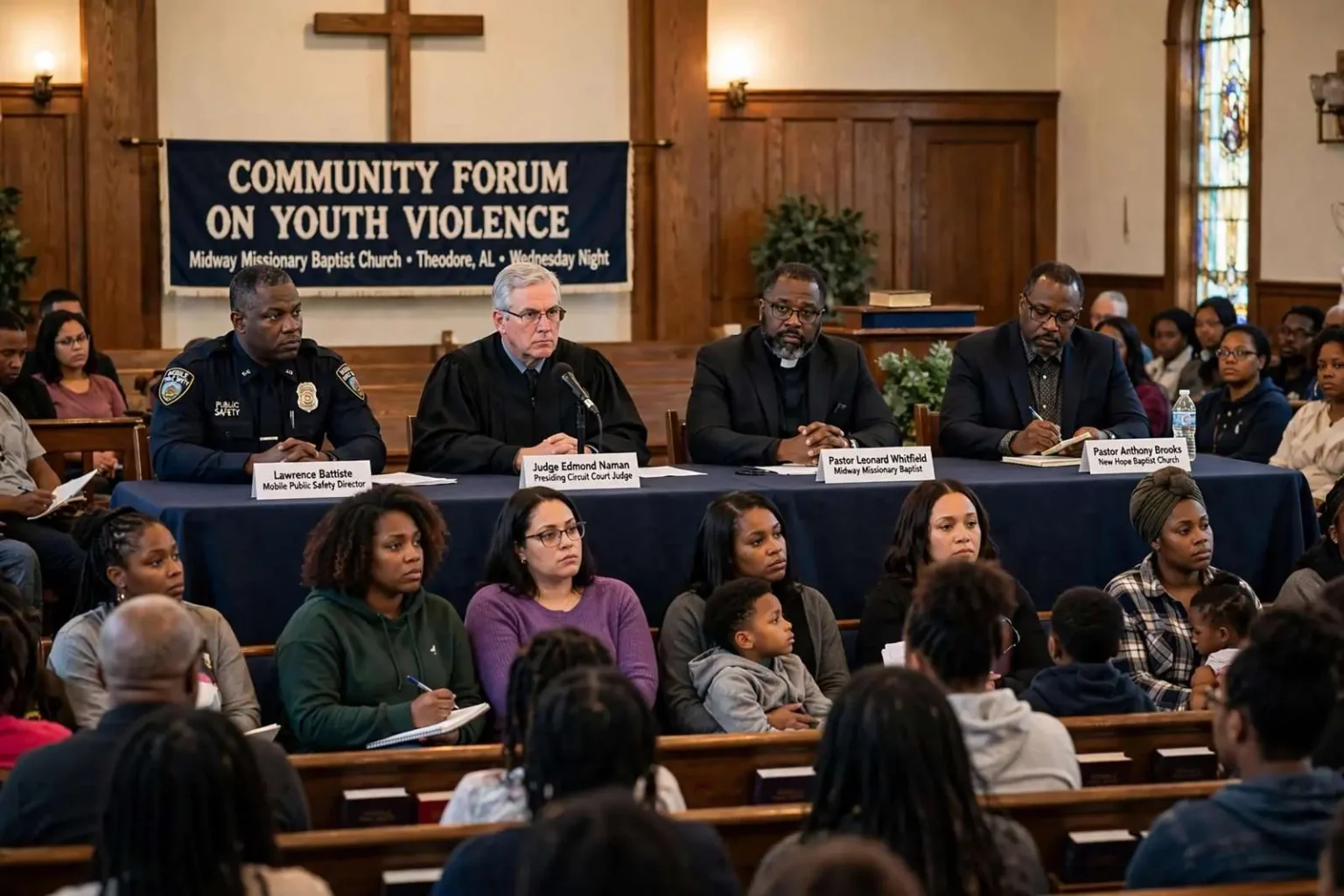
THEODORE, Ala. — Parents, guardians and children packed Midway Missionary Baptist Church in Theodore for a community forum on youth violence, where a panel of law enforcement officers and local officials fielded pointed questions about guns, repeat offenders and how the community should respond. The Wednesday-night discussion gave residents a direct line to leaders with the power to shape policy and intervention programs — and it made clear how deeply the violence gripping parts of Mobile County has reached into families and congregations.
The setting mattered. Churches across the region have increasingly become the venues where communities confront the crisis in their streets, offering a neutral, trusted space where officials can be questioned face-to-face and grieving families can speak without intermediaries. Midway Missionary Baptist Church, a longstanding congregation in the Theodore community south of Mobile, filled that role for an audience that included the people most affected by the county’s recent shootings.
Hard Questions From the Pews
Pastor Anthony Brooks of New Hope Baptist Church in Wilmer pressed the panel on how often relatives or close friends of a perpetrator are actually willing to come forward and turn someone in. The question goes to one of the most persistent obstacles in violent-crime investigations: witnesses who know the shooter often stay silent, whether out of loyalty, fear of retaliation or distrust of the justice system, leaving detectives with cases that the community knows the answers to but will not share.
Officials on the panel were forced to reckon with that dynamic in real time. Investigators have long said that most shooting cases are solved — or left unsolved — based on whether someone close to the offender talks, and every unsolved killing in the county reinforces the silence that allowed it. The exchange highlighted why programs that build trust between residents and law enforcement, and why witness-protection mechanisms, matter as much as any new ordinance.
Families Share Their Own Losses
The conversation turned personal when Taryn Taylor Brooks described how her son was wounded in a 2021 shooting on Airport Boulevard. She said bullets came through a wall and struck her child while the shooters were looking for someone else — despite her family’s efforts to keep him involved and busy.
Her account put a family’s face on the random, indiscriminate quality of the violence: a child inside a building, struck through a wall by shooters chasing someone else entirely. Her testimony that it happened even though the family had worked to keep her son engaged and occupied challenged the assumption that violence only touches children who are themselves on the street, and it gave the panel no easy answers.
Pastor Leonard Whitfield of Midway Missionary Baptist asked what rehabilitation programs exist at the state and federal level for young offenders, noting that too many leave custody only to reoffend. The question targeted the revolving door that community members say they see: young people pass through detention and return to the same streets, the same conflicts and the same patterns, with little treatment in between.
Community member Tinisha Trotter said fear is driving some children to arm themselves, recounting that even good kids in church tell her they want to shoot before they get shot. Her words captured what many residents describe as the engine of the crisis — a self-perpetuating cycle in which the fear of being a victim pushes young people toward becoming perpetrators.
Officials Weigh Solutions Beyond Laws
Mobile Public Safety Director Lawrence Battiste told the audience that creating new gun-ownership laws does not necessarily reach the people driving the violence. The distinction he drew is one prosecutors and police chiefs across the country have made in similar forums: the guns used in street violence are typically already illegally possessed or obtained, so marginal changes to lawful ownership rules do not intercept the young men actually pulling triggers.
Battiste’s answer reflected his vantage point atop the city’s public safety apparatus, which coordinates police, fire and other emergency services and has pressed for community-based intervention alongside enforcement. For the audience in Theodore, the message was that the levers that matter — investigation, prosecution, intervention and prevention — operate at the level of specific people and specific conflicts, not statutory language.
Mobile Presiding Circuit Court Judge Edmond Naman urged families to keep children in school and their needs met, warning that young people left alone on the street will be recruited by whoever reaches out first. The warning comes from the bench: judges see in case after case how a child with unmet needs becomes available to gangs, older offenders or whatever structure offers belonging, money or protection.
Naman’s remarks effectively redistributed the assignment. Laws and courts, his framing suggested, arrive after the fact; the decisive intervention happens at home and in school, in the years before a young person ever stands before a judge. For the parents in the pews, it was both encouragement and a sober reminder of the stakes in ordinary daily decisions.
What the Forum Was Designed to Do
Organizers said the goal was twofold: give frustrated residents a chance to be heard, and give officials insight into what is fueling youth crime across Mobile County. Both halves were on display during the evening — the emotional testimony of families who have lost or nearly lost children, and the panelists’ direct exposure to the questions that statistics and briefings cannot convey.
Forums of this kind have become a recurring feature of the region’s response to violent crime. Community meetings in Mobile, Prichard, Theodore and other communities give officials a way to explain what the justice system can and cannot do, and give residents a way to demand accountability and propose solutions of their own — mentoring programs, church-based outreach, neighborhood watch efforts and job pathways among them.
The panel format — pastors asking questions, law enforcement and judicial officials answering, families testifying — also builds the relationships that the system depends on. Witnesses come forward more readily to officers they have met; judges and prosecutors make better decisions when they understand what families are living through; and churches that host these evenings become ongoing partners rather than one-time venues.
The Broader Crisis in Mobile County
The forum took place against a backdrop of persistent concern about youth-involved violence in Mobile County. Community leaders, pastors and city officials have wrestled publicly in recent years with shootings that claim young victims, cases that go unsolved for lack of witnesses, and the steady drumbeat of young defendants appearing in local courtrooms. Each new incident renews the debate over where the response should focus: enforcement, prosecution, rehabilitation or prevention.
The reality the panelists described is that all of those elements interact. A case that is never solved because witnesses stay silent leaves a community believing violence carries no consequences. A juvenile who exits custody without treatment returns to the same conditions that produced the offense. A child who fears being shot, as Tinisha Trotter described, arms himself and adds another gun to the streets. Breaking the cycle requires progress at every link — which is why officials who work the problem daily tend to resist single-fix solutions.
Theodore and the Communities South of Mobile
Theodore, an unincorporated community in Mobile County south of the city, is one of the population centers that the county’s public safety agencies serve. Its neighborhoods sit along the U.S. 90 corridor and the tributaries of Dauphin Island Parkway, close enough to the city for its young people to be drawn into the same conflicts and networks that drive violence in Mobile’s streets.
The county’s unincorporated communities rely on the Mobile County Sheriff’s Office and Mobile police, depending on jurisdiction, and their residents experience the county’s crime trends without always having the municipal services and programs that city neighborhoods receive. That gap is part of what forums in places like Theodore address — bringing county-area families the same direct access to officials that city meetings provide.
Churches remain the anchor institutions for that work. In communities like Theodore, congregations such as Midway Missionary Baptist and Pastor Anthony Brooks’s New Hope Baptist Church in nearby Wilmer function as gathering places, service providers and moral voices, and their credibility with families is something no government agency can replicate.
Carrying the Conversation Forward
The questions raised at Midway Missionary Baptist — about witnesses who will not talk, about young offenders who reoffend after custody, about children who arm themselves out of fear — do not resolve in a single evening. What the forum accomplished was to place those questions, in the voices of the people living them, directly in front of the officials who control parts of the answer: the public safety director who can direct enforcement and intervention resources, the presiding circuit judge who can influence how young offenders are handled, and the pastors who can mobilize their congregations.
For the families who packed the sanctuary, the evening offered something less tangible but no less important: the experience of being heard. Taryn Taylor Brooks’s story of her son — struck through a wall by shooters aiming at someone else, despite every effort to keep him busy and involved — will not soon be forgotten by those who heard it. The officials on the panel left with their assignments unchanged but their understanding deepened, and the community left with proof that its grief and its questions can still summon the people in charge to a church in Theodore on a Wednesday night.
The work of answering those questions continues in courtrooms, patrol zones, classrooms and living rooms across Mobile County — but it starts, as it did that night, with a community willing to ask.


