
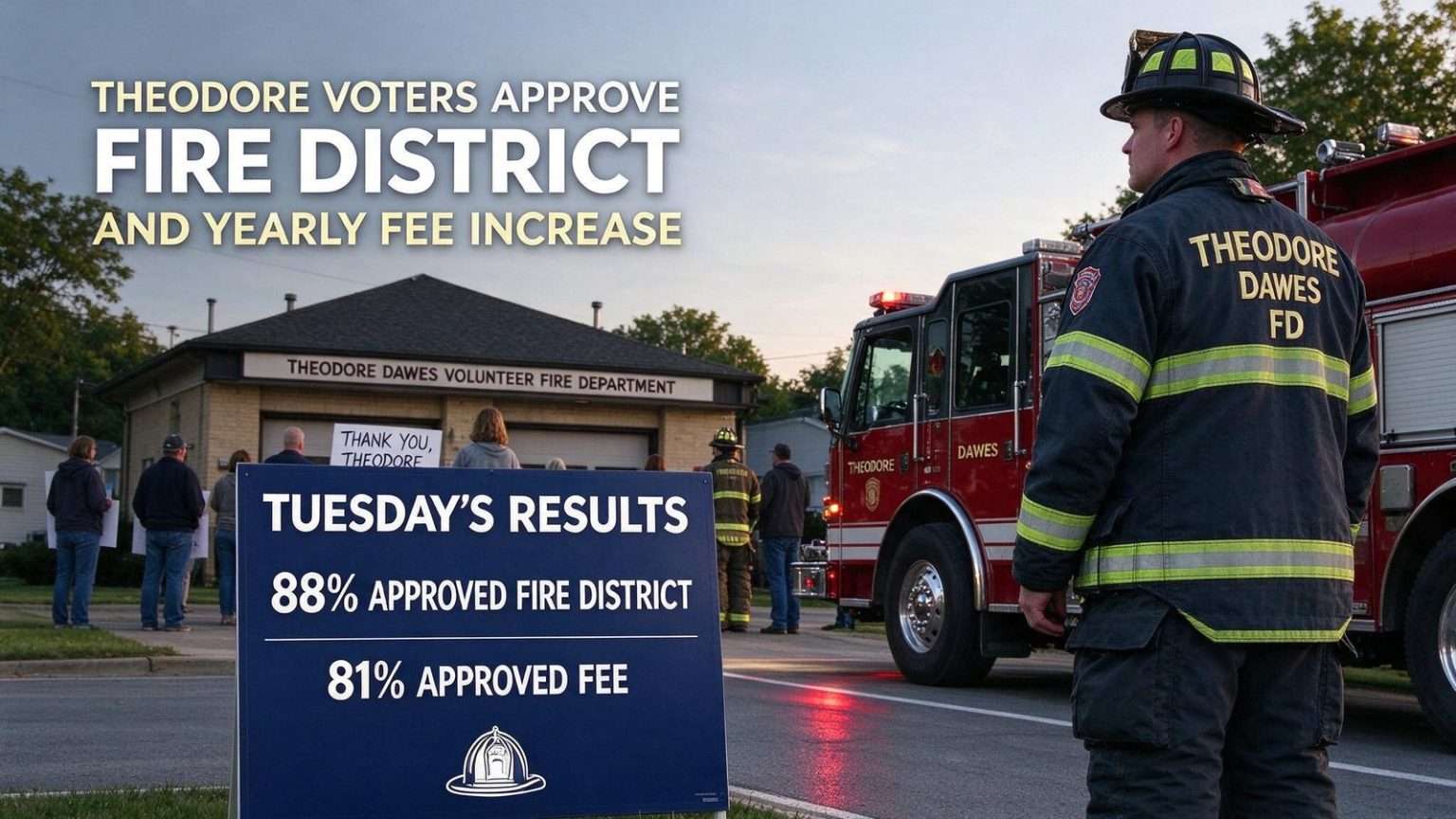
Voters in Theodore approved a measure Tuesday to create a fire district and increase yearly fire fees, according to the Theodore Dawes Volunteer Fire Department, handing the department a new funding structure after a campaign to convince residents that the change was needed. Deputy Chief Jeremy Lewis said the vote passed by a good margin, with 88 percent voting to create the district and 81 percent approving of the fee.
Those are lopsided numbers for any tax-or-fee question, which typically survive at the ballot box only when the organization behind them has spent months making its case. The department said that is exactly what it did. “With this passing, our core values as fire department will not change but our route to better serve our community will become easier,” the department posted on Facebook. “We have been proactive and informative throughout this process so this will allow us to move quickly at filling the gaps that the department needs to become more efficient.”
The vote means Theodore Dawes will operate as an organized fire district rather than a volunteer department relying on the older patchwork of funding. The department said elected board members will be busy in the coming months setting up the fire district bylaws, financials, and many other tasks — the unglamorous work of turning a yes vote into a functioning government entity.
“In the coming days, we will announce the procedures of nominating and voting board members,” the department said. “Again, every member within this department would like to thank our community’s support in the forming of Theodore Dawes Fire District.”
What a fire district changes
For residents, the practical difference comes down to reliability. A fire district is a legal entity with the authority to collect a dedicated fee, plan a budget and answer to an elected board, while a volunteer department operating outside that structure typically depends on a mix of fundraising, county support and whatever revenue it can assemble from year to year. The fee approved Tuesday gives the district a predictable revenue stream that arrives regardless of how good or bad a given fundraising season is.
That predictability is what lets a department plan. Fire service costs are dominated by big-ticket items — engines, tankers, turnout gear, air packs — that cannot be bought in small increments. A department with a steady fee can replace gear on a schedule instead of waiting for a windfall, and it can budget for training hours, building maintenance and the insurance and fuel costs that come with running apparatus out of a station every day.
Fire protection in unincorporated Mobile County
Theodore is one of the largest unincorporated communities in Mobile County, a sprawling area of subdivisions, schools, churches and commercial strips along U.S. Highway 90 and Theodore Dawes Road that sits between Mobile and Tillmans Corner. Because it has no city government of its own, services that city residents receive from a municipal fire department have to be built another way — and in Theodore, that way has long been the volunteer fire department.
Volunteer departments across Alabama face the same arithmetic. Call volumes in growing communities keep rising, training standards keep climbing, and the number of residents able to volunteer during the weekday hours when most calls come in keeps shrinking. Departments have responded in different ways — some have added paid daytime personnel, others have consolidated — but nearly all of them eventually run into the same question Theodore voters just answered: whether to create a district with the legal authority to fund itself properly.
How the vote came together
The margins reported by the department — 88 percent for creating the district and 81 percent for the fee — suggest the community conversation did its work. Fire fee proposals rarely clear 81 percent anywhere, and a department that posts numbers like those has usually spent the better part of a year at community meetings, open houses and social media explaining exactly what the money would fund and what it would cost each household.
Deputy Chief Jeremy Lewis credited the process. The department’s message throughout, according to its public posts, was that the change was about service delivery rather than about the department itself — that the same firefighters would respond to the same calls, but with better equipment, better training and faster, more consistent response as the funding gaps closed.
That framing matters in communities like Theodore, where fire fees have historically drawn scrutiny from residents on fixed incomes and skeptics who question whether a new fee becomes a stepping stone to higher ones. The strong approval suggests the department answered those questions convincingly enough that the issue never became close.
The board’s work begins
The next phase belongs to the elected board. Setting up bylaws, financial systems and the other machinery of a new district is the work of months, not days, and the department has told residents to expect announcements soon about how nominations and voting for board members will proceed. How that process runs — who can run, who can vote, and how quickly the seats are filled — will shape how the district is governed for years.
Boards of fire districts in Alabama typically set the fee, approve the budget, oversee purchases and hire any paid personnel, while the department’s leadership runs day-to-day operations. For Theodore Dawes, the immediate to-do list is organizational: banking, accounting, insurance, and the legal filings that turn the vote into an operating entity.
What residents should expect
In the near term, residents will see the same department responding to their calls. The changes the vote enables are gradual — equipment purchased on a schedule, gaps in staffing and gear filled as money arrives, and response capabilities that improve incrementally rather than overnight. The department’s own statement made that point: core values will not change, but the route to serving the community becomes easier.
Over the longer run, a funded district can do things a struggling volunteer department cannot. It can add paid coverage during daytime hours when volunteers are scarce. It can improve its insurance rating, which feeds directly into what homeowners pay for property insurance across the coverage area. And it can plan for growth in a community that keeps adding rooftops along its corridors.
The insurance angle
One benefit of a funded fire district arrives on a document most residents never think about: their homeowners insurance. Insurers rate communities partly on fire protection — the distance to a station, the water supply available, the staffing and equipment a department can put on the street. Departments with stable funding can upgrade apparatus, improve coverage and raise those ratings over time, and the savings show up in premiums across the district’s coverage area.
In a community like Theodore, where a large share of households own their homes, that effect can offset part of the fee for many residents, a point fire officials across Alabama commonly make when fee proposals are on the ballot. The exact impact depends on the rating improvements a district achieves and on each insurer’s rates, but the connection between fire service quality and insurance cost is baked into how the industry prices risk.
A community investment in its responders
The vote is also a statement about the department’s people. Volunteer firefighters in Theodore respond to house fires, wreck collisions on Highway 90, medical emergencies and storm damage without drawing the salaries career firefighters earn, and keeping them equipped, trained and safe costs money that fundraising carnivals and fish fries can no longer cover alone. The district’s fee formalizes what the community’s generosity had been doing informally.
The department’s thanks to the community, posted after the results were in, reflected that relationship. “Again, every member within this department would like to thank our community’s support in the forming of Theodore Dawes Fire District,” the department wrote — a closing note that acknowledged the vote was less about the organization than about the people it protects.
Watching the district take shape
Residents will get their first look at the new district’s priorities as the board organizes and the first budgets are drafted. The department has promised announcements on board nominations and voting procedures in the coming days, and the choices made in those early months — bylaws, financial controls, the pace of equipment replacement — will determine whether the efficiency the department promised becomes real.
What Tuesday’s vote settled is the question that had limited the department for years: whether Theodore would keep funding fire protection on goodwill and bake sales or whether it would build a structure capable of planning for the future. With 88 percent approval for the district and 81 percent for the fee, the community answered emphatically, and the firefighters of Theodore Dawes now have the mandate — and the money — to match the work they were already doing.