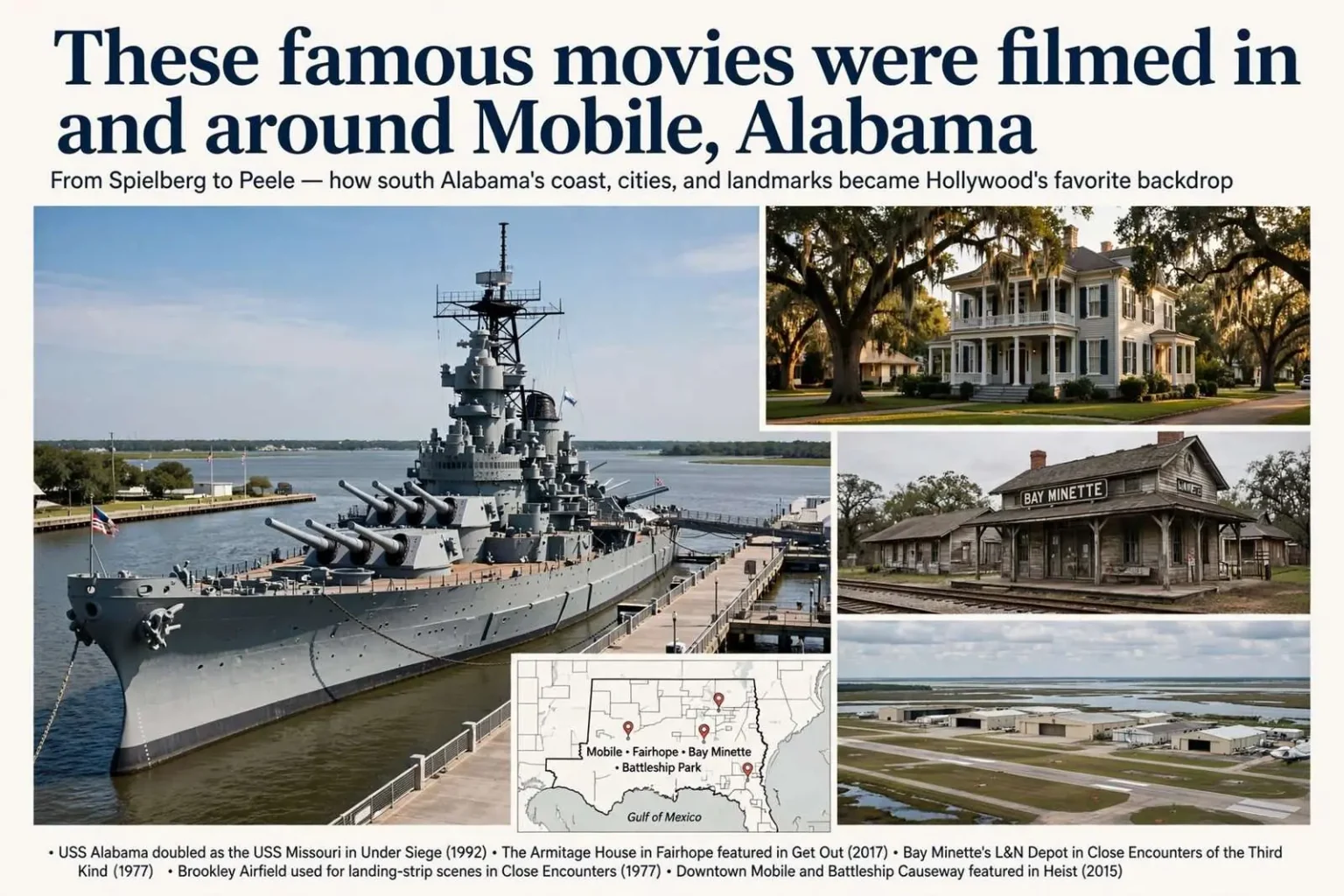
These famous movies were filmed in and around Mobile, Alabama
From Close Encounters to Get Out, a surprising number of famous movies were filmed in and around Mobile, Alabama. Here are the local filming locations.
The Mobile area has long been a favorite backdrop for filmmakers, thanks to its historic architecture, landmarks and coastal scenery. Stretch the map to include all of south Alabama and the possibilities only grow. Some of the most recognizable titles in Hollywood history shot scenes right here, and the list keeps growing as the region’s reputation spreads through location managers, production designers and directors who have worked here once and come back.
Steven Spielberg’s 1977 sci-fi classic “Close Encounters of the Third Kind” used the former Brookley Air Force Base for its landing-strip complex, while Bay Minette’s L & N Railroad station stood in for an evacuation scene. East of Fairhope, the house featured in the film’s alien abduction sequence still stands. The Brookley complex — a vast wartime airfield on Mobile Bay that the Air Force closed in the late 1940s and that later became the city’s industrial aeroplex — gave Spielberg the scale of military infrastructure the story demanded, and the old L & N depot in Bay Minette provided the small-town railroad gravitas of the film’s evacuation sequences.
Jordan Peele chose Fairhope and Mobile for his Oscar-winning thriller “Get Out,” filming the opening abduction in Mobile’s Park Place district and much of the action at The Armitage House in Fairhope. Scenes were also shot at Barton Academy. The film’s 2017 release and eventual Academy Award for Best Original Screenplay put an unlikely spotlight on the area: a landmark of modern horror, shot substantially on the streets of Mobile and the leafy avenues of Fairhope, a town better known for its antebellum- and Victorian-era homes than for its film credits.
Netflix’s “Gerald’s Game,” based on the Stephen King novel, was filmed largely in downtown Mobile, with producer and Fairhope native Scott Lumpkin noting that about 90 percent of the movie was shot on the Gulf Coast. Director Mike Flanagan also filmed “Oculus” in Fairhope. Lumpkin’s hometown ties are representative of a recurring pattern in the region’s film history — local producers and crew who, once established in the industry, steer productions toward the places they grew up, and in doing so build the case for the next production to follow.
The Battleship on the Big Screen
The USS Alabama at Battleship Memorial Park doubled as the USS Missouri in the Steven Seagal film “Under Siege,” with the USS Drum portraying a North Korean submarine. The 1992 action hit remains the area’s biggest Hollywood moment aboard the ship, and the casting was natural: the battleship’s massive deck, turrets and interior passageways are exactly what a naval thriller requires, and the Drum, a World War II-era fleet submarine moored alongside, supplied the villain’s vessel without the production having to build a set at all.
Battleship Memorial Park remains one of the most distinctive film locations on the Gulf Coast. The park sits at the mouth of Mobile Bay, where the battleship has been moored since 1965 as a memorial to Alabama veterans, and its mix of wartime hardware, waterfront exposure and period-correct details gives productions an authenticity that would cost millions to replicate on a soundstage.
The Battleship Park area and the Causeway also appeared in the 2015 heist thriller “Heist,” which transformed the Battle House Hotel into a 1940s casino. The Causeway — the low road that runs the length of the upper Mobile Bay, linking the city to the Eastern Shore through marsh and open water — is a favorite of directors for the same reason locals love it: the drive itself is cinematic, with the bay on one side and the Delta’s cypress on the other.
The Battle House, meanwhile, is among downtown Mobile’s most storied buildings, a historic hotel that has hosted generations of dignitaries and whose grand public spaces lend themselves to period work. Redressing its interiors as a 1940s casino required far less imagination than most set design, and the hotel’s downtown surroundings — blocks of early-20th-century commercial architecture — extend the period feel out the front door.
A Deep Bench of Local Credits
Other productions with local ties include “The Insider,” “The Final Destination,” “Rage,” “Friday the 13th Part VII: The New Blood” — filmed at Byrnes Lake in Baldwin County — and the 2023 Christian drama “Jesus Revolution,” which used Fairhope, Daphne and Mobile as stand-ins for Southern California. The range is striking: network prestige thrillers, teen horror franchises, action fare and faith-based drama have all found what they needed within a short radius of the bay.
The “Friday the 13th” installment points to one of the region’s most valuable but least glamorous assets — its water. Byrnes Lake and the hundreds of lakes, bayous and river sloughs across Baldwin and Mobile counties give horror productions the remote-woods atmosphere the genre depends on, within driving distance of crew bases and equipment houses in Mobile. “Jesus Revolution” made a different kind of argument: that the region’s coastal towns, with their palm-dotted streets and sun-washed storefronts, can plausibly pass for Southern California on screen, expanding the kinds of scripts the area can credibly host.
That flexibility is the core of the region’s appeal to location scouts. Few markets of Mobile’s size can offer, within an hour’s drive, a World War II battleship, a decommissioned submarine, a colonial- and Victorian-era downtown, antebellum neighborhoods, sugary-sand Gulf beaches, river deltas, deep woods and small towns whose architecture spans two centuries. Productions that might otherwise bounce between several states can often cover their needs here without moving the company.
The Business Behind the Credits
The Alabama Film Office keeps a running tally of feature films shot fully or partially in the state, a reminder of just how often the spotlight finds the Gulf Coast. State film offices exist to market locations, coordinate permits and connect productions with local crew, and Alabama’s office has been part of the pitch behind the region’s growing credits, working alongside city and county partners who understand the value of a film crew’s temporary economic footprint.
That footprint is real: productions rent lodging, hire local caterers, security, drivers and day players, and spend at hardware stores, gas stations and restaurants for the length of the shoot. A single feature can inject hundreds of thousands of dollars into a local economy in a matter of weeks, and the jobs it creates — camera assistants, grips, set dressers, production coordinators — have helped a generation of Gulf Coast crew members build careers without leaving the region.
Local pride runs alongside the economics. Residents who spot film trucks on their street, or who discover that a favorite scene was shot at a landmark they pass every day, tend to follow the industry’s moves here with unusual attention. Screening rooms and community theaters across the area have hosted screenings of locally shot films, and each new production generates a fresh round of “did you know that was filmed here?” conversations.
For the cities and towns involved, every credit compounds. “Close Encounters” introduced international audiences to the region half a century ago; “Get Out” did the same for a new generation; and Netflix releases stream the area into living rooms worldwide without a single ticket sold. The locations endure — the battleship still moored at the park, the depot still standing in Bay Minette, the Fairhope house still quietly famous — and the list of films that have used them keeps getting longer.
From Spielberg to Peele, from Seagal to Stephen King, the through-line is the same: when filmmakers need the Gulf Coast’s particular blend of history, water and atmosphere, they keep coming to Mobile, Baldwin County and the towns between. The Alabama Film Office’s running tally will surely grow, and south Alabama’s landmarks will keep collecting screen credits alongside their place in local memory.
Brookley’s second act as a film and aviation site is itself part of the story. After the Air Force departed, the airfield’s hangars and long runways passed into civilian industrial use, and their sheer scale has made the site a recurring choice for productions needing period military infrastructure or wide-open industrial vistas. For locals, seeing Brookley on screen in one of the most beloved science-fiction films ever made is a reminder that the bay’s working landscapes have cinematic value precisely because they are real.
Fairhope’s appeal to filmmakers flows from the same source. The bluff town’s walkable streets, historic homes and views over Mobile Bay create a setting that reads as timeless on camera, whether a production needs a present-day thriller or a period drama. The town’s long association with artists and free thinkers — dating back more than a century to its experimental beginnings — has made it a natural host for creative projects of every kind, and the “Get Out” and “Oculus” credits now sit at the top of its cultural resume.
Scouting the Gulf Coast
Location scouting for major productions typically begins months before cameras roll, and the region’s standing with scouts has been built the practical way — through productions that ran smoothly. Crews who find cooperative municipalities, available period properties and short drives between locations spread the word through the industry’s informal networks, which is how a region without a major studio backlot keeps attracting work. Word of mouth among location managers is worth more than any brochure, and south Alabama’s word of mouth has been very good for a long time.
The region’s climate extends the practical shooting season as well. Winters along the bay are mild enough for exterior work through most of the year, an advantage over productions that must chase good weather through expensive location moves. Combined with the density of distinctive locations described above, the climate means a production can often keep its entire schedule in one region instead of shuttling between states — the kind of efficiency that keeps line producers coming back.