Third Gun in a Month Turns Up on a Mobile County School Campus, Student Arrested
A loaded gun found at Mae Eanes Middle School marks the third weapon discovered on a Mobile County school campus in a month, following incidents at B.C. Rain and Mary G. Montgomery high schools.
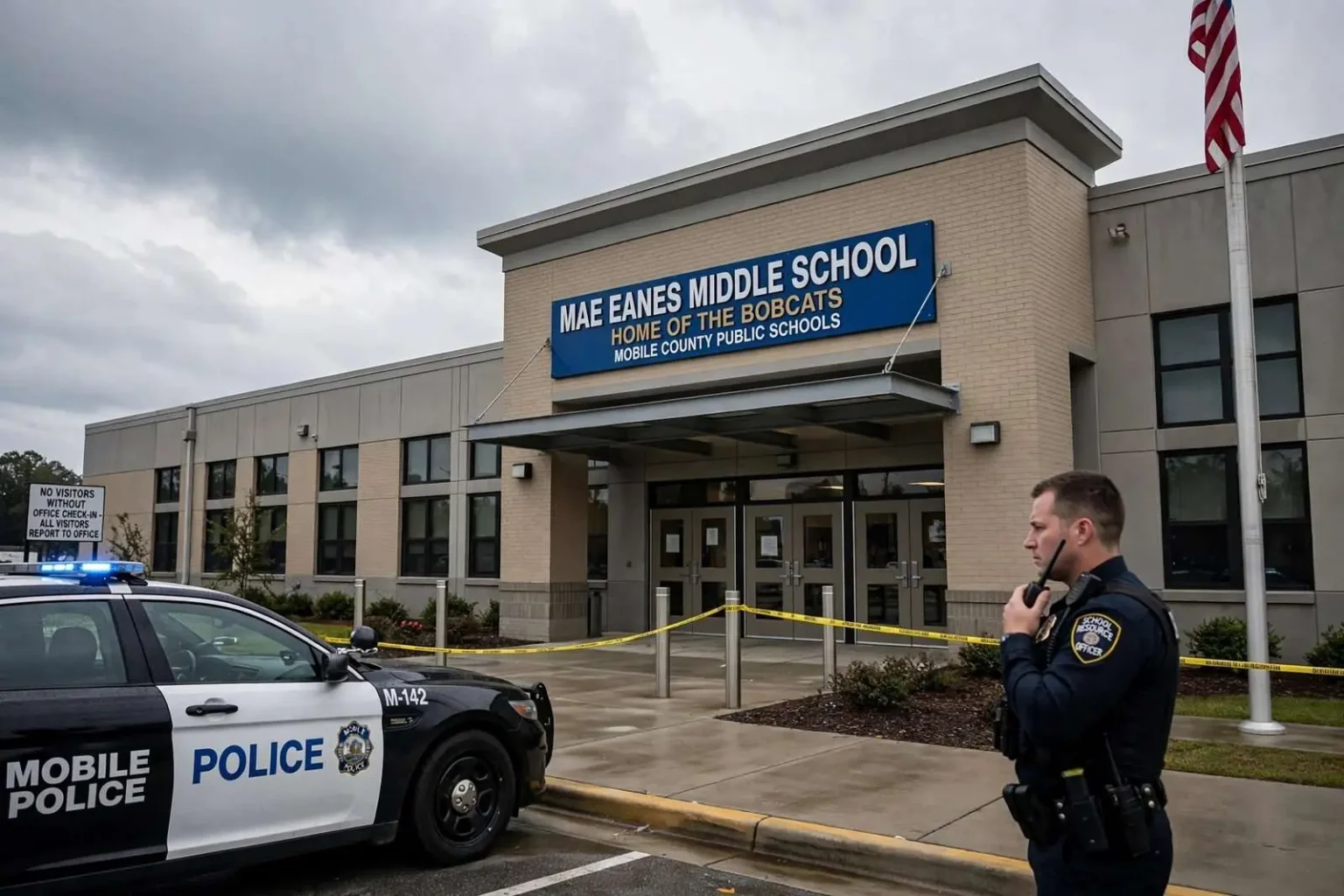
A loaded handgun brought to campus by a student at Mae Eanes Middle School last Friday marked the third time in four weeks that a firearm has been discovered on a Mobile County Public Schools campus, renewing concern among parents and administrators about weapons finding their way into local classrooms.
School officials say the string of incidents began several weeks earlier when a loaded handgun was found on the campus of B.C. Rain High School. The school’s principal alerted parents to that discovery. About a week later, an unloaded handgun turned up at Mary G. Montgomery High School, and that school’s principal likewise notified families.
The most recent incident, at Mae Eanes Middle School, involved a loaded weapon that a student is accused of bringing onto campus. The weapon was recovered before anyone was hurt, and the student was taken into custody by police.
A Swift Response
Mae Eanes Middle School principal Merrier Jackson credited the swift response of the school’s resource officer and the Mobile Police Department with helping the situation resolve without anyone being hurt.
“These are judgments, and he’s really trying to do the best job you can in making those judgments,” Jackson said of the school resource officer’s handling of the incident.
The sequence at Mae Eanes unfolded the way such incidents are supposed to — a tip or observation, a quick decision by the officer, a search, and a weapon off campus before it could be used. In each of the three cases, the system that ended the danger was the same: adults on campus acting on incomplete information, fast. That the outcomes were peaceful in all three incidents is the part of the story administrators emphasize; that three weapons made it onto three campuses in a month is the part that worries parents.
The geography of the incidents underscores how little the problem respects school boundaries. B.C. Rain High School sits in the northwestern part of Mobile, Mary G. Montgomery High School serves the Semmes area in the county’s western edge, and Mae Eanes Middle School draws from neighborhoods inside the city proper. Three campuses, three communities, three different grade configurations — and the same discovery each time.
Getting Word to Parents
Jackson said the school leaned on its automated notification system to get word out to families quickly once the situation was under control.
“We have a voice messenger system that’s phenomenal, because once I make that one message it goes out as many times as I would like it to go out, and it goes out to everyone who has a current number on file. And so we did that,” she said.
The tools only work as well as the data behind them. Automated calling systems reach the numbers families have on file with the school, which is why principals across the system regularly urge parents to keep contact information current — a message that gains urgency every time an incident makes notifications necessary. On the day of the Mae Eanes discovery, the system delivered the principal’s recorded message to households across the school’s attendance zone within minutes of the all-clear.
Under Mobile County Public Schools practice, the decision on whether and how to alert parents to an on-campus safety incident is left to the discretion of each school’s principal, since administrators are considered best positioned to judge how their own school community will respond.
“It’s been a very positive response from the entire incident. I’m glad that they leave that to the discretion of the principals, because you kind of know your audience and your school community,” Jackson said.
The discretion policy reflects a practical judgment about communication. A district as large as Mobile County’s — the largest school system in Alabama, spanning more than 90 schools from Dauphin Island to the northern county line — cannot tailor a single message to every community’s circumstances. A principal who knows her parents, the reasoning goes, can choose the timing, tone and level of detail that will inform families without igniting panic, and can follow up in ways a central office cannot.
The presence of police on campus is the load-bearing element of that response. Mobile County schools are staffed with school resource officers — sworn law enforcement officers assigned to work full time on school campuses — under arrangements with the Mobile Police Department and other agencies across the county. The officers handle everything from trespassers and traffic to the rare but grave problem of a weapon in a student’s backpack, and their dual role, both counselor and cop, is the part of the job the public rarely sees until an incident like Friday’s.
Jackson’s comment about judgments captured that dual role. An officer confronting a report of a weapon must decide in seconds how to approach a student, whether to search, how to secure other students, when to call for backup. Every one of those choices carries risk in both directions, and the principal’s point was that the officer had navigated them well.
What follows for the student accused in the case proceeds on two tracks. Under Mobile County Public Schools policy, a student found with a firearm on campus faces serious disciplinary consequences, up to and including expulsion, under the system’s student code of conduct. Because the student is a juvenile, school officials have released no details about the child’s identity, age or Motivation — a confidentiality standard that applies to every one of the three incidents this month, leaving parents to weigh the facts the district can share against the rumors that circulate in their absence.
The criminal side runs through the juvenile justice system, where a child accused of bringing a gun to school can face charges handled in juvenile court, with proceedings closed to the public. Police said the Mae Eanes student was arrested after the weapon was found; the specific charges, as in most juvenile matters, were not publicized.
Three Weeks, Three Campuses
The cluster has unsettled parents in a way single incidents rarely do. One discovery can be treated as an aberration; three in four weeks, at three different schools, reads as a pattern, and the question parents have been asking since Friday is not whether the district can respond quickly — the record of the past month suggests it can — but whether it can keep weapons off campuses in the first place.
Districts across Alabama confront the same problem from a standing start: firearms that leave home in a backpack. The most common defenses are human ones — teachers and students who notice something and say so, officers who take a tip seriously, principals who follow through. Every gun discovered on a Mobile County campus this month, by the district’s account, was found before it was used, which means somebody saw, or heard, or suspected, and acted.
Administrators also point to the message the incidents send about prevention. Parents are asked to secure weapons at home and to know what their children carry to school; students are urged to report anything they see or hear, with the assurance that a report made in time can stop a tragedy before it starts. The alternative — a weapon that stays hidden until it is used — is the outcome every adult in the system is working to prevent.
The notification protocol also shapes what parents experience in the first minutes after an incident. Because alerts go out only once the situation is under control, a family may learn of a discovery hours after it happened — a delay that draws complaints when parents hear about an incident from their children first, but one that is deliberate: alerting families mid-incident can send parents rushing to a campus while officers are still securing it, complicating the very response the message describes. The discretion given to principals exists precisely so they can calibrate that timing against the temperature of their own community.
For the families at Mae Eanes Middle School, the immediate fear has passed. The message went out, the student was arrested, and the campus returned to its routine. But the arithmetic of the past four weeks — one loaded gun at B.C. Rain, an unloaded gun at Mary G. Montgomery, a loaded gun at Mae Eanes — will follow the district into the weeks ahead, and the conversations between parents and principals about how schools stay safe are likely to continue long after the last notification call has gone out.
The Larger Question for the District
The pattern also lands on a school system already attentive to campus safety as a standing priority. Mobile County Public Schools operates under a code of student conduct that spells out zero-tolerance consequences for weapons, and administrators review each incident afterward for the same lesson: how the gun got to campus, who knew, and where the adults’ safety net caught it — or nearly failed to. Those reviews stay internal, but they are how a district of this size tries to turn a bad month into better practice.
What the past four weeks have demonstrated, on the evidence available, is that the response side of the equation works. Officers found what they were told to find, principals told parents what they needed to know, and no one was injured at any of the three schools. What it has not demonstrated is why the weapons were there at all, or how many others went unnoticed. Closing that gap is the work of the months ahead, and every parent in the district has a stake in how it goes.