Thomasville Imposes Overnight Curfew as a Precaution
Thomasville has enacted a nightly 10 p.m. to 5 a.m. curfew as a precaution, with an exemption for residents traveling to and from work.
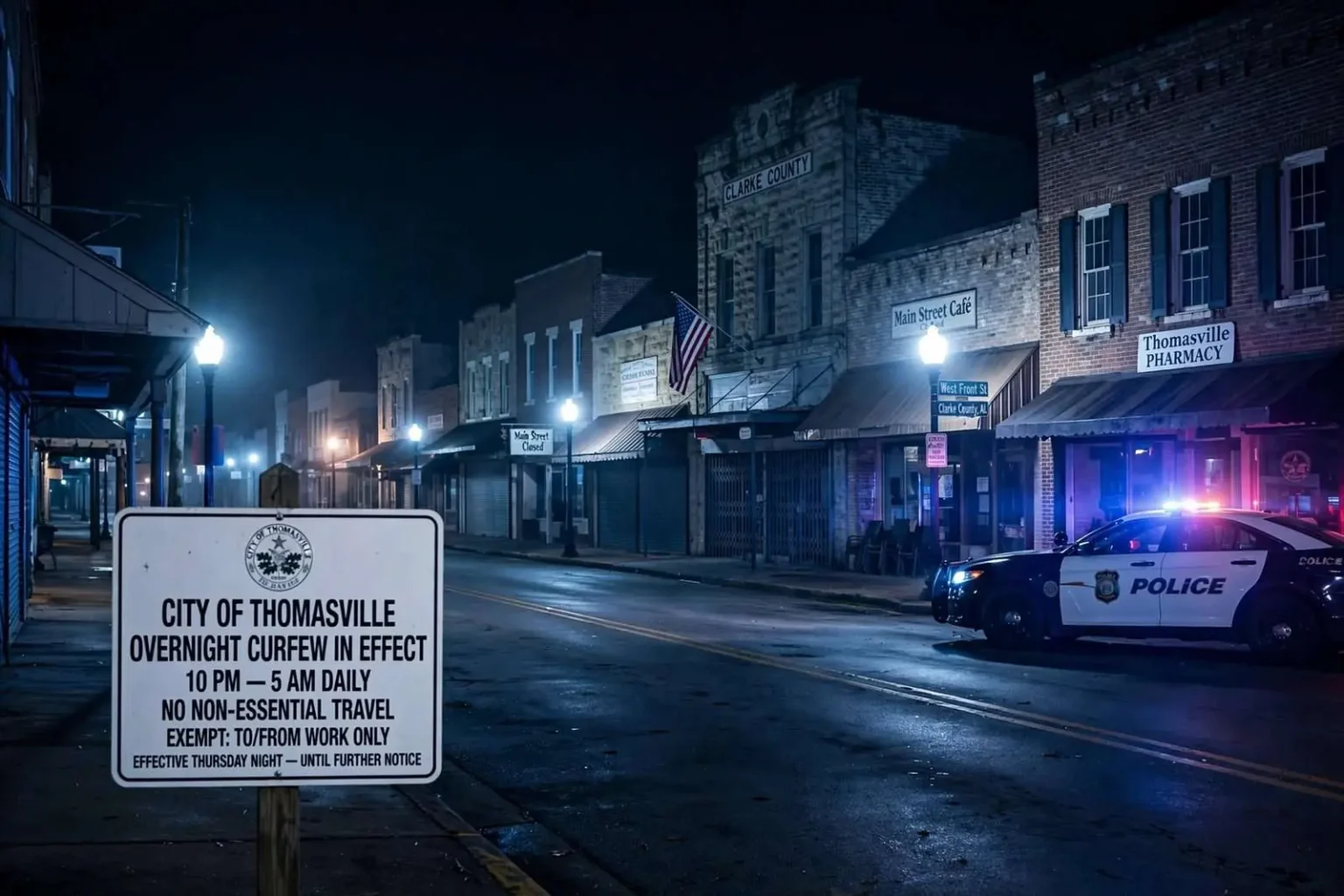
THOMASVILLE, Ala. — The City of Thomasville has put an overnight curfew in place, restricting movement through the city during late night and early morning hours. City officials said the curfew runs from 10 p.m. until 5 a.m. every day, taking effect Thursday night. Residents are being urged to remain at home during those hours, and the order makes the nightly restriction a standing condition of life in the Clarke County city for as long as it remains in force.
The order carves out an exception for people traveling to and from their jobs, so shift workers and anyone whose employment requires overnight travel are not covered by the restriction. That exemption matters in a small city where manufacturing plants, medical facilities and other round-the-clock operations employ residents on overnight shifts, and it means that the sight of a car on the road at 3 a.m. is not, by itself, a violation. The order directs its attention at movement that has no such purpose — the errand, the visit, the gathering that city leaders want to discourage during the restricted hours.
City leaders described the measure as precautionary rather than a response to any specific incident, part of a broader effort to limit unnecessary movement and gatherings in the Clarke County community. No end date for the curfew was announced at the time it took effect, which officials framed as an open-ended safeguard: the restriction lasts as long as the city’s leadership judges it necessary, and residents will learn it has ended when the city says so rather than by a date fixed in advance.
What the curfew restricts
Under the order, being out in Thomasville between 10 p.m. and 5 a.m. is restricted unless the travel qualifies for the work exemption. For most residents the practical effect is a reshaped evening: errands, social visits and anything else that puts a person on the street during the restricted hours are supposed to wait until morning. Businesses that close in the evening close into empty streets, and the city’s downtown — normally quiet overnight in any case — becomes a place where the only expected movement is the exempted commute of a shift worker.
Curfews enforced by municipalities generally carry consequences for violation, and cities that impose them rely first on voluntary compliance, backed by the police department’s authority to stop and question anyone on the street during restricted hours. For Thomasville’s police, the order adds a tool for the overnight hours: an officer who encounters someone out at 2 a.m. has a clear basis to ask why, and a clear answer for the traveler whose destination is a workplace. The work exemption gives the department a bright line, which in practice is what makes a curfew enforceable without becoming a dispute on every corner.
The restriction runs every day of the week, including weekends, when late-night movement is otherwise at its heaviest. That consistency is deliberate. A curfew that exempted Friday and Saturday nights would defeat its own purpose, and city officials set the same 10-to-5 window for every night of the week, making the schedule simple enough that no resident has to track a calendar to know whether tonight is a curfew night.
A precaution, officials say
The description of the measure as precautionary — not a response to any specific incident — is the part of the announcement that city leaders emphasized. Curfews are most often associated with a crisis: unrest, a storm, a public health emergency. By describing this one as a preventive step within a broader effort to limit unnecessary movement and gatherings, Thomasville’s officials placed the order in the category of measures a city takes when it judges that the cost of waiting for a problem to develop is higher than the cost of acting first.
The “broader effort” language signaled that the curfew is one piece of a larger approach. Measures that limit movement and gatherings are typically paired — a curfew on the hours, restrictions or discouragement on the assemblies — and the city’s statement tied the overnight restriction to that wider goal for the Clarke County community. For a city of Thomasville’s size, where the same few streets carry most of the town’s traffic and the police department is a small force, limiting the number of people out at night is a measurable change: fewer vehicles to check, fewer gatherings to monitor, fewer opportunities for the kind of incident that strains a small department.
Life under the overnight hours
For Thomasville’s residents, the curfew changes the rhythm of ordinary evenings in ways both large and small. The family that runs errands after an evening ballgame, the friends who meet for a late supper, the drivers who prefer to do their business after the day’s heat has passed — all of those routines now press against a 10 p.m. line. The order does not close businesses by itself, but it removes the customers who would have patronized them in the restricted hours, and shopkeepers and restaurant owners in town have had to weigh the overnight restriction in their own planning from Thursday night onward.
The work exemption keeps the city’s overnight economy functioning. Health care workers leaving a night shift, plant employees arriving for a midnight start and drivers passing through for employment reasons remain free to move, and the city’s announcement took care to spell out that protection. In a rural Alabama county, an overnight restriction with no work exception would put real jobs out of reach for real workers; the carve-out is what allows the order to restrict movement without stopping the paychecks of the residents it is meant to protect.
Enforcement questions follow any curfew. Officers charged with applying the order have to distinguish the exempted traveler from the restricted one, and the city’s willingness to keep the exemption broad — anyone traveling to and from a job — reduces the friction that narrower versions can produce. Residents with questions about whether a particular trip qualifies have the city’s announcement to consult: the restriction covers late-night and early-morning movement through the city, the exception covers work travel, and the hours are the same every day.
Thomasville and Clarke County
Thomasville is the largest city in Clarke County, a southwest Alabama county of small towns, timberland and river bottoms where the city serves as the commercial and medical center for the surrounding rural population. Its downtown, its hospital and its manufacturing employers draw workers and shoppers from across the county, and any restriction the city imposes on its own streets carries weight well beyond the city limits — county residents who work, shop and receive care in Thomasville plan around what the city does.
Municipal curfews occupy a well-established place in Alabama local government. City councils hold the authority to impose emergency and safety measures, and mayors typically announce them with the police department standing behind the enforcement. The measures are usually framed as temporary, and the absence of an end date in Thomasville’s announcement puts the decision about duration explicitly in the city’s hands — the order stands until the city says otherwise, which preserves the flexibility leaders said they needed while leaving residents without a fixed date to count down toward.
How residents will hear when it ends
The absence of an announced end date means the curfew’s expiration is an event rather than a calendar entry. Cities that impose open-ended restrictions generally lift them the same way they imposed them — a public announcement from city hall, carried through the channels residents actually use: local radio and newspapers, the city’s social media and the word of mouth that moves quickly through a town of Thomasville’s size. Until that announcement comes, the working assumption for residents is that the 10-to-5 restriction applies tonight and every night.
The city’s plea that residents remain at home during the restricted hours is the enforcement mechanism that matters most. A curfew in a small city succeeds or fails on compliance, and Thomasville’s officials have asked for the version of compliance that costs the department nothing: residents who simply stay in. The police department’s role is to handle the exceptions — the drivers who do not qualify for the exemption, the gatherings the order is aimed at — while the overwhelming majority of residents do their part by keeping their evenings inside the hours the city left open.
For the businesses and institutions that operate around the clock, the order asks for documentation and common sense: employees traveling to and from work are exempt, and employers with overnight shifts know their workers’ schedules. The city’s decision to announce the effective time — Thursday night — rather than let the order take effect without notice gave employers a cycle to adjust, and gave residents a clear first night to mark the beginning of the restriction.
A city watching its streets
What Thomasville’s curfew ultimately represents is a city government using the tools it has. The order is narrow — six and a half hours a night, one exemption, one purpose — and the leaders who imposed it described it in exactly those terms: a precaution, aimed at unnecessary movement, in a broader effort to limit gatherings in the Clarke County community. The measure takes the shape it does because of what a small city can and cannot do; a curfew is one of the few instruments that reaches every street at once, and it is applied when the city judges that reaching every street is what the moment requires.
For now, Thomasville’s nights are quieter by design. From 10 p.m. to 5 a.m., the shift workers on the roads are the only traffic the city expects, the businesses that would have drawn a late crowd have gone dark hours earlier, and the residents the order addresses are being asked to do the simplest thing an emergency measure can ask: stay home. When the city decides the precaution has served its purpose, the announcement will come, the streets will refill after 10, and the curfew will join the list of measures the town took — and will be remembered by how ordinary the nights became while it held.