
Thousands Line Mobile’s Streets From Downtown to the Cemetery to Honor Officer Justin Billa
Thousands lined Mobile streets and Highway 90 Tuesday to honor fallen MPD Officer Justin Billa during his funeral procession.
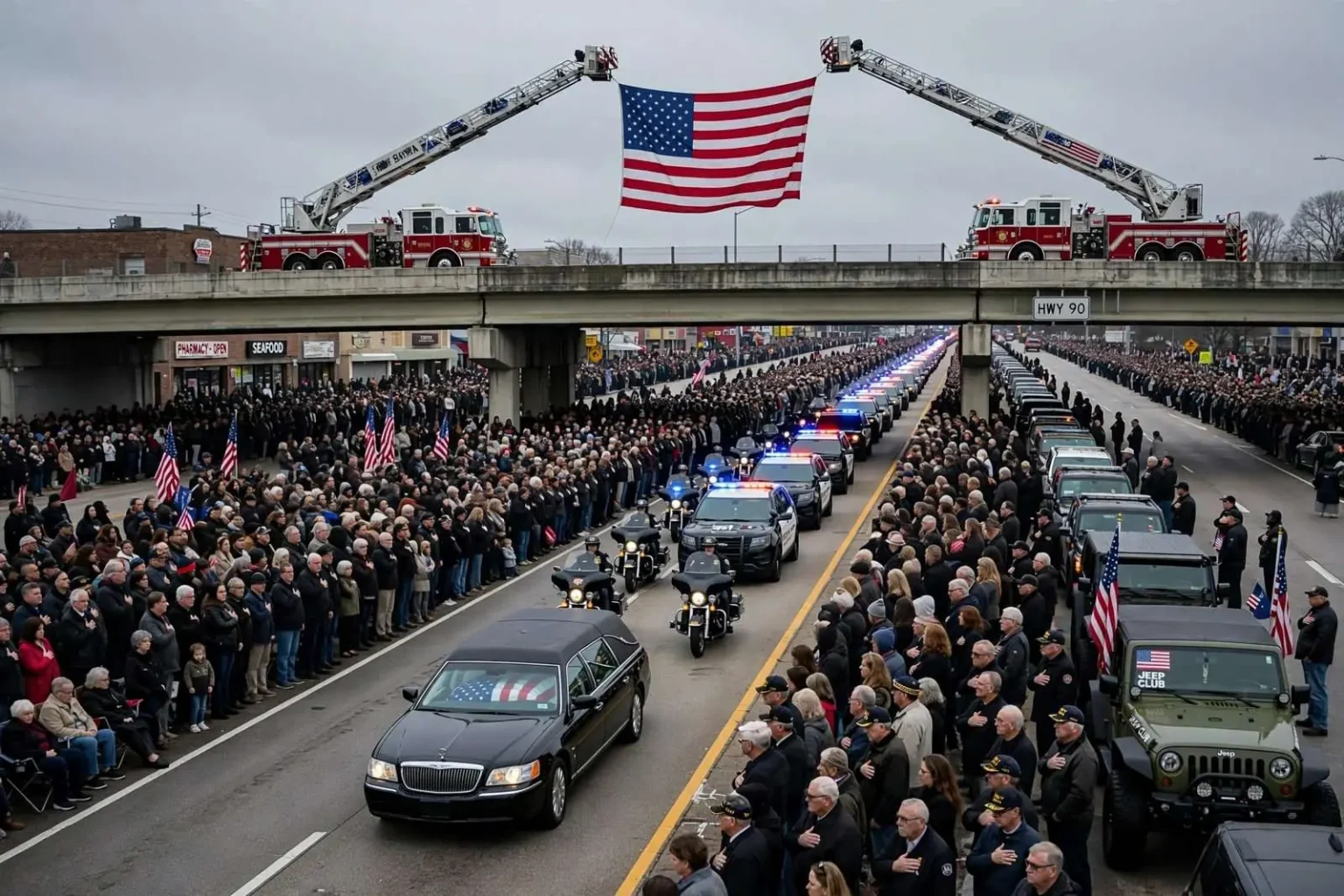
Thousands of people turned out Tuesday along the route from Mobile’s streets to the cemetery to pay their respects to Officer Justin Billa, the 27-year-old Mobile police officer killed in the line of duty. The procession moved across the city under gray winter skies, and the crowds that lined it — parents holding children, retirees in folding chairs, workers standing outside their shops — turned the ordinary geography of Mobile’s roadways into a corridor of mourning.
Spectators stood at attention or pressed hands over their hearts as the hearse carrying Billa passed. There was no coordinated signal and no script; the gestures happened block after block, as each crowd along the route made the same silent choice about how to greet a flag-draped casket moving past at procession speed. For the family riding behind the hearse, the display stretched on for miles — an unbroken line of residents who had never met the officer but understood exactly what his death cost.
First responders raised an American flag over Highway 90, and law enforcement vehicles from surrounding cities and states stretched mile after mile behind it. Fire apparatus on overpass ramps, ladder trucks holding flags aloft, ambulances with lights dark and engines idling: the machinery of the region’s emergency services turned out in force. Behind the hearse came the long column of patrol cars and motorcycles from agencies across south Alabama and beyond the state line, their light bars wrapped in black bunting, a rolling census of just how far Billa’s death was felt across the Gulf Coast’s law enforcement community.
A Community Turns Out
Among those gathered were people who knew Billa personally, including fellow church members who came simply to show support for his family. In a city where church communities function as extended family, the presence of his congregation along the route was its own kind of testimony — the people who knew the man, not just the badge, standing where the crowds stood because grief for a 27-year-old called for something more than a funeral attendance.
Others, like members of a local Jeep club, said they wanted the family to know the community stands behind them — noting that Billa had been part of a Louisiana Jeep club before joining law enforcement. The Jeeps arrived in formation, their owners’ tribute carrying a personal resonance the family would recognize immediately: before he was a Mobile police officer, Billa had been a Jeep enthusiast in Louisiana, part of that loose community of owners who wave to each other on the road and show up for each other off it. His old hobby’s culture does not forget its own, and the sight of the club’s vehicles rolling with the procession connected the life he lived before the badge to the death that ended it.
One onlooker, a Navy veteran, summed up the mood of the crowd: it was terrible that it happened to someone so young with his whole life ahead of him. The remark captured what made the day so heavy along the route. Police funerals are never ordinary, but the ones for the young carry a particular weight — the flag, the folded ceremonial cloth, the wide-open future that will not happen, all of it absorbed by a crowd that came to stand in the gap for a family it did not know.
The turnout said as much about Mobile as it did about Billa. This is a city with a long memory for its fallen officers — names carved into memorials, streets and scholarships carrying the names of officers killed in decades past — and each line-of-duty death reactivates that memory. The crowds that lined Tuesday’s route knew the ritual because Mobile has performed it before, and they came anyway, in the thousands, because the ritual’s meaning depends on the community showing up every single time.
For the officers in the procession, the day carried its own private weight. Police funerals are where the job’s risks stop being statistics and become a casket on a rolling stand, and the officers standing at attention along the route or driving in the column behind the hearse were performing a duty they all understand could one day be performed for them. Departments from across the region sent delegations for that reason — to honor a colleague, and to make visible the mutual promise that no officer is buried alone.
For many along the route, the sight of the flag waving above the passing hearse served as a reminder of the sacrifice of those who wear the badge — and a promise from the community that Officer Billa will not be forgotten. The flag over Highway 90, hoisted between the ladders of two fire trucks as the procession passed beneath, was the image much of the crowd took home: the ordinary highway, the impossible flag, the slow passage of a young officer toward his rest.
The days surrounding the funeral had already shown Mobile’s grief in stages — the initial shock of the line-of-duty death, the announcement of arrangements, the public visitation, and finally the procession that turned the whole city into a participant in the goodbye. Each stage drew more people than the last, culminating in the Tuesday turnout that stretched from downtown’s streets to the cemetery gates. Grief on that scale is hard to describe to anyone who has not stood in it, but its meaning was simple: a 27-year-old officer gave his life doing the city’s dangerous work, and the city wanted his family to see, in person, what that was worth.
In the weeks and months that followed, the reminders would settle into place — the memorial markers, the case moving through the courts, the department carrying on with one fewer officer on the roster. But Tuesday belonged to the route itself: mile after mile of Mobile residents standing in the cold, hands over hearts, Jeeps and church members and veterans and fellow officers among them, telling the Billa family in the only language a crowd can speak that their son’s service was seen, and that the city he died protecting will not let the memory of him fade.
Billa’s death had reverberated across Alabama law enforcement from the moment it was announced. A 27-year-old officer killed in the line of duty is, in any department, the worst news a roster can receive; in a department the size of Mobile’s, the loss lands on colleagues who trained beside him, rode with him and knew the sound of his voice on the radio. Departments process those losses while still doing the work — the shifts continue, the calls keep coming, and the mourning happens in the margins. That is why the funeral week matters so much to the men and women of the department: it is the one time the job stops, and the loss is allowed to be the whole story.
The regional response also reflected how interconnected Gulf Coast public safety agencies are. Officers from the small municipalities across Mobile County — the Eastern Shore departments, the Baldwin County agencies, the communities dotting Highway 98 — work alongside Mobile police daily through mutual aid, task forces and shared radio traffic. When one agency buries an officer, the others send columns. The mile-after-mile stretch of law enforcement vehicles behind the hearse was that network made visible: jurisdictions large and small, city police and county sheriff’s deputies, state troopers and federal partners, all rolling together in a display of solidarity that crosses every jurisdictional line.
Procession logistics on this scale take days of coordination that the public never sees. Routes are planned with police escorts, intersections are shut down in sequence as the column approaches, and fire departments position apparatus on the overpasses where the line of march passes beneath. Each raised flag along Highway 90 was the product of firefighters who arrived hours early to rig the ladders, and every clear stretch of roadway was the work of officers holding intersections while the procession passed — the region’s emergency services organizing, one last time, around one of their own.
For the families of other officers watching from the crowds, the day carried a particular resonance. Spouses and children of active officers attend these funerals knowing what the badge costs and fearing it quietly; the public turnout, they often say afterward, is what makes the fear bearable. Seeing thousands of strangers line a highway to honor a fallen officer is the community’s answer to the question every law enforcement family asks in the dark: whether the sacrifice would ever be noticed. Tuesday’s crowds along Mobile’s route answered it emphatically.
The cemetery service that closed the day belonged to the family, the department and the honor guard — the folded flag presented to Billa’s loved ones, the final radio call that departments traditionally make for a fallen officer, the last military-style honors rendered over the grave. But the day’s real measure had already been taken along the miles of roadway between downtown and the gates: a city of hundreds of thousands, given an ordinary Tuesday, chose to spend it standing in the cold for a 27-year-old officer it mostly never met. That choice — repeated at every overpass, every corner, every stretch of shoulder — is what a community’s promise to remember actually looks like.