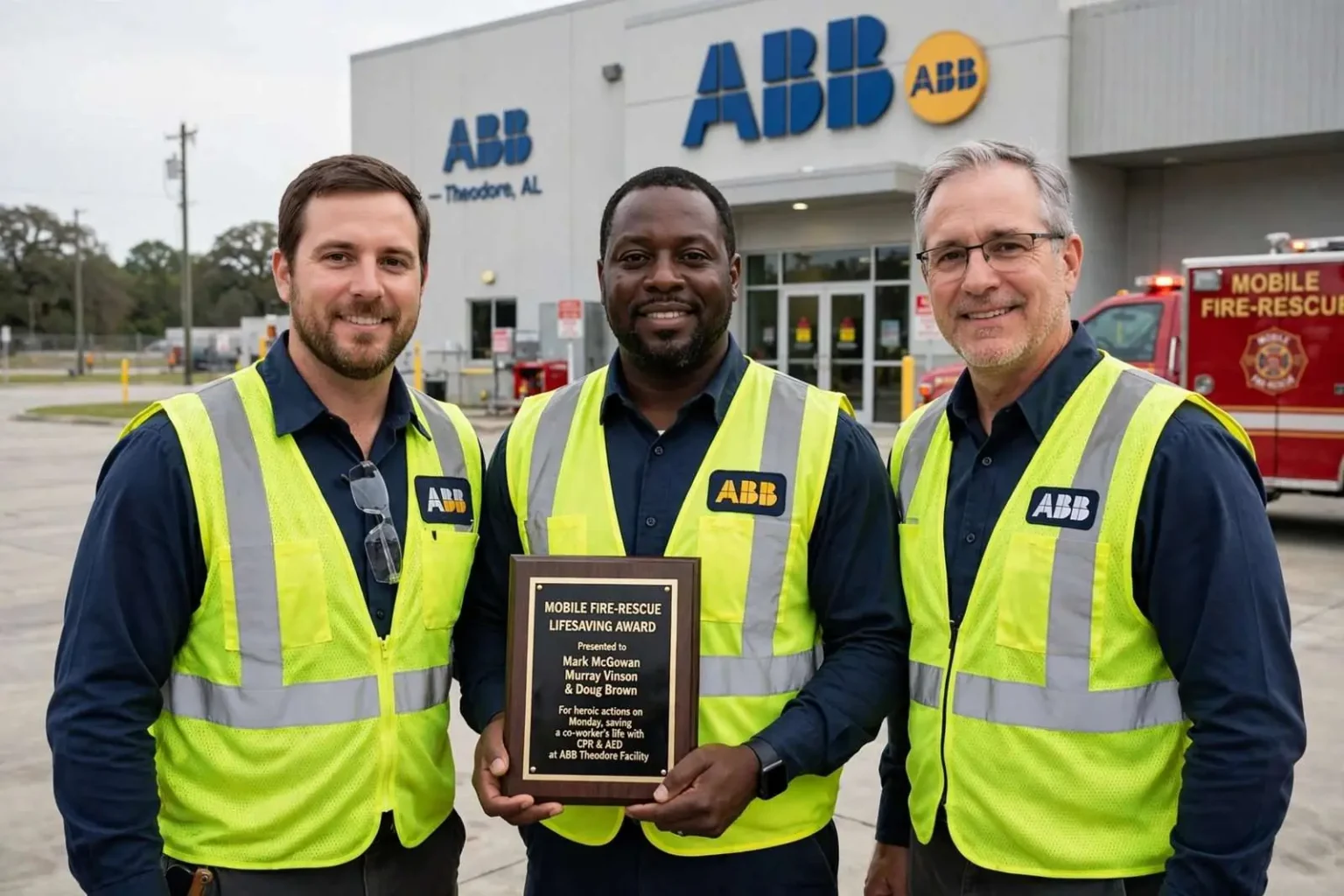
THEODORE, Ala. — Three co-workers at the ABB facility in Theodore are being credited with saving a fellow employee’s life after he collapsed at work. Mark McGowan, Murray Vinson and Doug Brown were on the job Monday when they found a co-worker unresponsive in his office, and in the minutes that followed they did everything right — calling 911, retrieving an automated external defibrillator and delivering a shock before paramedics arrived.
The three men called 911 immediately after finding their colleague, then grabbed the automated external defibrillator kept in their break room. Following the device’s voice prompts step by step, they placed the pads, delivered a shock, and began CPR, continuing compressions until help reached the plant. Emergency dispatchers coached them through those first critical minutes while an ambulance raced to the scene.
Mobile Fire-Rescue paramedics arrived at the facility a short time later and took over care, transporting the man to the hospital for treatment. He has since recovered and been released — an outcome that cardiac arrest survival statistics make remarkable, and one that his co-workers’ quick action made possible.
The three workers were recognized with a life-saving award from Mobile Fire-Rescue, the department’s formal acknowledgment of what their composure and training accomplished in the space of a few minutes on an ordinary Monday.
Why those first minutes decide survival
Sudden cardiac arrest is one of the leading causes of death in the United States, and its survival math is unforgiving. A person in cardiac arrest loses their chance of survival by roughly 10 percent for every minute that passes without CPR and defibrillation. In a typical emergency, an ambulance takes longer than that to arrive, which is why bystander action — compressions started immediately and a shock delivered early — is the single biggest factor in whether a victim walks out of the hospital.
That is exactly what happened at the ABB plant. McGowan, Vinson and Brown closed the gap between collapse and treatment: the 911 call brought help moving, the break-room AED put a defibrillator in their hands within moments, and the shock they delivered, followed by CPR, kept their co-worker’s heart in a rhythm that paramedics could work with when they arrived. Survival from out-of-hospital cardiac arrest remains low nationally — most victims never receive bystander CPR — which makes a recovery and full release like this one exceptional, and directly attributable to the three co-workers.
How an AED works — and why workplaces keep them
An automated external defibrillator is designed to be used by anyone. The device analyzes the heart’s rhythm through adhesive pads and speaks plain instructions: stand clear, press to shock, begin compressions. It will not deliver a shock unless the heart’s rhythm calls for one, which means a rescuer cannot accidentally harm the victim. Modern units walk users through everything, and training helps, but the devices are built so that untrained rescuers can succeed on first use.
Workplace AED programs exist because cardiac arrest strikes without warning and because the workplace is where many adults spend most of their waking hours. Federal occupational safety guidance encourages employers to install the devices in accessible, well-marked locations — break rooms and main corridors are common — and to check their batteries and pads on a schedule. The ABB facility in Theodore followed that model, and the device kept in its break room was exactly where it needed to be when it was needed.
Safety advocates stress the full chain of survival: early recognition and the 911 call, early CPR, early defibrillation, and advanced care from paramedics and hospital teams. Every link in the chain was present in the Theodore save. Miss any one of them — delay the call, skip the compressions, leave the AED on the wall — and the odds collapse.
ABB in Theodore and the region’s industrial workforce
ABB is a global technology and engineering company, and its Theodore operation is part of the cluster of heavy industry and manufacturing that lines the corridors south of Mobile. Theodore itself sits in southern Mobile County along U.S. Route 90, minutes from the Port of Mobile, the shipyards and the chemical and energy plants that anchor the regional economy. Facilities of this kind employ hundreds of workers across shifts, which means hundreds of people on site at any given time — and a real chance that someone, somewhere on the plant floor or in an office, will face a medical emergency in any given year.
Industrial employers in the region invest heavily in safety training, from forklift and lockout-tagout procedures to first aid, CPR and AED certification for volunteer responders on each shift. The Theodore episode shows why that investment pays off in ways that have nothing to do with production: the employees who responded were prepared because preparation is part of the workplace culture, and their preparation bought their co-worker the minutes his heart needed.
Mobile Fire-Rescue’s role
Mobile Fire-Rescue serves the city and provides emergency medical response across its districts, with paramedic ambulances dispatched to medical emergencies alongside engine companies. In this case, paramedics reached the Theodore plant shortly after the collapse, took over from the three co-workers, and delivered the advanced care — medications, airway management, continued defibrillation — that completed the save. The department’s recognition of McGowan, Vinson and Brown with a life-saving award reflects a practice seen across the fire service: honoring bystanders whose actions made the difference before professional help arrived.
The lesson for other workplaces
The Theodore save offers a checklist that safety managers across the Gulf Coast can borrow. Know where your AED is — not just where it is supposed to be, but where it actually is today. Make sure the pads and batteries are in date. Make sure enough people on every shift are trained, or at least familiar enough with the device to use it under pressure. Post clear signage. And practice the 911 call: knowing the plant address, the nearest entrance and who will meet the ambulance saves minutes when minutes are everything.
The recovered employee at ABB will likely never meet most of the people whose work made his survival possible — the dispatcher who coached the 911 call, the paramedics, the hospital team. But the three co-workers who found him unresponsive in his office and refused to freeze are the reason he went home. Mobile Fire-Rescue’s life-saving award put official recognition on what they did; the story itself is the best argument any workplace will ever need for keeping an AED charged on the wall and a plan everyone knows.
For the Theodore facility, the Monday collapse ended the way too few cardiac arrests do: with a shock delivered, compressions given, a hospital stay, and a full recovery. Three co-workers, one break-room defibrillator and a few well-practiced minutes made the difference between a loss and a homecoming.
CPR knowledge: what every bystander should know
The core of CPR has been simplified over the years precisely so that untrained bystanders can perform it. Hands-only CPR — pushing hard and fast in the center of the chest, about 100 to 120 compressions a minute — sustains blood flow to the brain and heart without rescue breaths, and dispatchers across Alabama coach callers through it on 911 calls. The compressions are tiring; rescuers are encouraged to switch off every couple of minutes, and in the Theodore episode the three co-workers could spell each other while the AED and dispatcher guided the effort.
Public health campaigns have pushed that knowledge hard in recent years, and fire departments including Mobile Fire-Rescue have participated in community CPR and AED training events across the area. Advocates emphasize that most cardiac arrests happen at home or at work — in other words, near people who know the victim — so the person most likely to save a life is not a paramedic but a family member, a friend or, as in this case, the co-worker in the next office.
The wider picture of cardiac arrest survival
National survival rates for out-of-hospital cardiac arrest hover around 10 percent, and they rise dramatically when a bystander performs CPR and an AED is used before EMS arrives. Studies of workplaces, casinos and airports — places where AEDs are common and staff are drilled — show survival rates several times higher than average. That gap is the entire argument for the devices and the training, and the ABB save is a textbook illustration: same event, same victim, radically different odds because three people knew what to do.
Emergency physicians describe saves like this one as a chain that held. The co-workers found the man quickly rather than leaving him unattended; the 911 call went out immediately; the AED came off the break-room wall and delivered a shock within the golden first minutes; compressions continued without a long gap; paramedics arrived to a patient who still had a fighting rhythm; and the hospital finished what the office started. Each link held, and the man recovered fully.
For Mobile County employers, the takeaway circulates with every retelling of the story: the cheapest life insurance a company can buy hangs on a wall in the break room, and the most valuable asset in a cardiac emergency is a co-worker who has practiced what to do. In Theodore, that combination saved a life — and earned Mark McGowan, Murray Vinson and Doug Brown a life-saving award they will carry for the rest of their careers.