Three men jailed in Washington County after trying to steal cellphone tower for scrap
Three men are jailed in Washington County, Alabama after allegedly cutting down a McIntosh cellphone tower and trying to sell it for scrap metal.
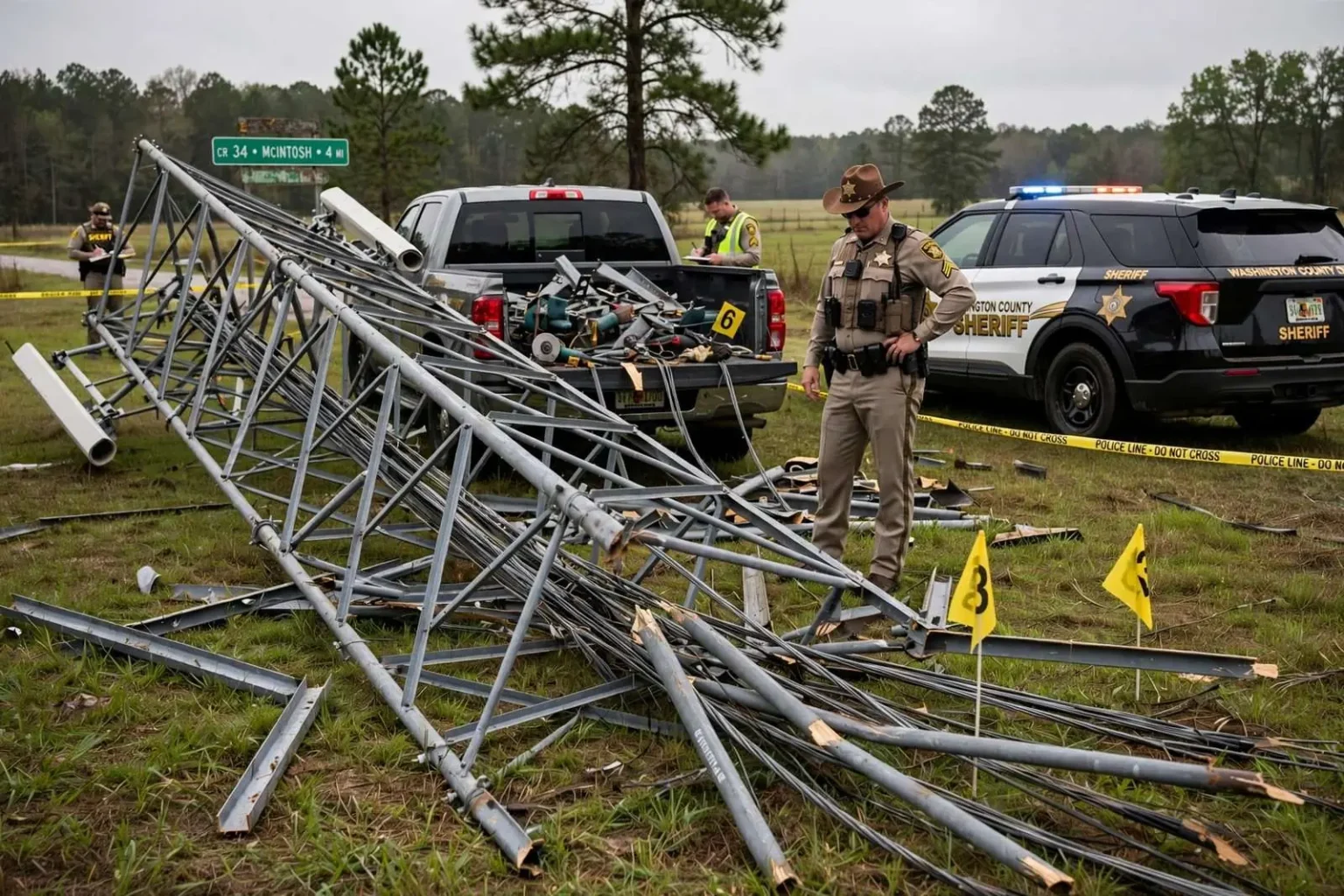
MCINTOSH, Ala. — It was going to be a towering theft. Three men are jailed in southwest Alabama on charges that they cut down a cellphone tower and tried to saw it up to sell for scrap metal, in a scheme that unraveled because they came back to finish the job.
Washington County Sheriff’s Lt. Bobby Jeter said a worker cutting grass for the tower company reported Thursday that the structure had fallen. But an inspection of the site near McIntosh revealed the truth: the guy wires that held the tower upright had been cut. What the company first took for a collapse was, investigators concluded, a deliberate takedown — someone had felled a working piece of telecommunications infrastructure with the intention of hauling it away a piece at a time.
Jeter said deputies began watching the area after the discovery. Their patience paid off when a resident called Saturday reporting noises near the site. Deputies arrived to find William Cameron, Ricky Reed and David Weaver cutting up the tower, and authorities said the men had already loaded pieces of the tower onto their truck. The three were jailed with bail set at $15,000 each, and it was unclear whether they had attorneys.
How the Scheme Unfolded
The sequence described by the sheriff’s office suggests a theft planned in stages. Cutting the guy wires of a guyed tower — the most common design for rural cellphone towers, in which the tall lattice mast is steadied by cables anchored to the ground in several directions — brings the structure down without climbing it or using heavy equipment. Once the tower is lying on the ground, its steel can be cut with torches or saws into sections manageable enough to load onto a truck and sell to a scrap yard, where galvanized and structural steel commands a price by the pound.
What the suspects apparently did not count on was the maintenance cycle of the wireless industry. Tower companies contract with local workers for routine site upkeep, including mowing, and it was one of those workers who reported Thursday that the tower was down. The inspection that followed, and the discovery of the cut guy wires, turned a property-damage call into a criminal investigation — and gave deputies a reason to stake out the site in anticipation of a return visit.
The Return Visit That Ended It
Deputies’ decision to watch the site reflected a simple calculation: whoever felled the tower would have to come back for the steel, because cutting up and hauling off an entire tower requires multiple trips. The resident’s Saturday call about noises near the site gave deputies the moment to move. Arriving deputies found all three suspects still at work, with tower sections already loaded on their truck — evidence that connected the men directly to the stolen material and to the act of cutting it up.
The case landed the three men in the Washington County Jail, each with bail set at $15,000. Charges in cases of this kind typically include theft of property and related counts, and the value of the tower — both its scrap steel and its far greater replacement cost as an operating cell site — factors into how offenses are graded under Alabama’s theft statutes, where felony classifications scale with the value of the property involved.
Why Thieves Target Towers and Metal Infrastructure
The theft near McIntosh fit a pattern that law enforcement across Alabama and the Southeast has confronted for years: as scrap metal prices rise, thieves strip anything made of metal that stands unattended. Copper wiring from air conditioners and substations, aluminum bleachers, highway guardrail sections, bronze cemetery vases, and the steel of vacant farm buildings have all been targets. A guyed communication tower is an ambitious version of the same crime — a large mass of valuable steel sitting in a rural field with no one watching it day to day.
Alabama legislators have responded to the scrap metal theft wave with a regulatory framework governing who may buy metal and under what conditions. State law requires scrap yards to keep records of sellers, including identification and descriptions of the material, and it restricts cash purchases of certain regulated metals. The framework is designed to make stolen metal traceable once it reaches a legitimate dealer, though it depends on stolen property being recognized — which is exactly what a tower cut into unidentifiable pieces is meant to defeat.
What a Tower Theft Costs
The financial impact of felling a working cell tower goes far beyond scrap value. A cellular site is a node in a carrier’s network, and the loss of the structure takes the site’s coverage off the air until it can be replaced — a service outage for the residents and travelers who depend on that site’s signal in a rural stretch of Washington County. Rebuilding a guyed tower means engineering work, new steel, foundation work, crane service, and the construction process itself, a cost that typically runs into the hundreds of thousands of dollars before the site transmits again.
For the wireless carriers and tower companies that own thousands of such structures across the Gulf South, rural thefts are an operational headache layered onto an already expensive maintenance burden. Sites are visited on maintenance schedules rather than watched continuously, which is why the McIntosh theft was discovered by a grass-cutting contractor rather than a company employee — and why the sheriff’s office’s decision to surveil the site, rather than simply process it and leave, proved decisive.
Washington County and the McIntosh Area
The theft site near McIntosh sits in the southeastern corner of Washington County, near the Mobile County line and the Tombigbee River. McIntosh is a small town with industrial roots — chemical plants and the region’s paper industry have long operated nearby — and the surrounding countryside is rural, with stretches of forest and fields where infrastructure like towers, pipelines, and power lines crosses private land with little oversight. That landscape makes rural Washington County the kind of place where a determined thief can work for hours without being seen, and where deputies responding from Chatom, the county seat some 20 miles away, must balance coverage of a large territory.
It also explains how the case was broken: in a rural community, a resident who hears unexplained machinery noises near a site that has just been in the news of neighborhood talk is likely to pick up the phone. The Saturday call that brought deputies to the scene came from exactly that reflex, and it turned a surveillance assignment into an arrest with all three suspects and the stolen steel in hand.
The Charges and the Legal Process Ahead
With three suspects in custody and bail set at $15,000 each, the case moved into the court system. In Alabama, theft charges are graded by the value of the property: theft of property in the first degree applies when the property’s value exceeds $2,500, and it is a Class B felony carrying a potential sentence of up to 20 years. A cell tower’s replacement value places any theft of an entire structure far above that threshold, and prosecutors also have available charges related to the damage caused in taking the property down. The Washington County District Attorney’s Office would review the deputies’ report before presenting the case for indictment in circuit court.
The men’s bail of $15,000 each — set after their arrest — allows release pending trial upon posting a bond, typically through a bail bond company for a non-refundable fee. The report that it was unclear whether they had attorneys reflected the early stage of the proceedings: defendants who cannot afford counsel are entitled to court-appointed representation, and attorney appearances are usually entered at or before the first court dates.
How Rural Sheriff’s Offices Build Cases Like This
The tower theft case illustrates the tools a rural sheriff’s office brings to an unusual crime. The first was documentation: the inspection that identified the cut guy wires distinguished a crime from an accident and gave investigators a theory of the case. The second was surveillance — committing deputies to watch a remote site on the chance the thieves would return, a decision that requires staffing a rural county can ill afford to spare. The third was responsiveness to the community: taking the resident’s Saturday-night call seriously enough to move immediately, so that deputies arrived while all three suspects and the truck were still on the scene.
Catching suspects in the act is disproportionately valuable in metal theft prosecutions. Scrap metal cases built after the fact often struggle with proof — the material has been sold, melted, or scattered, and linking a defendant to a pile of cut steel is difficult. A case in which deputies observe men cutting up the tower and loading the pieces leaves little to argue about, which is why the return-visit stakeout is a tactic rural agencies use repeatedly against metal thieves, from air conditioner coils to farm equipment.
The Aftermath for the Community
For the people who live near the site, the case’s resolution answered the immediate question of who felled the tower, but the practical effects lingered. A cellular site serving the area remained out of service until the owner could rebuild, a gap in coverage that matters in a rural region where a given tower may be the only reliable signal for miles. The tower company faced the cost of clearing the fallen structure and constructing a replacement, and the site joined the industry’s statistics on rural theft and vandalism — a category that has grown costly enough to change how companies secure their properties, from fencing and lighting to alarms and cameras.
The three men — William Cameron, Ricky Reed and David Weaver — remained in the Washington County Jail after the arrests, and the case proceeded through the courts from there. What began as a grass-cutter’s routine report of a fallen structure ended with all three suspects in custody and the stolen steel still on the truck — a small, clear-cut victory for a rural sheriff’s office, and a demonstration that even a towering theft, patiently planned, can be undone by a watchful neighbor and deputies willing to wait for the thieves to come back.