Three pastors who served in Mobile, Baldwin County named on Southern Baptist abuse list
Three pastors who served in the Mobile and Baldwin County area are among 33 Alabama names on a Southern Baptist Convention abuse list made public this week.
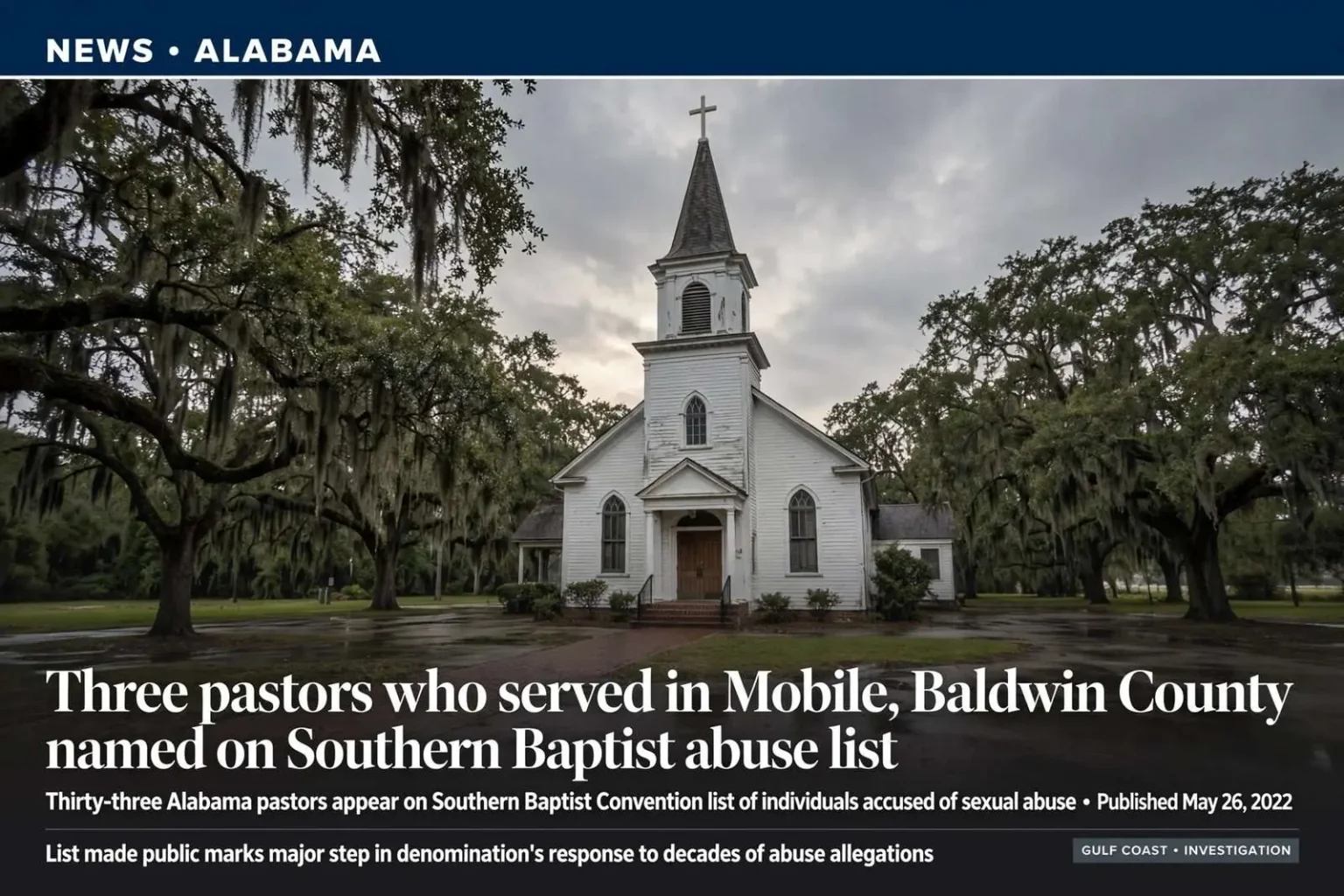
Thirty-three Alabama pastors appear on a Southern Baptist Convention list of individuals accused of sexual abuse that was made public for the first time Thursday, according to national reporting on the release. Three of those named previously worked in the Mobile area or in Spanish Fort, according to the list. The publication of the list marks one of the most consequential steps the nation’s largest Protestant denomination has taken in response to its long-running abuse crisis, and its reach extends to congregations on the Gulf Coast.
The Southern Baptist Convention’s executive committee released the list on May 26 after it had been kept internal for years. The existence of such a record — maintained by the convention’s own administrative body rather than shared with churches or the public — became one of the central controversies in the denomination’s reckoning with abuse, with survivors and advocates arguing for years that keeping accusations inside a file drawer allowed accused ministers to move between congregations without warning the churches that hired them.
In a joint statement, interim president and CEO Willie McLaurin and committee chairman Rolland Slade said the publication “is being made public for the first time as an initial, but important, step towards addressing the scourge of sexual abuse and implementing reform in the Convention.” The word “initial” was pointed: the list’s release was framed not as a conclusion but as a beginning, an acknowledgment of how much documentation exists and how much remains to be examined through the reform process now underway.
Two of the pastors on the list previously served at churches in the Mobile area, while another served in Spanish Fort, according to the published records. For local congregations, the entries are a record of men who once stood in Mobile-area pulpits and led music in Baldwin County sanctuaries — positions of trust that the documented cases show were used, in each instance, against children in their care.
The documented cases
The records detail documented cases. Henry Hobson, a former pastor of Moffett Road Baptist Church, admitted in 1993 to abusing a 14-year-old girl in 1991, according to the accounts; a civil case was resolved through a settlement before trial. Moffett Road Baptist Church sits along one of Mobile’s oldest corridors in the city’s western suburbs, and its former pastor’s admission — made publicly acknowledged more than three decades after the abuse — was among the entries connecting the national list directly to a Mobile congregation.
Marshal Seymour, a former youth pastor at Parkway Assembly of God in Mobile, was charged in 2007 with unlawful sexual activity and counts related to sexual performance by a child; he later pleaded guilty to third-degree assault. The case illustrates a pattern that abuse advocates have documented repeatedly across denominations: the charge a defendant ultimately pleads to can bear little resemblance to the conduct alleged, leaving public court records that obscure the seriousness of what was claimed while the underlying accusations follow the individual through church employment records.
Walter Jay Bowen, a former minister of music at First Baptist Church in Spanish Fort and a local radio personality, was arrested in 2010 on charges of abusing a child younger than 12 and was sentenced to 10 years in prison under a plea agreement. Bowen’s case reached into Baldwin County’s public life through his radio work, and his conviction — a decade-old plea agreement with a decade-long sentence — stands as the most formally resolved of the three local entries on the list.
The convention is scheduled to hold its annual meeting June 14-15 in Anaheim, California, where the investigation report is expected to be discussed. That meeting will be the first since the list’s release, and messengers — the denomination’s term for the local church representatives who vote its business — are expected to take up the reforms that the documentation has made impossible to defer: databases, screening requirements and the governance changes needed to give the convention some authority over churches that historically answer to no one but themselves.
Why the list matters
The Southern Baptist Convention is not a hierarchy in the way Catholics or Methodists organize. Each congregation is autonomous — it calls its own pastors, manages its own finances, and answers to no denominational supervisor. That structure is theologically central to Southern Baptist identity, but it also meant that for decades the convention’s national bodies held no mechanism to track accused ministers or warn the next church that hired them. An accused youth pastor could resign from one congregation and take a pulpit in another state with no record following him, a pattern that national investigations documented repeatedly.
The list’s release addresses part of that structural gap by creating public visibility, if not yet a formal database with due-process safeguards. Survivors’ advocates have welcomed the transparency while pressing for the next step — a permanent, searchable system that churches can check before hiring, maintained independently of the executive committee that kept the old records private.
Alabama’s thirty-three entries give the national reckoning a local face. Behind each name on the list is a congregation that trusted a minister, a family that believed its children were safe, and in the documented cases, young people who carried the harm into adulthood before the truth surfaced through admissions, charges or civil claims. The Mobile-area entries span decades — the 1990s, the 2000s, the 2010s — which is itself part of the record: the pattern was not a single era’s failure but a persistent one.
For congregations now, the practical question is what to do with the list. Churches screening candidates for ministry positions can consult it alongside background checks and references; members who worshipped under the named pastors now have documented context that was previously scattered across court files and news archives; and survivors who never reported may find in the documentation both corroboration and, perhaps, the standing to come forward now.
The June meeting in Anaheim will determine whether the list’s release becomes the turning point its publishers described or another document in the file. What is already settled is the record itself: thirty-three Alabama ministers on a list the nation’s largest Protestant denomination kept private for years, three of them with ties to Mobile-area and Spanish Fort churches, and a public reckoning that has finally begun.
The pressure that produced the list has been building for years. National investigations into Protestant church abuse documented hundreds of cases across Southern Baptist congregations and showed how accused ministers moved between churches with impunity, and survivor-led advocacy inside the convention turned what had been scattered local scandals into a denominational governance question. Messengers at previous annual meetings had voted for reform measures over the executive committee’s objections, and the committee’s decision to publish its internal records followed those votes and mounting legal scrutiny.
The executive committee itself had been the focus of much of the criticism. Reports that the body maintained records of accused ministers — some dating back decades — while responding to congregations’ inquiries about candidates with silence or denials made the committee a symbol of the institutional failure survivors described. The joint statement from McLaurin and Slade acknowledging the release as a step toward “implementing reform” represented the current leadership’s public alignment with that critique, a marked shift in tone from the body’s earlier posture.
For Alabama’s Southern Baptist churches, the state’s thirty-three entries land in the heart of the convention’s territory. Alabama is among the most Southern Baptist states in the nation, with the Alabama State Board of Missions — the state convention — coordinating cooperation among hundreds of congregations, and Southern Baptist churches form the religious backbone of many Gulf Coast communities. The list’s local entries therefore touch institutions with deep roots: a Moffett Road church along one of Mobile’s main arteries, a youth ministry in the city itself, and a Baldwin County congregation whose music minister was a familiar radio voice.
What survivors and churches can expect
Abuse advocates have outlined what meaningful reform beyond the list requires: an independent, permanent database that churches can search before hiring staff; mandatory reporting training for clergy and lay leaders; survivor-informed policies for handling new accusations; and financial and institutional support for survivors who come forward years or decades after the abuse. Several of these elements were at the center of the reform package debated at recent annual meetings, and their implementation is what the Anaheim agenda is expected to address.
Congregations, meanwhile, face their own responsibilities under the autonomy that has defined Southern Baptist life. A published list does not automatically alert a church whose new ministerial candidate appears on it — the church must check. Denominational leaders have urged member congregations to review their hiring practices, train staff who work with minors, and treat any past accusation documented in public records as information owed to the families in their pews.
For the Mobile-area congregations named in the records, the list’s publication may reopen conversations that ended years ago when a pastor resigned or a case was settled. Congregational health after abuse is a long process, and the national reckoning gives local churches both a framework and a prompt for the accounting they owe their own members.
The convention’s annual meeting in Anaheim runs June 14-15. Whatever its messengers decide, the list now exists in public view — thirty-three Alabama names among a nationwide record that the denomination can no longer keep in a drawer.