Three Shot, Two Cut in Early-Morning Incident on Bel Air Boulevard Near Cottage Hill Road
Mobile police investigated an early-morning shooting on Bel Air Boulevard near Cottage Hill Road that left three people shot and two cut by broken glass.
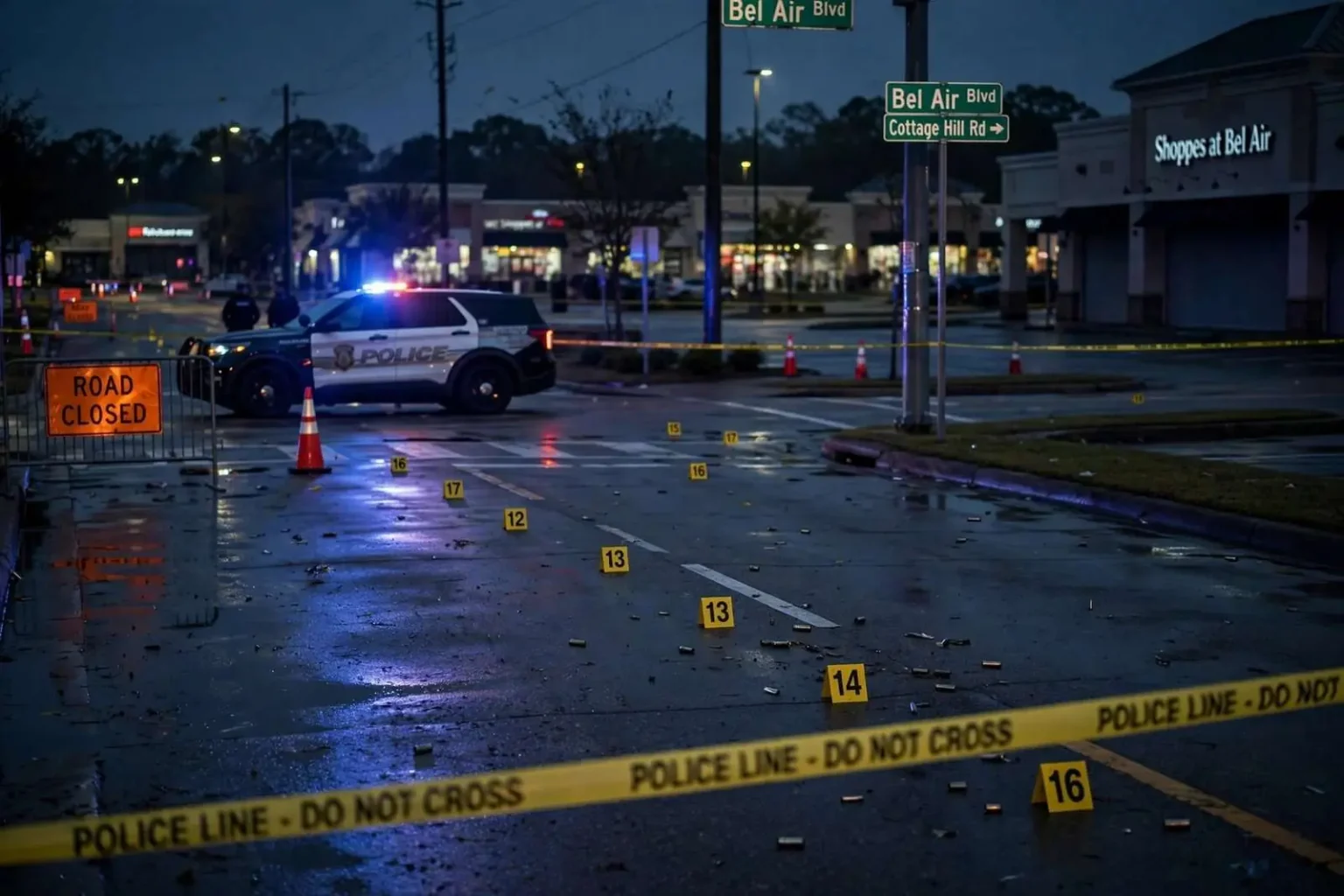
Five people were hurt in what Mobile police described as an early-morning shootout on Bel Air Boulevard between Airport Boulevard and Cottage Hill Road, an incident that scattered shell casings along one of the city’s busiest commercial corridors and left investigators working Monday to piece together what happened.
Police said the incident unfolded shortly before 12:45 a.m. Monday, March 29, 2021. Multiple victims then arrived at University Hospital, where three were treated for gunshot wounds and two for cuts caused by broken glass. Their conditions were not immediately released.
The pattern of victims — some shot, some cut, all arriving at the hospital’s emergency department within a short span — is one investigators treat as a signature of a rolling or moving incident, in which people flee a scene by car while injured and end up at the hospital in groups, sometimes in vehicles driven by other participants. Officers determined the shooting occurred on Bel Air Boulevard just before the victims reached the hospital, connecting the corridor and the emergency room arrivals into a single case.
A Corridor Closed Through the Night
The roadway was closed for more than two hours and reopened shortly before 5:30 a.m., the closure stretching through the pre-dawn hours while investigators documented the scene. Bel Air Boulevard is no ordinary street: it carries the traffic serving the Bel Air Mall district and connects Airport Boulevard — one of Mobile’s principal east-west arteries — with Cottage Hill Road to the south. A shutdown of that stretch, even in the small hours, sends police and planners rerouting around a district that never fully sleeps.
At least 40 evidence markers were visible between the Cottage Hill Road intersection and the entrance to the Shoppes at Bel Air, a spacing and volume that told investigators and bystanders alike how much gunfire the block had absorbed. Evidence markers in a shooting scene typically denote shell casings, and 40 or more of them spread across that distance suggests sustained gunfire from more than one position or more than one moving vehicle — the kind of exchange that leaves a scene police can reconstruct only slowly, marker by marker.
An officer at the scene said not all of the victims may have been shot at that location, a caution that widened the investigation beyond the corridor itself. In moving shootouts, the place where markers fall and the place where people are struck often differ, and detectives must work backward from the hospital, the vehicles, and the ballistics to establish the true sequence of events.
The Hospital as the Second Scene
University Hospital, the region’s major trauma center operated within the USA Health system, received the victims and became the second locus of the investigation. Trauma centers in cities across the country function as informal early-warning systems for gunfire: when multiple patients arrive in minutes with wounds from the same incident, the hospital’s notifications to police trigger the scene work that follows.
For the hospital’s staff, the arrivals tested the surge protocols that trauma teams maintain for mass-casualty events — triaging five patients across two categories of injury, gunshot wounds and lacerations from shattered glass, in the middle of a March night. The conditions of the victims were not immediately released, and hospital officials defer such details to police during active investigations.
Investigating a Shootout
Mobile police classified the incident as a shootout, a designation that shapes the investigation in specific ways. Unlike a single-shooter attack, a shootout implies participants on multiple sides exchanging fire, and detectives must determine who was armed, how many weapons were involved, whether the participants knew one another, and whether bystanders — drivers, workers, residents — were anywhere in the line of fire when the exchange happened.
The ballistics work comes first. Shell casings collected between the Cottage Hill Road intersection and the Shoppes at Bel Air entrance will be matched to specific weapons, and any vehicles recovered with damage will add trajectories and glass patterns to the reconstruction. Detectives also canvass the surrounding businesses, whose surveillance cameras cover much of the Bel Air district, for footage of the vehicles involved in the minutes before and after the shooting.
The officer’s remark that not all victims may have been shot at that location adds a spatial puzzle to the ballistic one. Investigators were working to piece together the sequence of events — where the exchange began, whether it moved along the boulevard, and where each victim was when wounded or cut. That reconstruction, built from casings, glass, vehicles, and hospital interviews, determines whether the case proceeds as one incident or several connected ones.
The investigation remained active, with police promising updates as more information became available. In cases of this kind, arrests typically follow the physical evidence rather than precede it: ballistics matches, identifications from surveillance footage, and statements from the wounded themselves, once they are able to give them, drive the charging decisions that follow.
Bel Air: A District on Alert
The Bel Air district sits at the commercial heart of midtown Mobile, anchored by the Bel Air Mall and surrounded by retail strips, restaurants, hotels, and medical offices that serve customers across the metropolitan area. An overnight shootout along its spine reverberates through that business community in practical ways: merchants reviewing their camera systems, managers briefing early-shift employees about the investigation, and the retailers near the Shoppes at Bel Air entrance opening onto a parking area that had been a crime scene hours before.
The district’s traffic volumes during business hours — thousands of vehicles along Bel Air Boulevard and the Airport Boulevard interchange — make the timing of the incident nearly as significant as its location. At 12:45 a.m., the corridor’s exposure was limited to night workers, late drivers, and the residents of nearby neighborhoods, which police described as fortunate given the volume of fire the scene suggested.
Residents of the neighborhoods that surround the district — the established communities along and off Cottage Hill Road — have watched the Bel Air area cycle through periods of violent crime and periods of relative calm, and each incident renews the discussion about policing levels, lighting, and camera coverage in the district. City officials have pointed to the rapid response and the evidence collection in cases like this one as the working answer: the department treats gunfire in commercial corridors as a priority that draws investigators, not just patrol cars.
The City’s Broader Context
The shootout arrived during a stretch in which Mobile, like cities across the country, had been confronting elevated gun violence, and the incident’s setting — a major commercial corridor rather than a residential block — reinforced the concern that gunfire was following people into the places where the city does its shopping, working, and traveling. Police leadership has repeatedly emphasized that exchange-of-gunfire incidents are among the most dangerous to the public precisely because of their unpredictability: bullets fired in a running gun battle ignore property lines, storefront glass, and the cars of anyone on the road.
The response visible on Bel Air Boulevard — the two-hour closure, the evidence grid, the canvass of the surrounding blocks — reflects the investigative weight the department applies to such scenes. Each casing collected is a potential ballistics match, and matches across cases are how investigators connect incidents that appear isolated, identify the weapons circulating in the city, and build the federal and state cases that remove them.
For the five people treated at University Hospital, the immediate medical question resolved into recovery or further treatment as their conditions stabilized, though police did not release details. Investigators follow up with wounded victims once they are able to be interviewed, and those accounts — however reluctant they sometimes are — remain the most direct evidence of who was present and what started the exchange.
What Was Known and What Remained Open
By daybreak Monday, the public record of the incident was bounded and specific: five people hurt, shortly before 12:45 a.m., on Bel Air Boulevard between Airport Boulevard and Cottage Hill Road; three treated for gunshot wounds and two for cuts from broken glass at University Hospital; more than two hours of closure ending just before 5:30 a.m.; at least 40 evidence markers between the Cottage Hill Road intersection and the Shoppes at Bel Air entrance; and an official acknowledgment that the scene on the boulevard might not have been the only location where the violence touched its victims.
Everything beyond that — the number of shooters, the weapons, the relationships among the participants, the motive — remained inside an active investigation, with police promising updates as more information became available. That discipline is deliberate: early details in shootout investigations are often revised as ballistics and footage come in, and departments have learned to release the timeline rather than speculate ahead of it.
The people of midtown Mobile, meanwhile, returned the corridor to its Monday routine. Commuters crossed the intersections where the markers stood, the shops near the Shoppes at Bel Air opened, and the district absorbed the night’s violence the way commercial corridors do — visibly at first, with police tape and closed lanes, then gradually, as the investigation moved from the street to the evidence lab and the questions it carried moved from what happened to who did it.
Anyone with information about the incident was urged to contact Mobile police or the department’s anonymous tip channels, as the investigation remained active and updates were promised as more information became available.