Mahjong Social Play Event ‘Tiles for Tomorrow’ to Benefit Coastal Alabama Chamber Education Programs
The Coastal Alabama Business Chamber and the Mahjong Collective will host Tiles for Tomorrow, a mahjong social play fundraiser, on Aug. 28 at the Peninsula Golf & Racquet Club in Gulf Shores.
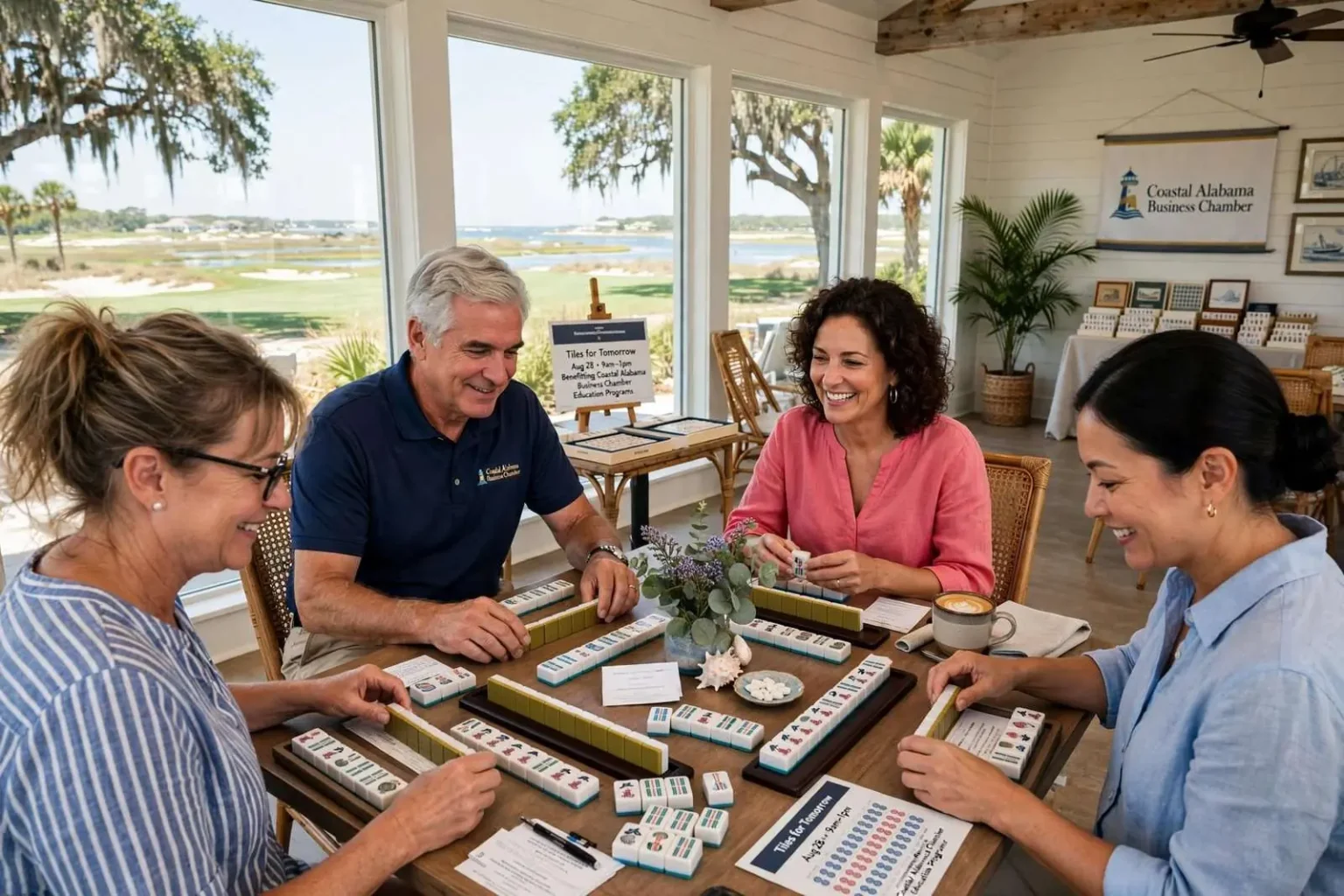
GULF SHORES, Ala. — The Coastal Alabama Business Chamber, together with Lynn Cooper of the Mahjong Collective, will host Tiles for Tomorrow on Aug. 28 from 9 a.m. to 1 p.m. at the Peninsula Golf & Racquet Club Clubhouse in Gulf Shores. The mahjong social play event benefits the chamber’s educational programs. Guests will rotate through casual games and meet fellow enthusiasts over the course of the morning, in a format designed to welcome seasoned players and first-timers at the same tables.
The venue gives the event a resort-caliber backdrop for a weekday morning. The Peninsula Golf & Racquet Club sits among the golf courses and residential communities along the Fort Morgan peninsula side of Gulf Shores, and its clubhouse has long hosted civic gatherings, tournaments and private functions for the coastal business community. A four-hour morning block there allows the chamber to run a full rotation of games without rushing players, and the midweek timing keeps the clubhouse’s regular golf and dining traffic largely undisturbed.
Registration is being handled through the Coastal Alabama Business Chamber, and organizers encourage early sign-ups because table assignments depend on knowing how many players will rotate through the field. Newcomers and experienced players alike are welcome, and the social-play structure means no one needs an established foursome to participate — the rotation itself builds each table.
Mahjong’s Steady Resurgence
The choice of game is less incidental than it may appear. Mahjong has enjoyed a pronounced revival across the United States over the past several years, particularly American mahjong, which is played with a standardized annual card of winning hands. The game rewards pattern recognition, memory and a certain tolerance for calculated risk — and, crucially for a fundraiser, it seats four people at a table and keeps them talking for an hour at a stretch.
The American version of the game took shape in the early twentieth century, when the ancient Chinese tile game was adapted stateside into a standardized form governed by a new card of winning combinations published each year. That annual card is the engine of the game’s modern social life: leagues, community centers and country clubs across the country refresh their play every spring when the new card arrives, which keeps even decades-long players learning. Gulf Shores is hardly an outlier in this respect — coastal and retirement communities throughout the South have seen mahjong groups multiply at clubs, churches and neighborhood associations, often organically and with little promotion.
The demographics also fit the venue. Baldwin County’s population has grown rapidly in recent decades, and much of that growth has come in active adult communities along the coast, where tabletop games bridge the social gap between longtime locals and recent transplants. A morning event, rather than an evening one, matches the rhythms of that community while leaving the afternoon free — a scheduling choice that widens the pool of players able to attend.
The revival has been amplified by social media, where mahjong’s colorful tiles photograph well and where celebrity players have pulled the game back into the mainstream. Tiles have become a lifestyle accessory as much as game equipment, and specialty tile makers now sell designs ranging from classic ivory-look sets to custom coastal-themed tiles that suit a Gulf Shores event down to the ground.
How the Format Works
The rotating format used at social play events like this one means participants meet several groups over the morning rather than spending four hours with the same three people. For a chamber event, that structure functions as networking whether or not anyone calls it that. A player might sit down beside a restaurant owner from Gulf Shores’ beach districts, a real estate professional from Foley and a banker from Orange Beach over the course of a single rotation, and the game gives each of them an immediate shared subject that has nothing to do with business cards.
That is precisely why chambers and civic groups have embraced game-based fundraisers. Conversation at a cocktail reception tends to cluster in existing friendships, while conversation at a game table is forced — pleasantly — by the deal of the tiles. Four hours of rotation means dozens of new introductions per player, and the shared stakes of the game break the ice faster than any structured mixer. For newcomers to the area, events like this double as an entry point into the coastal business community, which can otherwise take years to navigate.
Organizers describe the play itself as casual, meaning the event is not a tournament with rankings and prizes but a social session where tables play at their own pace. Players of different skill levels can share a table because the rotation dissolves any one table’s dynamics every hour or so. Hosts from the Mahjong Collective circulate to help newcomers learn the card and the flow of play, which lowers the intimidation factor that keeps some would-be players away from established leagues.
Supporting Chamber Education Programs
Proceeds support the Coastal Alabama Business Chamber’s educational programming, which serves the business community across the Gulf Shores, Orange Beach and Foley area. Chamber education initiatives typically include workforce development, leadership training and youth programs connecting students with local employers. On the coast, those functions carry particular weight, because the tourism-driven economy produces seasonal labor cycles and workforce needs that differ sharply from those of inland markets.
Leadership programs run by chambers of commerce have long served as a farm system for local civic life, identifying emerging professionals and walking them through the workings of county government, school systems and the regional economy. Youth-oriented initiatives, meanwhile, connect high school and community college students with employers in hospitality, construction, health care and the marine trades — the industries that anchor the coastal economy. Fundraisers like Tiles for Tomorrow underwrite that work without raising membership dues, which is why the chamber’s calendar of social events matters beyond the pleasure of the events themselves.
The chamber itself was formed through the merger of the area’s legacy business organizations and now represents one of the fastest-growing regions in Alabama. Its programs span advocacy at the state and county level, tourism-adjacent promotion, small business support and the education portfolio that this event funds. For members, the mahjong morning is also simply a member-benefit: a chance to gather in a premium venue during the shoulder season, when the summer rush has eased and the calendar has room for community-building.
The partnership with the Mahjong Collective reflects a broader trend of chambers hiring specialist hosts for themed events rather than producing every gathering in-house. Lynn Cooper’s group brings the game expertise — cards, tiles, table setup and rule guidance for newcomers — while the chamber brings the venue, the beneficiary mission and the member network. The division of labor has proven effective at other coastal events, keeping the games moving and letting chamber staff focus on the members rather than the mechanics of play.
Chambers and Community Life on the Alabama Coast
The event is part of a wider pattern of chamber-driven community life across south Alabama. The Southwest Mobile County Chamber of Commerce plays an important role in connecting business leaders, promoting economic development and organizing community events in its own corner of the region, and chambers in Foley, Fairhope, Daphne and elsewhere run similar calendars of fundraisers, festivals and networking functions. Sporting events, charity tournaments and cultural festivals fill out those calendars, each one doubling as an economic driver that draws visitors and their spending into local shops, restaurants and hotels. Together, the region’s chambers form a connective tissue between municipal governments and the business community that no single institution could replicate.
For Gulf Shores specifically, the growth of these programs tracks the city’s transformation from a seasonal beach town into a year-round destination economy. The city’s tourism engine — anchored by Gulf State Park, the beachfront districts and a national-caliber events calendar — generates the tax base that funds city services, while organizations like the chamber work to diversify the economy beyond tourism through workforce training and business recruitment. Education programming sits at the center of that effort, because employers across the coast consistently cite trained labor as their limiting factor for growth.
Details and Registration
Tiles for Tomorrow runs from 9 a.m. to 1 p.m. on Aug. 28 at the Peninsula Golf & Racquet Club Clubhouse in Gulf Shores. Interested players should contact the Coastal Alabama Business Chamber for registration details, including any entry contribution associated with play and table availability. Newcomers and experienced players alike are welcome, and the rotation format accommodates both without requiring advance foursomes.
Organizers suggest arriving early enough to check in, receive a game card and be seated for the first rotation. Players are generally asked to bring nothing more than enthusiasm; tiles, mats and cards are provided at the tables under the Mahjong Collective’s supervision. Refreshments and social time are built into the morning’s schedule, and the event concludes in time for attendees to return to work or lunch plans by early afternoon.
For the chamber, the morning serves several purposes at once: it raises funds for education programs, introduces new faces to the member network, and puts a fresh spin on the standard fundraising luncheon by replacing speeches with play. For the players, it is four hours of a game that has hooked generations of Americans — pattern recognition, friendly competition and conversation, all in the service of the next cohort of coastal Alabama’s workforce.