Toll Authority Approves $3.2 Billion Mobile River Bridge Financing, Sets $3 Toll
The Alabama Toll Road, Bridge and Tunnel Authority approved a 45-year financing plan and a $3 ALGO Pass toll for the $3.2 billion Mobile River Bridge and Bayway Project, with construction expected to begin in October and financial closing set for Sept. 16-17.
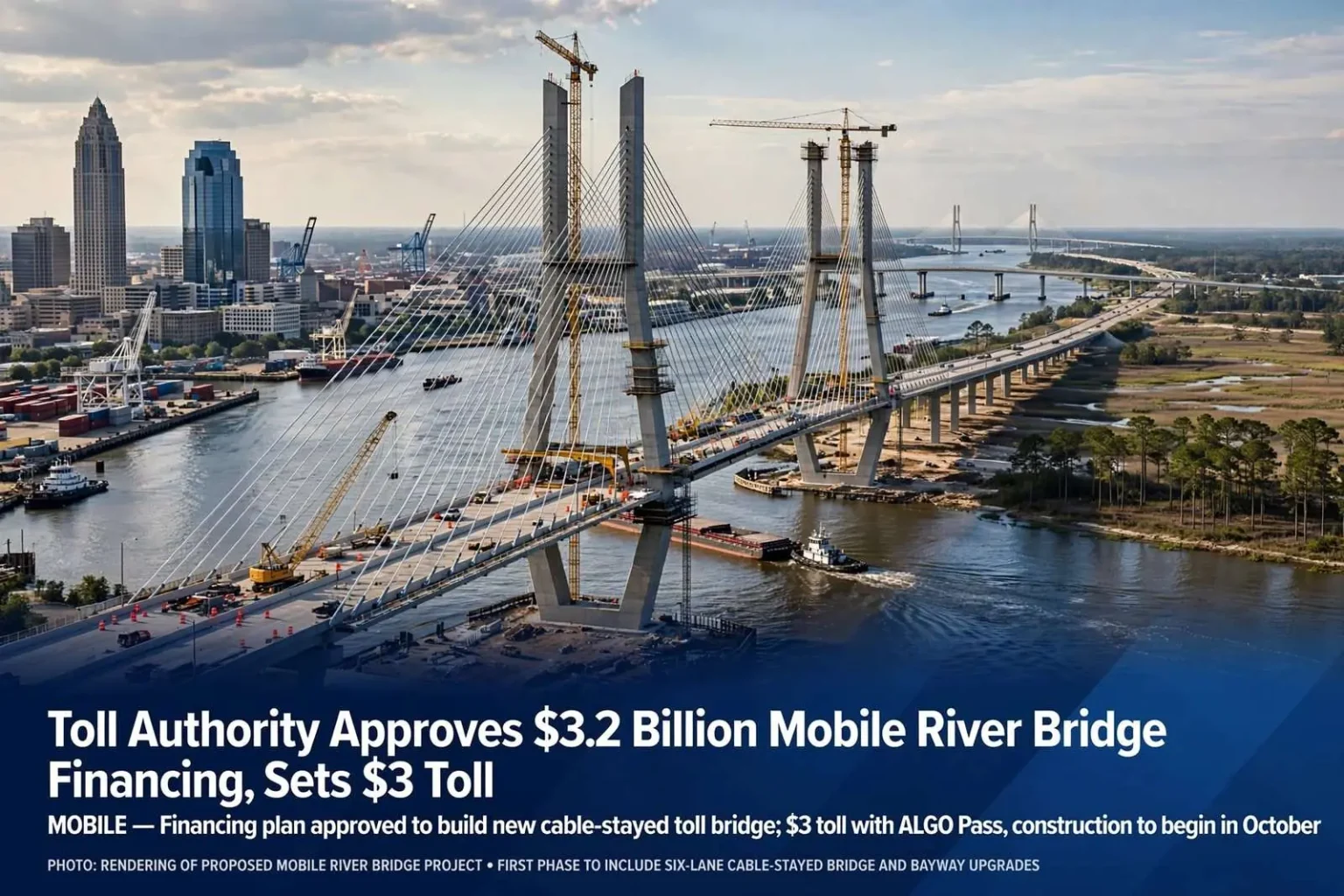
MOBILE — The Alabama Toll Road, Bridge and Tunnel Authority approved a financing plan Friday for the $3.2 billion Mobile River Bridge and Bayway Project, along with a toll policy that sets the price at $3 per trip for drivers using an ALGO Pass — up from the previously proposed $2.50. Construction on the project is expected to begin in October.
The vote sets in motion the most significant change to Mobile’s transportation network in decades, capping years of study, debate and political wrangling over how to relieve congestion on Interstate 10, the region’s most heavily traveled artery. The highway currently squeezes through the George C. Wallace Tunnel under the Mobile River and onto the Jubilee Parkway, the elevated span locals call the Bayway, and the daily backups there have become a defining frustration for commuters, freight haulers and beach-bound tourists alike.
What the project builds
Plans for the project include a new cable-stayed toll bridge across the Mobile River, interchange improvements, and upgrades that would expand the existing Bayway to six lanes. The new bridge would rise over the river just north of the existing tunnels, connecting downtown Mobile to the Eastern Shore with a span tall enough for port traffic to pass beneath. Cable-stayed design — in which cables run directly from tall towers down to the bridge deck — has become the signature look of major river crossings across the country, and a tower rising over the Mobile skyline would give the city its most visible new landmark in generations.
Traffic between Mobile and the Eastern Shore currently funnels through the Wallace and Bankhead tunnels beneath the Mobile River and onto the Jubilee Parkway, the twin-span bridge over Mobile Bay. The corridor is the only direct interstate route between Mobile and Baldwin County, one of the fastest-growing counties in Alabama, and the crossing has long operated beyond the capacity it was designed for.
A scaled-back first phase
Ed Austin, chief engineer for the Alabama Department of Transportation, told the authority that years of work with regional planning organizations, Alabama’s congressional delegation and federal partners went into developing a version of the project that could actually be built.
“Construction inflation and engineering challenges on the Mobile River Bridge and Bayway as originally conceived make this project financially unachievable,” Austin said. “Working closely with the U.S. Department of Transportation and the Federal Highway Administration, we developed a phased approach that reduces the construction cost of the initial project to approximately $3.2 billion.”
Austin said ALDOT anticipates an approximately five-year timeframe to complete the first phase.
“Phase 1 will build a new six-lane Mobile River Bridge, improve interchanges west of the new bridge, and modify the existing Bayway to provide six lanes of capacity. Phase two will replace the Bayway in the future,” Austin said.
How the plan is financed
Austin described the funding package as a 45-year financing plan built around a Transportation Infrastructure Finance and Innovation Act, or TIFIA, loan as the primary long-term financing instrument, supplemented by bond financing, federal grants and state funds. TIFIA loans, a federal credit program for major surface transportation projects administered by the U.S. Department of Transportation, offer favorable terms to projects that can pledge dedicated revenue — in this case, the tolls the bridge will collect over decades of operation.
Members of the authority approved a resolution financing the project through four bond series: Series 2026A Bonds, or First Lien Bonds; Series 2026B Bonds, the TIFIA Loan; Series 2026C Bonds, or Third Lien Bonds; and Series 2026D Bonds, the Taxable Third Lien Bonds. The layered structure — first-lien bonds at the front of the repayment line, federal loan money in the middle, and taxable third-lien bonds behind them — is characteristic of large toll projects, where lenders accept different levels of risk in exchange for different interest rates and repayment priority. Toll revenue pledged to the project will service that debt over the 45-year life of the plan, which is why the toll itself is as much a financing question as a traffic-management one.
Closing set for September
Austin said the authority anticipates a two-day closing process on the TIFIA bonds beginning on or around Sept. 16. ALDOT spokesperson Tony Harris said the Authority’s action authorizes the sale of bonds and the execution of the TIFIA loan, and also authorizes ALDOT to officially green-light the project’s design-build contractor once financial closing occurs, a two-day process scheduled for Sept. 16 and 17.
Harris described the vote as procedural but said it represents one of many essential steps in the project’s development. Projects of this scale reach construction through a long sequence of such actions — environmental clearance, financing authorizations, contractor selection, financial closing — and each one is essential precisely because the sequence cannot be skipped or reordered.
The design-build delivery method, which ALDOT has used on its biggest recent projects, pairs the designer and the builder in a single contract, letting construction begin on parts of the work while design continues on others. Financial closing — the day the bonds are actually issued, the loan documents are signed and the money is formally committed — is the trigger that converts all of the preceding authorizations into a contract the state can enforce and the contractor can mobilize on.
Who voted
The Alabama Toll Road, Bridge and Tunnel Authority includes Gov. Kay Ivey, Lt. Gov. Will Ainsworth, ALDOT Director John Cooper, Finance Director Bill Poole, State Rep. Steve Clouse (R-Ozark), State Rep. Rex Reynolds (R-Huntsville), State Sen. Greg Albritton (R-Atmore), Ivey Chief of Staff Liz Filmore and Ivey Deputy Chief of Staff Brooks McClendon. The composition reflects the stakes: a multibillion-dollar, decades-long financing commitment signed by the state’s governor, finance director and legislative leaders carries weight in bond markets precisely because it cannot be undone by any single office.
The toll fight continues
Tolling has been the project’s defining controversy. Officials have long maintained that a project of this size cannot be built without toll revenue backing the debt, since no realistic combination of federal grants and state fuel taxes could cover the cost. Residents and commuters, particularly in Baldwin County, have pushed back hard against paying to cross a bay their taxes already connect, and the debate has run through public meetings, political campaigns and legal challenges.
The jump from the previously discussed $2.50 toll to $3 per trip with an ALGO Pass will rankle drivers who have watched the project’s costs rise, and it ensures the pricing debate will continue as construction begins. Officials have long argued that the toll spreads the cost of the bridge onto the drivers who directly benefit from it, freeing other state dollars for roads that cannot collect their own revenue.
The ALGO Pass, the state’s electronic tolling sticker system, allows vehicles to move through toll points at highway speed without stopping at a booth, with the charge drawn from a prepaid account. Electronic tolling of this kind is now the default for new toll facilities across the country, cutting the cost of collection and eliminating the backups that toll plazas once created — a critical feature on a corridor where congestion is the entire problem being solved.
What happens next
Officials still anticipate construction beginning in October, though no date has been set for a groundbreaking ceremony. The gap between the two reflects how modern mega-projects actually begin: with early utility relocations, clearing, geotechnical drilling and staging-area preparation that do not look like construction from the road but count as it on the schedule.
The phasing also manages expectations about what will change and when. The first phase delivers the new bridge and six-lane capacity through the corridor within roughly five years of the October start, while the full replacement of the aging Bayway waits for a future phase whose timing and funding remain to be worked out. The Jubilee Parkway span has carried Interstate 10 traffic across Mobile Bay since 1980, and its condition has been a recurring concern for state highway engineers as traffic volumes have grown year after year.
The five-year construction window will bring its own disruptions. Bridge and interchange work of this scale means lane closures, detours and changing traffic patterns through the corridor, and ALDOT typically builds extensive public communication campaigns around major projects so that drivers can plan around closures. Residents can expect periodic updates as the October start approaches and as the interchange improvements west of the new bridge get underway.
Why the region has pushed for it
The commercial stakes are substantial. The Port of Mobile sits just upriver of the crossing, and the freight traffic that connects the port to Interstate 10 funnels through the same tunnel and Bayway corridor that commuters use every morning. Trucking companies, port tenants and manufacturers along the coast have lobbied for relief from the bottleneck for years, arguing that an unpredictable crossing time ripples through logistics contracts and delivery windows across the Southeast.
Interstate 10 is also the primary route for the millions of visitors who travel each year to Alabama’s Gulf beaches, and summer weekends routinely turn the Bayway into a parking lot as beach traffic stacks up against local commuting. Regional planners have spent years documenting the cost of doing nothing: wasted fuel, lost freight time and the economic drag of a bottleneck on the main east-west interstate route along the Gulf Coast.
For now, the financing approval is the milestone that matters: after years in which the project’s future was uncertain, the state has committed a funding structure, a toll rate and a construction date. The four bond series are expected to close in a two-day process beginning on or around Sept. 16, and from there the work shifts from conference rooms in Montgomery to the banks of the Mobile River.