Tracked great white shark Cabot detected off the Alabama coast
A tracked great white shark named Cabot was detected about 25 miles off Mobile Bay, his first Gulf of Mexico ping since 2019, according to OCEARCH.
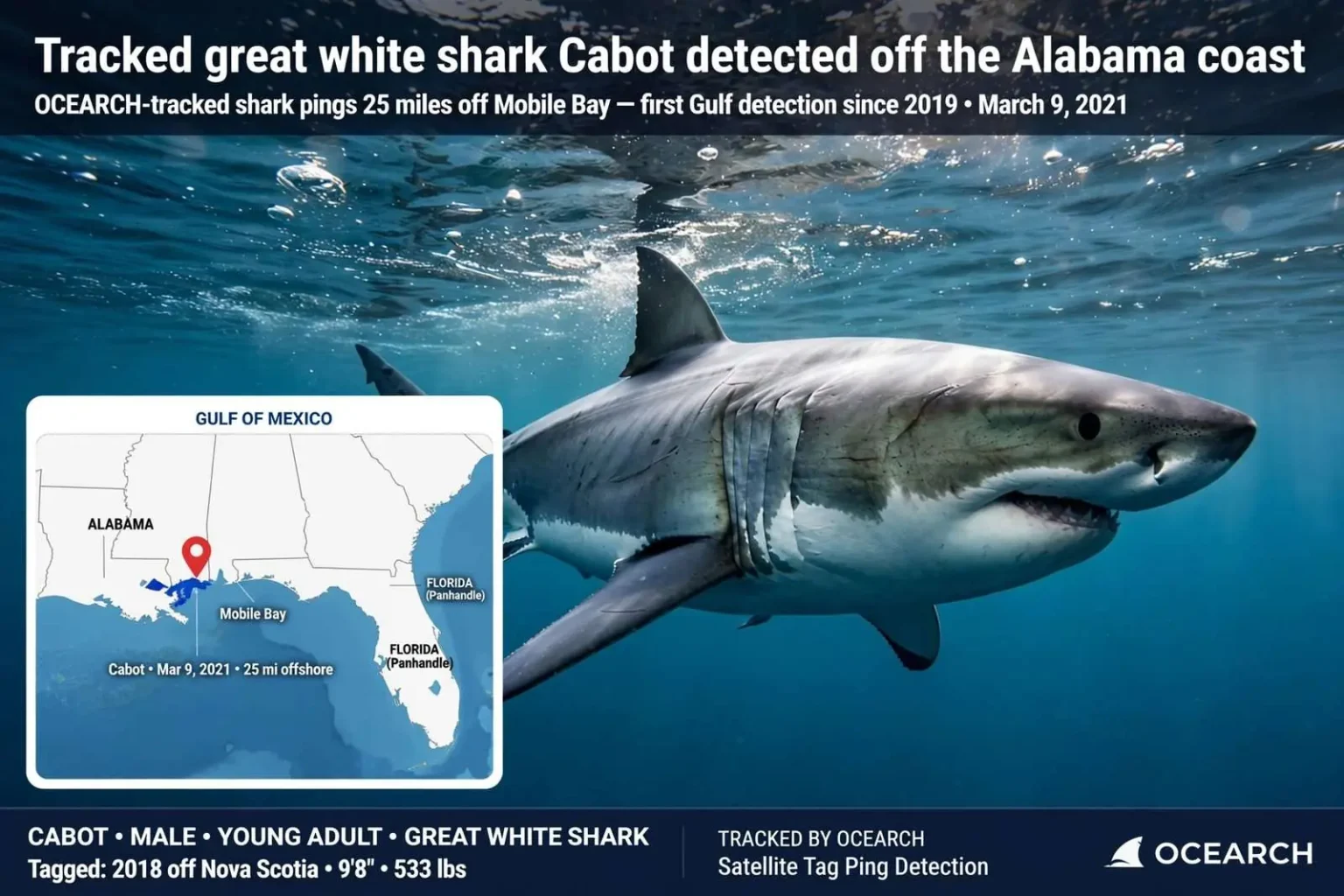
A young adult great white shark being tracked by the research group OCEARCH was detected in the Gulf of Mexico roughly 25 miles off Mobile Bay, marking the shark’s first ping in the region since 2019.
The shark, named Cabot, is a 533-pound, 9-foot-8-inch male first tagged by OCEARCH off Nova Scotia in 2018. He has spent the past few years traveling up and down the East Coast. On March 9, 2021, Cabot pinged in the Gulf of Mexico for the first time since 2019, according to tracking data. At the time of the detection he was about 25 miles outside of Mobile Bay.
The ping placed Cabot among a small but growing set of great whites documented in the Gulf of Mexico, waters that researchers once thought great whites visited rarely. Tracking data accumulated over the past decade has shown that the western North Atlantic’s great white population makes regular use of the Gulf, with tagged animals recorded off Texas, Louisiana, Florida’s west coast and the Florida Keys across the winter and early spring months.
Who Cabot is and how he is tracked
OCEARCH, the research organization behind the tracking data, tags great whites with satellite transmitters that transmit a location estimate each time the shark’s dorsal fin breaks the surface — each transmission recorded as a “ping.” The pings are plotted on the group’s public tracking map, which has made individual sharks into minor celebrities, followed by thousands of people who check in on their movements.
Cabot was named for the explorer John Cabot, consistent with OCEARCH’s practice of naming its sharks after historical figures or sponsors. He was first tagged off Nova Scotia in 2018, part of the organization’s expeditions to the Canadian Atlantic, where great whites congregate in summer to feed on seals. At tagging he measured 9 feet 8 inches and weighed 533 pounds — a young adult male, years away from full maturity. Great white males can exceed 13 feet and approach a ton, and the species can live for decades, meaning a shark tagged as a juvenile can produce tracking data for many years.
Each ping depends on the shark surfacing long enough for the transmitter’s antenna to reach a satellite. Gaps of days or weeks between pings are normal, since great whites spend most of their time submerged. The March 9, 2021 detection ended a gap in Cabot’s Gulf record dating back to 2019, when his transmitter last registered him in the region.
Great whites in the Gulf of Mexico
The Gulf has turned out to be a regular wintering ground for a subset of the western Atlantic great white population. Researchers have pieced together a seasonal pattern from tracking data: sharks summer in the cool waters of the Canadian Maritimes and the northeastern United States, then move south along the coast in fall, with some animals continuing past Florida into the Gulf from December through April.
The waters off Mobile Bay and the Florida Panhandle lie along that route. Great whites tracked into the northern Gulf typically cruise the continental shelf in water depths from the coastline out to the shelf edge, feeding on fish, rays, and other prey. Sightings close to Alabama’s beaches are rare, and the sharks detected offshore usually keep to deeper water well beyond the swimming beaches. Cabot’s position — about 25 miles outside the bay — was consistent with that offshore pattern.
For the scientific community, each ping contributes to a still-incomplete picture. Great white populations in the Northwest Atlantic declined steeply in the late twentieth century before federal protections helped them begin recovering, and researchers are still mapping where the recovering population goes, what it eats, and how it uses habitats like the Gulf. Tracking detections like Cabot’s are the primary data source, since the species is too rarely seen to study by direct observation.
What the detection means for the coast
For coastal residents, a great white ping 25 miles offshore is a curiosity more than a warning. The species remains exceptionally rare close to Alabama’s swimming beaches, and the Gulf’s great white visitors spend their time over offshore shelf waters. Swimmers’ usual Gulf companions — spinner sharks, blacktips, bull sharks and other nearshore species — account for essentially all of the shark activity along the region’s beaches.
The detection still generated attention along the coast, where OCEARCH’s public tracking map has built a following. Sharks with social media followings have become an unlikely public-engagement success for marine science, and researchers credit the map’s followers — schoolchildren, anglers, beachgoers — with building support for the research that depends on expensive expeditions and tagging operations.
Cabot’s Gulf visit also connected Alabama’s coast to a research story that usually plays out far to the north. The great whites tagged off Nova Scotia and Cape Cod belong to the same population that occasionally passes the Florida Panhandle, meaning a shark followed by schoolrooms in New England in the fall can surface on Alabama’s coastal radar in the spring.
How OCEARCH’s work functions
OCEARCH conducts its tagging from a custom research vessel using a method that lifts the shark onto a submerged platform, where a veterinary team can take samples, attach instruments and complete measurements within minutes before release. The organization publishes its tracking data on a public map and shares detections openly, which is how Cabot’s March 9 ping became known along the Gulf Coast.
The group’s expeditions have tagged dozens of great whites along the western Atlantic, building one of the largest datasets on the species anywhere. Each tagged shark carries instruments that can transmit for years, turning individual animals into long-term data sources. Movements documented from these tracks have reshaped scientific understanding of the species’ range, dive behavior and seasonal migrations — including the recognition that the Gulf of Mexico is a regular destination rather than an anomaly.
The March 9, 2021 ping put Cabot about 25 miles outside Mobile Bay, back in Gulf waters after years of East Coast movement documented since his 2018 tagging off Nova Scotia. For researchers, the detection confirmed what his 2019 Gulf visit had suggested: that the young male includes the Gulf in his annual circuit.
Great white biology at a glance
The great white shark is the largest predatory fish in the ocean, and the population that patrols the western North Atlantic is among the best-studied in the world. Adults in that population typically range from 11 to 16 feet, with females growing larger than males. They are long-lived — estimates run to several decades or more — slow to mature, and reproduce infrequently, traits that make populations vulnerable to overfishing and slow to recover.
Young adults like Cabot occupy a middle stage of that life history. At 9 feet 8 inches and 533 pounds at tagging, he had outgrown the fish-and-ray diet of juveniles and was approaching the seal-hunting phase that dominates adult great white feeding in the North Atlantic. Tracking studies show young adults ranging more widely than either juveniles or full adults, exploring coastlines and open water as they establish the movement patterns they will hold for life.
That exploratory phase is what likely brought Cabot through Gulf waters. Regional great whites tracked in the Gulf cruise enormous distances between pings, and researchers have documented animals crossing between the Gulf’s eastern and western sides within a single season. Where exactly Cabot went after his March 9 ping would become clear only as subsequent detections arrived on the tracking map.
The Alabama coast and its sharks
Alabama’s Gulf waters host a rich shark fauna, from the small sharks that patrol the surf zone to large species offshore. The state’s coastal waters, fed by Mobile Bay’s estuary and the productivity of the northern Gulf shelf, support nursery areas where several species give birth and juveniles mature. Anglers encounter sharks regularly, and the Alabama Department of Conservation and Natural Resources manages shark fishing under federal and state rules.
Great whites rank among the rarest visitors to those nearshore waters. Documented encounters along the Alabama coast are few, and none in the modern record approaches the frequency of shark interactions involving the nearshore species that actually share the beaches with swimmers. The regional ecosystem’s large sharks — great hammerheads, tigers, bulls — draw far more attention from anglers and researchers.
That context is what makes a tracked great white’s offshore passage newsworthy rather than alarming: it documents the species’ use of Gulf habitat without changing the practical reality for anyone on the sand. Twenty-five miles out, Cabot was closer to the shelf’s open water than to any swimmable beach.
Following Cabot’s next moves
OCEARCH’s public map plots each new detection as it arrives, and Cabot’s followers could expect updates whenever he surfaced long enough to ping. Sharks tagged by the organization often ping for a decade or more, meaning the data trail that began off Nova Scotia in 2018 could continue for years.
The March 2021 Gulf ping added a data point to a question researchers have pursued for years: how the Gulf of Mexico fits into great white migration. Each tagged animal that enters the Gulf refines the answer, and Alabama’s offshore waters — on the route between the Florida Straits and the western Gulf — are part of the map being drawn.
For now, the facts stand as the tracking data recorded them: Cabot, the 533-pound male tagged off Nova Scotia in 2018, pinged on March 9, 2021 about 25 miles outside Mobile Bay, his first Gulf detection since 2019. Where the young shark surfaced next was, as always with great whites, up to him.