

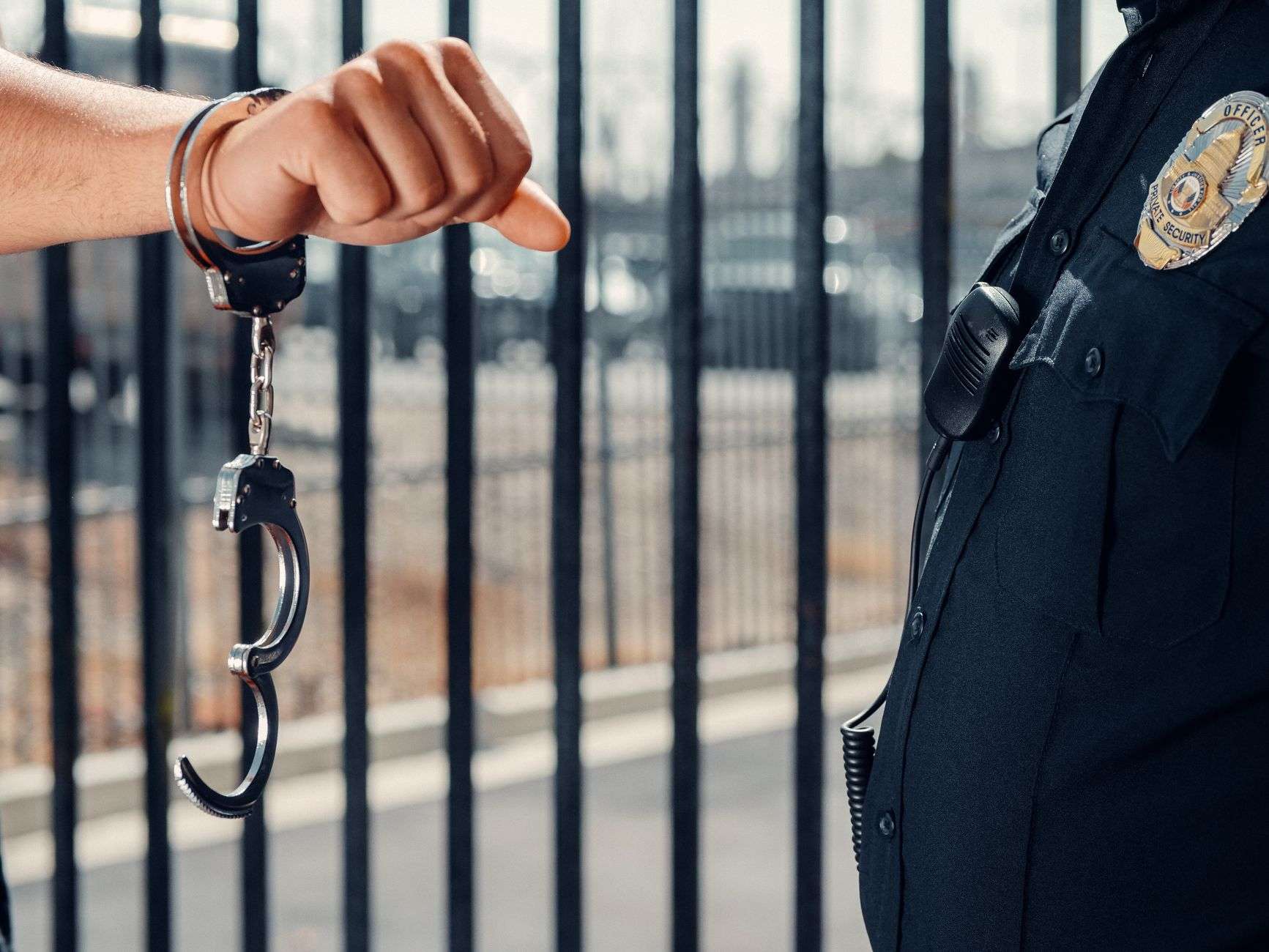
With his hands cuffed and officers guiding him to a vehicle bound for jail, Prichard Police Chief Walter Knight was surrounded by a group of local journalists with cameras rolling. "How does it feel to be on the other side of a perp walk?" one journalist asked. "Talk to my lawyer," Knight responded. The scene has put the practice of perp walks in Mobile County under fresh scrutiny after a state lawmaker called it a way to humiliate someone accused, but not convicted, of using their public office for personal gain. It has also raised broader questions about the fairness of the practice and about whether journalists, particularly in television, lean too heavily on dramatic footage while serving the needs of law enforcement.
"I think we need to maybe reassess those (perp walks)," said state Rep. Napoleon Bracy, D-Saraland, who criticized how Knight was handled in a social media post this week. "What happened with the police chief, Walter Knight, showed me that perp walks can be used to just humiliate people. I think the perp walk in this case was used as a humiliation tactic to tear down this person's character and parade them around as some hardened criminal to the community. I just think it was excessive." Lori Myles, spokesperson for the Mobile County Sheriff's Office, said she could see Bracy's point. The agency typically conducts perp walks for "high-profile" crimes such as murders, though it has no written policy governing the practice.
"We usually do them for every high-profile case and in this particular case, the indictments had been leaked and several media outlets knew about it," Myles said. "It was one of those things that unfolded before anyone knew it was going on." The Evolution of the Perp Walk Mobile is one of the few places in Alabama where perp walks still occur, though the practice has existed since the early days of American policing. Its use is shaped by local police culture, courthouse and jail design, and media access. "Perp walk," short for "perpetrator walk," is also known as a prisoner escort — officers publicly walking an arrested suspect in front of the media from a police station or courthouse to a transport vehicle.
The practice is closely associated with New York City and was popularized by former U.S. Attorney Rudy Giuliani, who frequently staged high-profile white-collar arrests during the 1980s. John Gotti, O.J. Simpson and Bernie Madoff are among the figures famously captured in perp walks. One of the most notorious prisoner transports in American history occurred in 1963 in the basement of Dallas police headquarters, when television cameras captured the fatal shooting of Lee Harvey Oswald by Jack Ruby two days after the assassination of President John F. Kennedy. Perp walks have long drawn criticism from those who say they undermine the presumption of innocence by publicly portraying suspects as guilty before trial. A federal appeals court raised constitutional questions about the practice in Lauro v. Charles, when the Second U.S.
Circuit Court of Appeals ruled in 2000 that police had violated the Fourth Amendment by staging a perp walk solely for the media with no legitimate law enforcement purpose. The ruling was binding only within the Second Circuit — New York, Connecticut and Vermont — but the decision has coincided with agencies nationwide becoming more limited in orchestrating photo opportunities during prisoner transports. Several large Alabama law enforcement agencies do not conduct perp walks, or reserve them for high-profile cases such as murders. Huntsville police do not hold perp walks, and Montgomery police conduct them only for high-profile murder arrests without notifying local media in advance, according to previous reporting.
Background and Context
Tuscaloosa police also reserve perp walks for high-profile cases; the most recent notable example came in 2023 after the arrest of then-University of Alabama basketball player Darius Miles on a capital murder charge. State Rep. Allen Treadaway, R-Birmingham, a retired assistant chief with the Birmingham Police Department, said he could not recall the department discussing perp walks or the publicity surrounding inmate transports, crediting the facility's layout for helping avoid turning transports into public spectacles. "We had the luxury of pulling up to the back of the county jail connected to the courthouse, and a lot of times, you don't have that situation," Treadaway said.
"You have to take them to a transport vehicle or walk them down the street." In Mobile, the setup requires officers to publicly escort suspects outdoors to a transport vehicle bound for the county jail. Even so, the practice has been curtailed in recent years; in 2024, under then-Police Chief Paul Prine, the city stopped conducting perp walks in high-profile cases. Adam Lankford, chair of the Department of Criminology and Criminal Justice at the University of Alabama, said a key issue for law enforcement is whether the person being arrested poses a danger. If so, he said, the arrest and transport — sometimes involving drawn weapons — can naturally create a dramatic scene for anyone observing, including the media.
"If the person being arrested is not dangerous, but officers pretend otherwise, then that creates an artificial and staged performance that seems misleading and inappropriate," Lankford said. "No one is guaranteed complete privacy when they're arrested, as evidenced by the fact that arrests often occur in public places and mug shots are sometimes posted online. But treating someone as dangerous when no evidence supports that conclusion is excessive and a poor use of public resources." Media's Role The controversy also raises questions about media ethics and whether television journalists risk being used by authorities to shape public perception.
Tom Arenberg, an instructor in the Department of Journalism & Creative Media at the University of Alabama, said there is value in the public seeing law enforcement in action, and that perp walks can reveal how police are handling a case, including whether political or publicity motives are at play. But he said the practice also raises ethical concerns. A perp walk that occurs immediately after an arrest, he said, can produce video that projects guilt "that may or may not be true." "It's not the media's responsibility to ensure a fair trial, but that should be a standard consideration of journalism ethics in deciding whether to show visuals," Arenberg said.
Arenberg said stations that use perp-walk footage should do so sparingly and provide context that the charge is only an allegation, ideally along with a response from a defense attorney. In Knight's case, he noted, that response did not occur. Myles said perp walks can still serve a purpose for investigators. "You want to be able to do it for someone who will not lawyer up, and may give information and it's a high-profile murder," she said. "There have been a lot of times I've had a detective say that a perp walk helped us out." A Substitute for Transparency? Perp walks also provide one of the few opportunities for media outlets to photograph or record video of criminal defendants in Alabama.
Background and Context
Television cameras are not allowed inside Alabama courtrooms, access to inmates is often restricted, and police arrest records — aside from those available through AlaCourt — are not routinely released to the media. Police body camera footage is also not considered a public record in Alabama and is rarely released to news organizations. Even so, media ethics advocates caution against treating perp walks as meaningful government transparency. "They may make for compelling video and journalists are certainly entitled to use the footage in their stories, but they are no substitute for open records, body camera footage, access to law enforcement and court documents and proceedings, and other more substantive source material that enhances accountability," said Seth Stern, chief of advocacy at the Freedom of the Press Foundation.
Jane Kirtley, a professor of media ethics and law at the University of Minnesota, said that while perp walks can offer insight into how someone was arrested or treated in custody, their primary value is often to boost law enforcement's standing with the public. "Law enforcement has a tremendous stake in convincing the public that they've arrested the perpetrator, that the public need to no longer fear that it is in peril from someone still at large, and that they are doing their job," Kirtley said. "Those things may, or may not, be true. It's up to journalists to challenge these assumptions, hold law enforcement accountable, and keep the public informed rather than be a public relations tool for law enforcement."
Wider Significance for Coastal Alabama
This story is part of a broader set of changes playing out across Mobile, Baldwin and the wider Gulf Coast region. Local residents, businesses and government agencies have been watching developments like this one closely, because decisions made in Mobile and Baldwin counties often ripple outward into neighboring communities across south Alabama, Mississippi and the Florida Panhandle. Public meetings, council work sessions and state legislative hearings have all carried echoes of the underlying concerns, with stakeholders ranging from neighborhood associations to industry groups weighing in on what the outcomes will mean for daily life along the Gulf Coast. Reporters and editors in the region have worked to document how these issues affect ordinary people, from commuters on Interstate 10 to families visiting the public libraries and parks that anchor so many of the Port City’s neighborhoods. The deeper context often emerges over months rather than days, as projects move from announcement to planning to construction, and as the people most directly affected find their voices in the public record. Continued coverage remains important, both for accountability and for the historical record, and the unfolding situation is one that warrants attention from anyone with a stake in the future of south Alabama.
Looking ahead, observers across the region expect the conversation to continue evolving. Local officials have signaled their intent to monitor outcomes closely, and community organizations have indicated they will remain engaged as new information becomes available. The intersection of state policy, local implementation and on-the-ground impact is precisely where stories like this one tend to develop their lasting significance. For Mobile and Baldwin residents, the practical effects will play out over time, in everything from tax bills and utility rates to traffic patterns and the availability of public services. Following the developments requires patience and attention to detail, but it is also a reminder of how civic life in coastal Alabama continues to be shaped by decisions that begin far from the neighborhoods they ultimately touch. Residents who want to stay informed can do so by following local government meetings, attending public hearings when significant issues arise, and reading the regional reporting that tracks how these stories progress from one phase to the next.
Local news organizations continue to follow this story closely, and updates are expected as more details emerge. The developments have generated discussion across the region, with attention from both longtime residents and newcomers who are following the issue for the first time. Community leaders have emphasized the importance of staying engaged with local government and participating in public meetings when significant decisions are being made. As the situation continues to unfold, residents are encouraged to remain informed through reliable local reporting and official city and county communications channels. The story remains active, and additional information is anticipated in the coming days and weeks as the relevant agencies and stakeholders complete their work.