
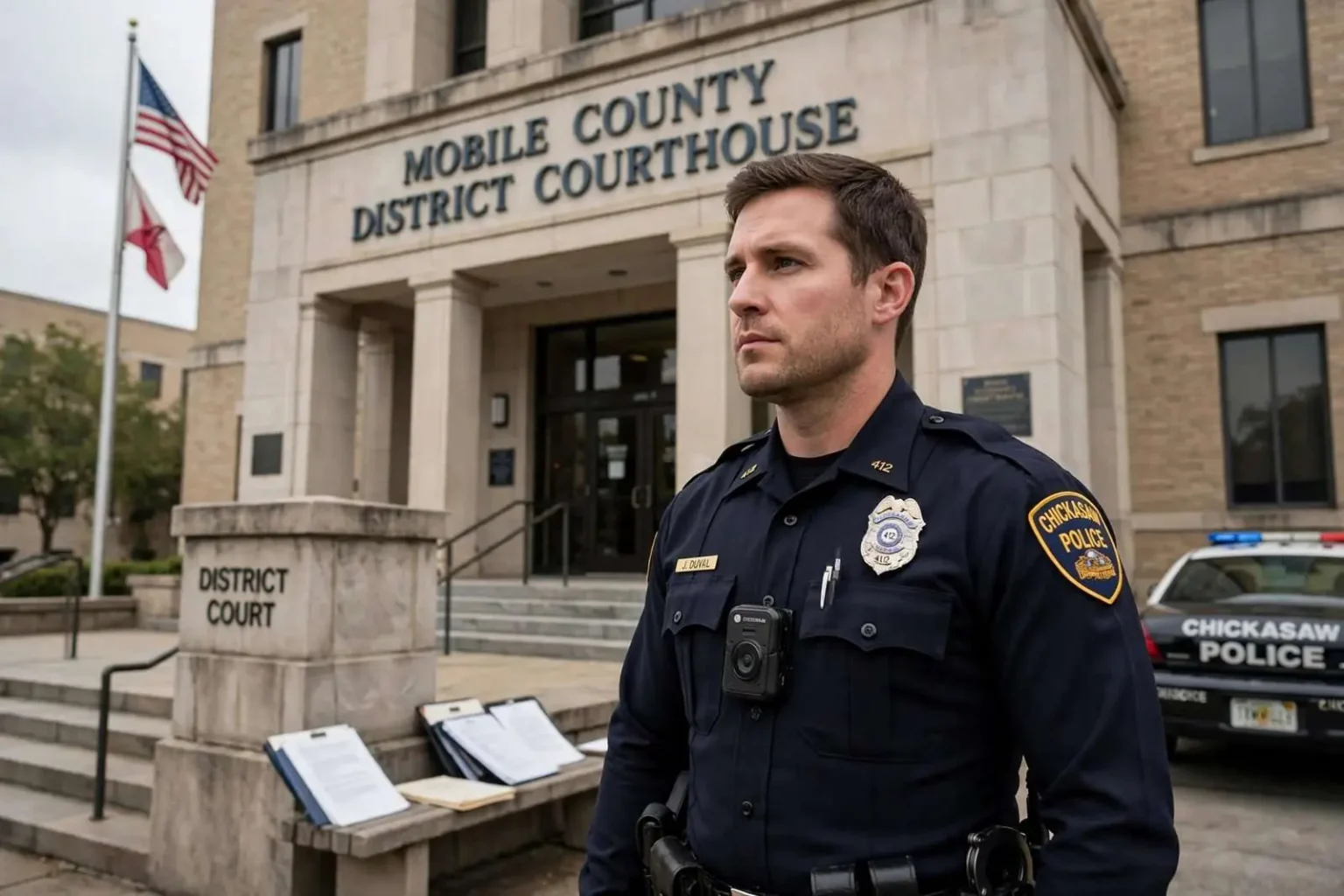
MOBILE, Ala. — A judge has dismissed a criminal case against a Chickasaw police officer, clearing the way for him to return to full duty with the department.
Officer Johnny Duval had faced a misdemeanor trespassing charge after being accused of unlawfully entering a home in October. Court records show the charge has been dismissed due to an evidence issue. Chickasaw Police Chief Chip Parker said Duval is clear to return to full duty.
The dismissal resolves a case that had put an officer from one of Mobile County’s smaller police departments in the middle of a criminal prosecution. Trespassing in the second degree, the misdemeanor tier of Alabama’s trespassing statute, covers unlawful entry or remaining on premises, and carries far lighter penalties than the felony trespassing charges that apply to dwellings under aggravated circumstances.
What an evidence-issue dismissal means
Dismissals based on evidence issues are a routine feature of criminal dockets, and they can occur at any stage before conviction. Prosecutors and judges dismiss cases when evidence problems make a conviction unlikely or a fair trial impossible — witnesses who cannot be located, materials that were not properly handled, records that cannot be authenticated, or gaps between what the charging document alleges and what the proof actually shows.
A dismissal is not a finding of innocence, but it does end the case unless prosecutors choose to refile, which they can do within the statute of limitations. In practice, many evidence-based dismissals end matters permanently, because the underlying problems do not change on refiling. For the defendant, the record shows a dismissed charge rather than a conviction, which matters enormously for employment, licensing and — for a police officer — certification.
Chief Parker’s announcement that Duval is clear to return to full duty indicates the department treated the dismissal as the conclusion of the matter from a personnel standpoint. Departments typically place officers on administrative or modified duty while criminal charges are pending, then restore full duties once the legal question resolves. Whether the department conducted any internal review alongside the criminal case has not been disclosed.
Duval’s career record
Duval has served with the Chickasaw Police Department for about four years. Before that, he worked for the Mobile Police Department, where he was named officer of the month twice, in 2015 and 2017. He has also worked as a school resource officer, a specialized assignment that places officers inside schools to handle campus security, mentoring and law enforcement education.
The officer-of-the-month recognitions at MPD reflect internal commendations typically awarded for performance in specific cases or sustained service — a form of departmental acknowledgment that officers carry with them as they move between agencies. Movement from a large municipal department like Mobile’s, one of the biggest in the state, to a smaller suburban department like Chickasaw’s is a common career pattern in Mobile County, often driven by the broader range of duties smaller agencies offer their officers.
Chickasaw, a city of roughly 6,000 residents squeezed between Prichard and Saraland in Mobile County, operates a compact police department whose officers handle the full range of municipal law enforcement. The city incorporated in 2006 and formed its own police force shortly afterward, making it one of the younger departments in the county.
Alabama’s trespassing law
Alabama’s criminal code divides trespassing into three degrees. First-degree trespassing, a felony, involves knowingly entering or remaining unlawfully in a dwelling or fenced commercial property. Second-degree trespassing — the misdemeanor Duval faced — covers unlawful entry onto premises that are not dwellings, or remaining on property after notice not to. Third-degree trespassing is the violation-level offense for defying posted notice or failing to leave when directed.
Misdemeanor trespassing charges carry modest penalties, typically fines and potential jail time measured in months rather than years. Cases often turn on questions of notice and intent: whether the person knew entry was prohibited, whether there was signage or a verbal warning, and whether the entry was a mistake. Those questions are also where evidence problems most often surface — a missing witness who delivered the warning, an unrecorded conversation, or documentation that does not establish what the state needs to prove.
That is doubly true when the allegation involves a home. Though Duval was accused of unlawfully entering a home, the charge filed was a misdemeanor, indicating prosecutors viewed the circumstances as falling within the lower tiers of the statute. Residential entry cases hinge on testimony about permission and notice, and if that testimony becomes unavailable or unreliable, the case weakens quickly.
The court process behind the dismissal
Misdemeanor cases in Alabama begin in district court, where charges are filed, arraignments held and trials conducted. A dismissal can be entered by the judge or by prosecutors moving to nolle pross the charge. The record of the dismissal appears in the state’s court system, which is how the disposition became public in Duval’s case through court records.
For an officer, the distinction between a pending charge and a dismissed one carries professional weight. Alabama’s Peace Officers Standards and Training Commission can act against an officer’s certification following convictions for certain offenses; a pending misdemeanor charge alone does not trigger decertification, but it can affect duty status and future employment. With the charge dismissed, Duval faces no such consequences from the criminal matter.
The speed with which Chief Parker confirmed Duval’s return to full duty reflects how smaller departments handle these episodes. In a compact agency, an officer on modified duty meaningfully reduces patrol capacity, so the department has strong operational incentives to resolve the matter quickly once the courts do.
School resource officers and department duties
Duval’s background as a school resource officer is a significant part of his service record. SRO assignments place officers on school campuses under agreements between the law enforcement agency and the school district, where their duties blend security, mentoring and classroom instruction on law-related topics. Officers in those roles complete specialized training and are among the most visible members of a department to the community, since students and parents interact with them daily.
Departments value that experience when officers return to patrol or investigations. SRO work builds skills in de-escalation, juvenile matters and community relations that transfer directly to neighborhood policing. In a small department like Chickasaw’s, where every officer’s background shapes what the agency can offer, a veteran with Mobile PD experience and school-based assignments is a substantial asset on the roster.
The Chickasaw department, formed after the city’s 2006 incorporation, has built its ranks largely through officers transferring from larger Mobile County agencies. That hiring pattern gives the department experienced personnel from day one, though it also means the agency inherits the reputations — good and bad — that officers carry from their prior services. In Duval’s case, the record includes MPD’s officer-of-the-month awards in 2015 and 2017, formal recognition within one of the state’s largest departments.
How dismissals affect officers’ records
A dismissed charge leaves a practical footprint even though it ends in no conviction. Arrest records persist, and clearing them requires expungement proceedings under Alabama law, which allows certain dismissed charges to be removed from public records upon petition. Officers and other professionals whose livelihoods depend on background checks often pursue expungement after a dismissal to remove the episode from consideration in future screenings.
Within the department, the question of what appears in the officer’s internal file depends on agency policy. Some departments maintain records of any arrest of an officer and any resulting internal review regardless of court outcome; others treat an uncharged or dismissed matter as closed. Chief Parker’s statement focused on the operational outcome — Duval’s return to full duty — without addressing the file.
For the public, the episode illustrates the mechanics of accountability in a small department. Charges against officers are public record the moment they are filed, and dispositions are equally public when they arrive. The same transparency that publicized the October arrest also documented the dismissal, and the chief’s confirmation of the officer’s return closed the loop on a case that had briefly pulled a Chickasaw patrol officer out of service.
What comes next
With the criminal case dismissed and the chief’s announcement made, Duval resumes the duties he held before the charge — patrol work in a department of modest size where every officer’s presence matters. Unless prosecutors refile, which the evidence issue makes unlikely, the matter is concluded.
The case’s resolution ends a period of uncertainty that began with the October arrest and ran through the court process. For the department, the return of an experienced officer with Mobile PD service, two officer-of-the-month commendations and school resource experience restores full strength to the roster. For Duval, the dismissal and the chief’s public confirmation amount to a cleared name and a return to the career he has built across two Mobile County agencies.
Residents of Chickasaw will see him back on duty as before. The court record will show what it shows: a misdemeanor trespassing charge, filed and dismissed due to an evidence issue, with no conviction and no further proceedings.
