Trial set to begin for Pensacola man accused of carjacking, rape
The trial is set to begin for Joshua Edwards, accused in an Escambia County arrest report of carjacking and raping a woman in the Pensacola area.
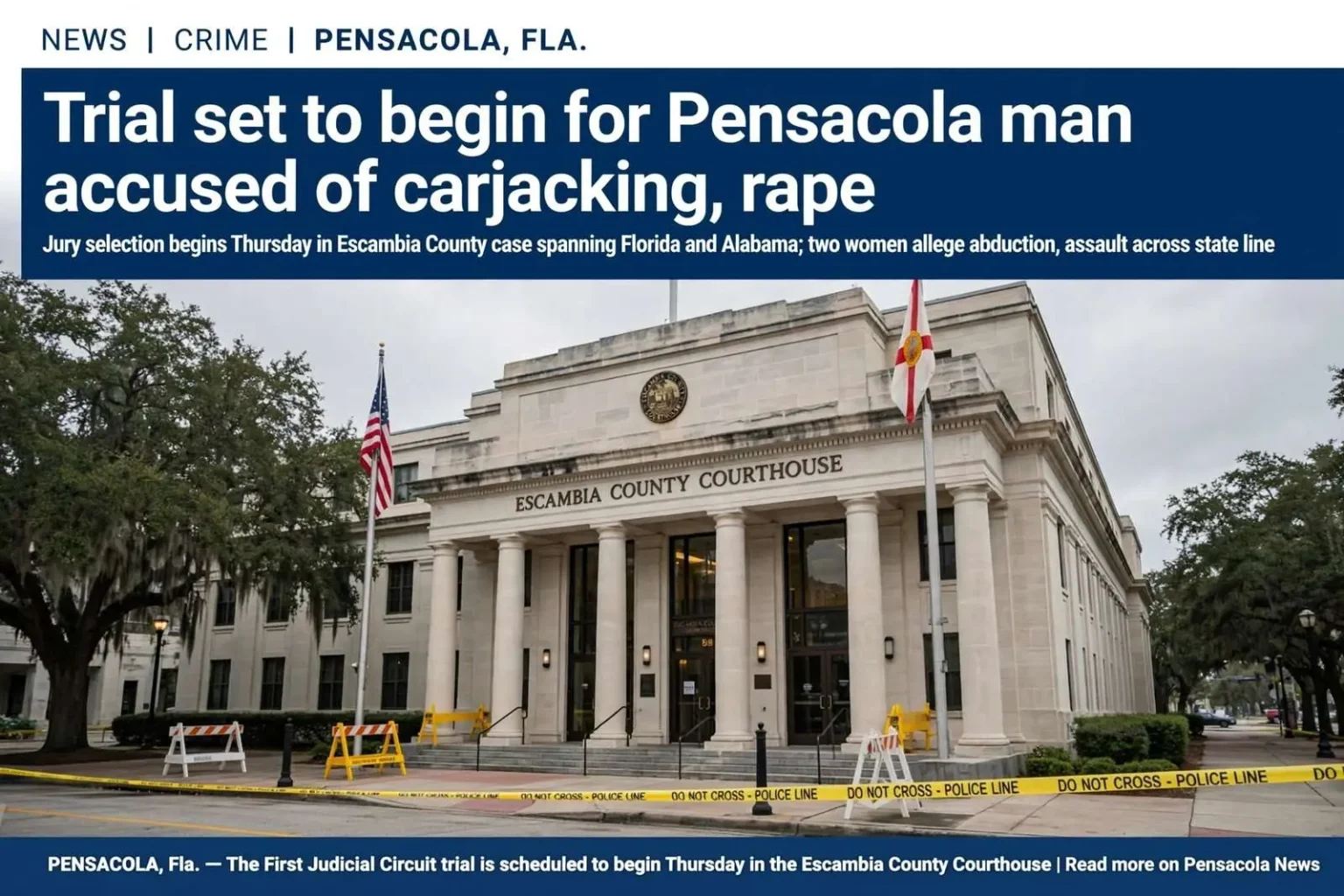
PENSACOLA, Fla. — The trial is set to begin Thursday for a Pensacola man accused of a violent crime spree that began with a carjacking at a gas station and ended with his arrest a few hours later near a westside shopping center, according to the Escambia County arrest report in the case.
Joshua Edwards faces charges stemming from the abduction and rape of a woman who was pumping gas into her car at a Circle K at the intersection of Jackson Street and New Warrington Road. According to the arrest report, Edwards pulled a pistol on the woman, forced her into her own vehicle and drove away with her inside the car.
The report states that Edwards drove the victim to Bill Dixon Park, where he allegedly raped her at gunpoint. The park, located in the western part of Pensacola, became one of the key crime scenes in the case as investigators reconstructed the route of that night.
A drive across two states
The ordeal did not end at the park. Deputies said Edwards also drove the victim across the state line into Lillian, Alabama, a small unincorporated community in Baldwin County just over the border from Escambia County, and then back into Florida. The cross-border route meant that investigators on both sides of the state line had a stake in the case, and it added miles and hours to a night that began with an ordinary stop at a neighborhood gas station.
During the drive, deputies said, Edwards forced the victim to take narcotics. The allegation became part of the lengthy list of charges built from the arrest report, adding to the counts connected to the carjacking and the sexual assault at the park.
For Escambia County investigators, cases that cross state lines bring added complexity. Lillian sits at the southern tip of Baldwin County, Alabama, connected to the Pensacola area by U.S. 98 and the Perdido Bay bridges, and deputies here work regularly with Baldwin County authorities and Alabama law enforcement when crimes trace that route.
A second victim on Fenceline Road
The arrest report describes a second confrontation that night. After driving back into Escambia County, Edwards allegedly approached a woman outside her home on Fenceline Road and demanded her keys at gunpoint. He then drove off in her vehicle as well, leaving the two women together at the home.
The second woman let the first victim into her house and called 911, according to the report. That call set in motion the police response that would end the night’s violence, and the Fenceline Road encounter gave investigators a second scene, a second stolen vehicle and a second witness account to work from.
The two women’s accounts, along with the physical evidence gathered from the gas station, the park and the residential street, formed the backbone of the case detectives assembled in the hours after the 911 call. The speed with which the sequence of events was documented reflected the seriousness with which the sheriff’s office treats armed carjackings and sexual assaults.
The arrest
According to the arrest report, Edwards is a member of the Aryan Brotherhood, a detail investigators noted in the document. Gang affiliation is routinely documented in arrest reports because of its bearing on sentencing enhancements and on how the Department of Corrections classifies an inmate after conviction.
Deputies captured Edwards a few hours after the 911 call, taking him into custody behind a shopping center near the Walmart on Blue Angel Parkway. The arrest location is in the southwest part of Escambia County, a commercial corridor not far from the neighborhoods where the night’s crimes began and ended.
During the arrest operation, deputies recovered a Kel-Tec 9mm pistol in the area. The pistol, a compact firearm made by the Cocoa, Florida-based manufacturer, matched the weapon described in the women’s accounts, and its recovery gave prosecutors physical evidence to pair with the testimony about the gunpoint crimes.
What the charges mean
Armed carjacking and armed sexual battery are among the most serious felony charges in Florida’s criminal code, each carrying the possibility of decades in prison, and the use of a firearm during the commission of those crimes adds mandatory minimum sentencing under the state’s 10-20-Life law. That statute requires judges to impose at least 10 years for displaying a firearm during a felony, 20 for firing one, and 25 years to life for shooting and injuring someone.
Because Edwards is alleged to have committed crimes against two victims, in multiple locations, across two states in a single night, prosecutors typically file an array of counts — kidnapping, armed sexual battery, armed carjacking, and drug-related charges among them — and the case proceeds through circuit court in Pensacola. A defendant convicted on multiple counts serves the sentences according to how the judge structures them, and the mandatory firearm minimums constrain that discretion.
The First Judicial Circuit State Attorney’s Office, which prosecutes felony cases in Escambia County, will present the evidence to a jury beginning Thursday. Victim advocates with the office work with survivors of sexual violence throughout the court process, and Florida law provides protections that allow victims of sexual offenses certain rights during testimony and proceedings.
The neighborhood sites of the case
The geography of the case traces a familiar loop for Pensacola residents. The Circle K at Jackson Street and New Warrington Road sits in a busy westside commercial area where gas stations, restaurants and shops serve surrounding neighborhoods. Jackson Hill and the surrounding streets are among the older parts of the city, and the gas station at that corner is a routine stop for drivers moving between Navy Boulevard and the areas farther west.
Bill Dixon Park, where the assault allegedly occurred, is a city park serving the western part of Pensacola, the kind of neighborhood green space families use for outings on weekends. Law enforcement officials note that parks and other public places are frequently documented as crime scenes when perpetrators move victims to locations away from witnesses, which is what the arrest report alleges happened here.
Fenceline Road runs through a residential section of unincorporated Escambia County, where the second woman encountered Edwards outside her own home. The Blue Angel Parkway corridor, where the arrest ended the night, is named for the Blue Angels, the Navy flight demonstration squadron based at nearby Naval Air Station Pensacola, and it is one of the main commercial arteries of the county’s southwest.
The court process ahead
With jury selection set to begin Thursday, the trial will unfold in the Escambia County courthouse in downtown Pensacola, where circuit judges handle the docket of felony trials for the county. The proceedings are expected to center on the accounts of the two women, the physical evidence recovered from the scenes and from Edwards at the time of his arrest, and the forensic work that connects the defendant to each location along the route.
Trials of this kind typically last days rather than weeks, though multi-count cases with two victims and crimes spanning two states can involve a lengthy witness list, including deputies, crime scene technicians, forensic nurses and analysts who processed the narcotics allegation. The defense, meanwhile, will test every link in that chain.
For the residents of the neighborhoods along the route — from the gas station on New Warrington Road to the homes on Fenceline Road — the trial brings the night’s events back into public view. The two women who survived that night, and whose 911 call from a Fenceline Road home set the response in motion, are expected to be central to the state’s case as it is laid out before an Escambia County jury.
How law enforcement assembled the case
The speed of the arrest reflected a coordinated effort between patrol deputies and investigators working from a rapidly developing description of events. After the 911 call came in from the Fenceline Road home, deputies had two victim accounts, a description of the stolen vehicle and a chain of known locations stretching from the Circle K where the night began to the residential street where it paused. That information was broadcast to units across the southern half of the county within hours.
Finding the suspect behind a shopping center near the Walmart on Blue Angel Parkway placed the arrest in one of the busiest retail corridors in southwest Escambia County. Deputies recovered the Kel-Tec 9mm pistol in the area as well, closing the loop on the firearm that the women said was pointed at them at multiple points during the night. Weapon recovery matters enormously in these cases, both for the prosecution’s proof and for the mandatory minimum sentencing questions that follow a firearm conviction.
The narcotics allegation added another investigative thread. Cases in which victims are forced to take drugs require toxicology work on top of the standard forensic processing, and the results become part of the evidence package reviewed by the State Attorney’s Office before trial. The cross-state driving also meant coordinating with authorities in Baldwin County, Alabama, to document the portions of the route that fell outside Florida jurisdiction.
Support available to the victims
Escambia County has a network of victim services that comes into play in prosecutions of this kind. The State Attorney’s Office maintains a victim advocate program that shepherds survivors through each stage of a criminal case, from initial interviews through trial testimony, and Florida’s constitution enshrines specific rights for crime victims, including the right to be informed of proceedings and to be heard at sentencing.
Sexual assault survivors in the Pensacola area also have access to specialized forensic examinations and counseling resources through area medical providers and nonprofit organizations. Those services exist precisely for cases like this one, where the path from a 911 call to a jury verdict can stretch over many months and the people at the center of the case need support that outlasts the news cycle.
As testimony begins Thursday, the court will weigh the accounts the two women gave on the night of the crimes against the physical evidence — the vehicles, the pistol, the scenes at the gas station, the park and the Fenceline Road home. The jury’s verdict will determine how the night that began at a West Pensacola gas pump is measured under Florida law, in a case that has moved from a 911 call to a courtroom in the span of a few months.