Trump Campaign Event Announced for Mobile Civic Center
A presidential campaign rally was set for the Mobile Civic Center Theater in August 2015, with free tickets drawing early attention downtown.
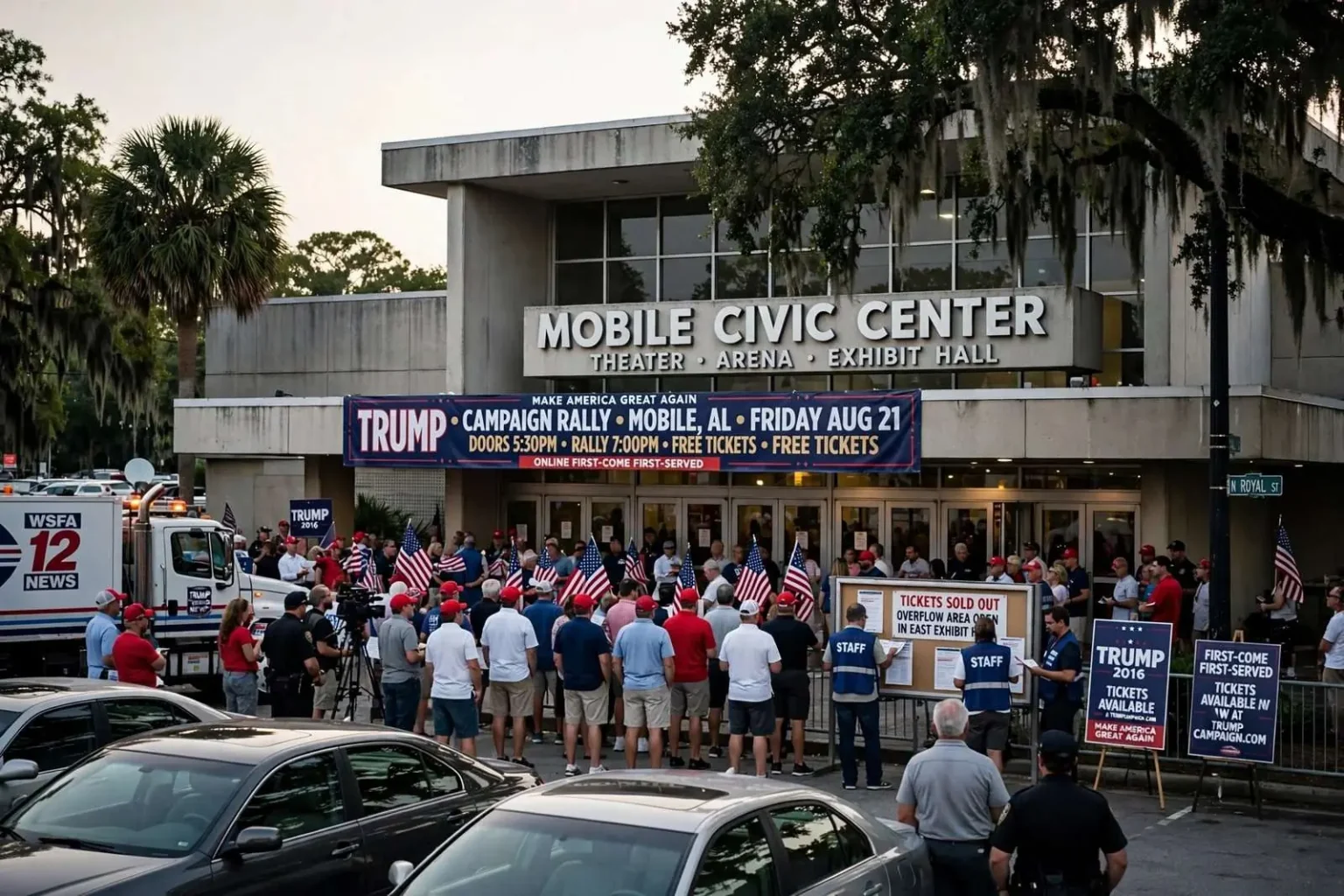
Mobile was added to the campaign trail in August 2015 when organizers announced a presidential candidate pep rally at the Mobile Civic Center Theater. The event was scheduled for a Friday evening, with doors set to open at 5:30 p.m. ahead of a 7 p.m. start. Admission was free, but attendees needed a ticket to get inside. Tickets were distributed online on a first-come, first-served basis, and organizers set up an overflow area in the East Exhibit Hall of the Civic Center in anticipation of a large turnout — a hedging move that, as it turned out, badly underestimated what was coming.
The visit marked the first stop in Mobile by a major-party presidential contender since the opening round of nationally televised primary debates that summer, and it arrived with the candidate — Donald Trump, whose campaign announced the stop — holding a commanding position in the race. National polling at the time showed Trump with a substantial lead over the rest of the Republican field, and state-level surveys suggested similarly strong support among Alabama Republican voters, whose party had grown reliably conservative across every statewide office. Alabama was not a battleground in the general-election sense, but its early primary on the regional “SEC primary” calendar made it a worthwhile stop for candidates courting Southern conservative voters.
City officials and downtown business owners took note of the announcement, anticipating a jump in foot traffic and interest in the Civic Center complex, a venue more accustomed to hosting conventions, trade shows and local sporting events than presidential politics. The Civic Center, on the western edge of downtown, had for decades been Mobile’s principal indoor arena and meeting space, home to minor-league hockey and basketball, high school graduations, concerts and the city’s Mardi Gras balls. A rally by the front-runner for a major party’s presidential nomination was a different order of event — and different in kind from the political visits the city had seen in recent cycles.
A Crowding Problem Measured in Days
Interest built quickly once tickets went live. Local media coverage amplified the announcement, social media did the rest, and within days the demand for seats had swamped the Theater’s capacity. What had been booked as a Theater event — a hall of some 1,900 seats — was on its way to becoming the largest political gathering Mobile had hosted in modern memory. The overflow area in the East Exhibit Hall was announced in the same breath as the original plan, an acknowledgment by organizers that free tickets online could draw a crowd no indoor room in the city would hold.
For Mobile, the announcement offered a rare moment in the national spotlight. Local leaders said they expected the rally to bring visitors from across the region — the Florida Panhandle and south Mississippi both sit within an hour’s drive of downtown — and Civic Center staff began preparations for what was expected to be one of the larger single-night crowds the venue had hosted in recent years. Downtown restaurants and bars readied for a pre-rally and post-rally crowd, the kind of spontaneous commerce that a convention calendar rarely produces in late summer.
The rally would ultimately outgrow its original venue entirely, a testament to how quickly interest built in the days following the initial announcement. With demand running far past anything the Civic Center could hold, the campaign moved the event to Ladd-Peebles Stadium, the 40,000-seat football stadium in the Toulminville area of the city that hosts the annual Senior Bowl and the Mobile Alabama Bowl. The relocation turned a pep rally into a stadium show, and the resulting crowd — tens of thousands of people on an August Friday night — confirmed that the online ticket demand had been no glitch. But in the immediate aftermath of the news, the story for many Mobile residents was simpler: a nationally known figure was coming to their city, and getting a seat meant paying close attention to when tickets went live.
Alabama in the 2015 Campaign Season
The Mobile stop came amid a broader wave of national campaign activity across Alabama that same month. Multiple presidential candidates scheduled appearances in the state within days of one another, part of an early push to court Southern voters ahead of the primary season. A state party luncheon and stops by other contenders were among the events planned in the surrounding weeks, underscoring how much attention Alabama was drawing early in the election cycle — a level of engagement the state rarely enjoyed before its primary was moved onto the March “SEC primary” calendar, which grouped Alabama’s vote with other Southern states and gave the region real leverage in the nominating fight.
The Civic Center and Its Place in Mobile Life
The choice of the Civic Center as the anchor for the announcement said something about how Mobile planned for the unexpected. The complex — an arena, a theater and exhibit halls under one roof — has been the city’s multipurpose stage since the 1960s, designed to hold everything from touring shows to trade expositions. Its Theater had hosted political speakers and town halls before, and its Exhibit Halls could absorb overflow in a way few venues in the city could match. The East Exhibit Hall overflow plan was the Civic Center doing what it was built to do: flex to demand.
That flexibility proved prescient. When the event moved to Ladd-Peebles Stadium, it left the Civic Center’s role reduced but still relevant to the story — the venue where a stadium-sized crowd had first been imagined as an overflow room. The episode also gave the city a preview of the logistics a mega-rally requires: parking plans, security coordination with the Secret Service, traffic control around a stadium that usually fills for Friday-night football in the fall rather than late-summer political events.
What the Rally Meant for the City
For a city of Mobile’s size, hosting a front-runner’s stadium rally carried practical benefits beyond the event itself. The national media presence — satellite trucks, traveling press, cable-news hits delivered against the backdrop of a packed stadium — projected the city’s name to a national audience at no cost. Business owners in the vicinity of both venues reported strong nights, and hotels across the downtown and west Mobile corridors absorbed visitors who might otherwise have passed through without stopping.
The rally also registered politically. Alabama would go on to give Trump one of his strongest primary performances that spring, and the stadium crowd — recalled since as one of the largest single campaign events of the entire 2016 cycle — became part of the campaign’s own narrative about the depth of its support. For local Republicans, the turnout validated Alabama’s early position in the primary calendar; for the city, it demonstrated that Mobile could stage an event of national scale on short notice.
There were, inevitably, complications: traffic that backed up for hours around the stadium, long security lines under an August sun, and a crowd far beyond the number of seats — with thousands watching from the open end zone and standing room along the concourses. But the dominant memory for most who attended was scale. Mobile had seen presidents and candidates pass through before, but a single campaign drawing tens of thousands to a Friday-night rally was without local precedent, and it reset expectations for what political events in the city could look like.
From Announcement to the General Election
Looking back from later in the cycle, the August 2015 announcement stands as the beginning of Mobile’s unlikely role in a presidential campaign that would carry the eventual nominee to the White House. The city would see the candidate again — and the region’s deep Republican margins made Alabama a reliable stop for GOP campaigns through the fall. The Civic Center announcement, the ticket scramble, the venue switch to Ladd-Peebles and the stadium crowd became a local chapter of national political history, retold each time the campaign’s largest rallies are recounted.
The attention had a practical dimension for campaign watchers as well. Candidates decide where to spend scarce time based on signals, and a stadium-sized turnout in a state that was never going to be contested in November sent exactly the signal a front-runner wanted: proof of enthusiasm that transcended the early states where campaigns usually test their strength. Alabama Republicans, for their part, got an up-close look at the field’s most unorthodox contender months before their primary, and the party organizations that hosted the month’s other visits — a luncheon here, a forum there — found their own events measured against the spectacle in Mobile.
For Mobile’s civic institutions, the sequence left a practical legacy as well: a demonstration that the city’s venues, from a Theater designed for hundreds to a stadium built for football, could be re-purposed on days’ notice to meet demand nobody had planned for. And for the residents who clicked for tickets the moment they went live, the memory endures of a Friday evening in August when a presidential campaign — briefly, improbably — made their city the center of American politics.