Overwhelming Demand Moves Trump Rally to Ladd-Peebles Stadium
Ticket demand for a Mobile campaign rally forced organizers to relocate the event from a 1,950-seat theater to Ladd-Peebles Stadium.
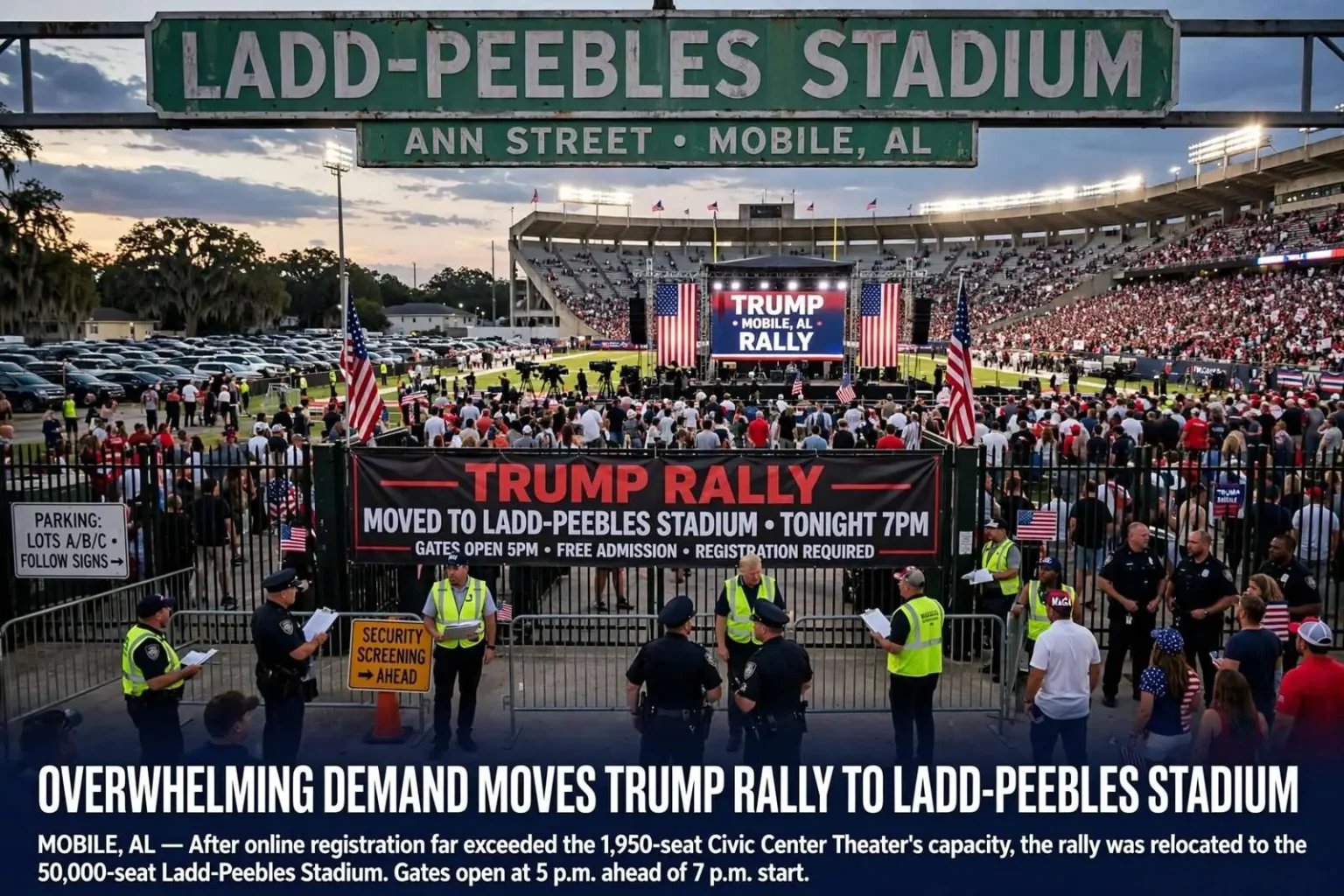
A campaign rally originally planned for the Mobile Civic Center Theater was relocated to Ladd-Peebles Stadium after ticket demand far outpaced the venue’s capacity, organizers announced days before the scheduled event. The venue switch — from a theater to a football stadium — was a dramatic measure of the attention a single campaign stop had generated along the Gulf Coast.
The Civic Center Theater seats roughly 1,950 people. Once free tickets went live on an online registration platform, requests poured in well beyond that number, prompting a scramble to find a larger space capable of accommodating the crowd. Organizers had planned for a capacity-style political event; the registration numbers told them within hours that Mobile had other plans.
Ladd-Peebles Stadium, the storied athletic venue on Ann Street that has hosted college football rivalries, high school championships and the Senior Bowl for decades, offered the answer. The stadium can hold up to roughly 50,000 people, giving organizers enormous headroom compared to the original site. The move multiplied the available capacity by more than 25 times — the difference between a theater crowd and one of the largest gatherings the city can host.
Word of the venue change spread quickly through word of mouth and social media in the days leading up to the event. Free tickets obtained through the online platform late in the week showed Ladd-Peebles listed as the new location, with gates set to open at 5 p.m. ahead of a 7 p.m. start. Residents who had registered for the Civic Center checked their tickets, noted the change, and made new plans for an evening that now involved stadium parking, security lines and a crowd measured in tens of thousands.
Staging a Rally at a Football Stadium
Local officials and stadium staff moved quickly to prepare the facility, coordinating parking, security and crowd flow for what was expected to be one of the larger political gatherings in the city’s history. A stadium event is a different operational animal from a theater event: parking lots instead of parking decks, entry gates instead of lobby doors, and a security footprint that scales with a crowd twenty-five times the size originally expected.
Ladd-Peebles has long served as a gathering point for the community, hosting the Senior Bowl, the annual Alabama-vs-Auburn high school all-star matchup, and decades of local prep football rivalries. The stadium’s operators know how to move a big crowd — it is what the venue does on autumn Friday and Saturday nights — but turning it over to a presidential campaign event on short notice was an unusual use of the space. Stadium officials said they were equipped to handle it, given their experience managing large crowds for sporting events.
For ticket holders who had already secured seats at the Civic Center Theater, the move meant a change of plans but also a much less restrictive cap on attendance. No one would be turned away for lack of room; the question shifted from whether a seat existed to whether the holder wanted to stand in a stadium concourse rather than sit in a theater row. Many longtime Mobile residents noted the familiarity of the venue — the same place where they had watched high school championships and January’s Senior Bowl would now host a political rally.
A Venue With Deep Local History
Ladd-Peebles Stadium occupies a particular place in Mobile’s civic life. Opened in the heart of the city on Ann Street, it has been the stage for the Senior Bowl — the premier college football all-star game and a fixture of the NFL draft calendar — as well as generations of high school football, college matchups and community events. For decades, the stadium’s stands have been where the city gathers when the occasion is big.
A political rally fits that tradition in scale if not in kind. The stadium’s open bowl, its press facilities and its parking infrastructure were built for crowds that arrive by the tens of thousands, and those features transfer directly to campaign events. The stage setup differs — a rally platform rather than a gridiron — but the mechanics of ingress, security and crowd management are the ones the venue’s staff practice every season.
The Civic Center Theater, by contrast, is an indoor performing arts space — intimate, seated and air-conditioned. It was a reasonable first choice for a campaign stop, and the fact that its 1,950 seats were overwhelmed almost immediately by online registrations speaks to the size of the crowd organizers ultimately faced. Rather than hold an event that thousands would be turned away from, organizers moved the entire production to the biggest stage available.
What the Demand Meant
Demand of that scale for a campaign visit said something about the political moment along the Gulf Coast. Free tickets are easy to request and no-shows are common, so registration numbers always overstate actual attendance — but the sheer volume of requests that forced a venue change told organizers that the interest was not marginal. A rally that outgrows a theater and forces a move to a 50,000-seat stadium is, by any measure, a major political event for the host city.
Planning the Evening
The logistics of the relocated rally came together in a matter of days. Parking plans had to be drawn for a crowd an order of magnitude larger than anything the Civic Center event would have drawn; security coordination expanded to include the campaign’s own detail alongside local law enforcement; and stadium staff readied concessions, restrooms and the public-address system for an event with no ticket turnstiles in the traditional sense. Free-entry stadium events present a particular challenge: gates open at 5 p.m., but the size and arrival pattern of the crowd is an estimate rather than a certainty.
Campaign rallies run on energy, and the stadium format feeds it. A crowd of tens of thousands inside a football bowl, with a stage at one end and cameras sweeping the stands, produces the kind of visual that becomes the image of the event — the same visual template as a college football Saturday in a venue built for exactly that scale.
For attendees, the practical advice was the same as for any big stadium event: arrive early, expect security screening, park according to signage and plan for the crowd after the event ends. Gates at 5 p.m. and a 7 p.m. start gave attendees a two-hour window to get in, find their spots and be seated for the program’s opening.
Mobile’s History With Big Political Events
Mobile has hosted its share of major political gatherings over the decades, and the city’s civic venues — the Civic Center, the stadium, and the convention infrastructure downtown — have long made it a stop for campaigns touring the Gulf Coast. What set this event apart was the manner of the escalation: an ordinary theater booking transformed within days into a stadium rally by sheer ticket demand, with the venue change itself becoming part of the event’s story.
The episode also showcased the city’s ability to pivot. Between organizers, the Civic Center, stadium operators and city officials, a venue change was executed in days — parking plans redrawn, security scaled up, and the public informed through the same online ticketing platform that had registered the crowd in the first place. Cities that cannot execute that kind of switch lose the event entirely; Mobile moved it to a bigger stage.
By the time gates opened at Ladd-Peebles at 5 p.m. on the day of the rally, the story of the event had already been written in miniature: a city that wanted in — 25 times more than the original venue could hold — and a city equipped to put on the show at the size the demand demanded. The stadium that hosts the Senior Bowl each January added a presidential campaign rally to its long resume of occasions when Mobile came together, in numbers, in one place.
The ticketing platform at the center of the venue switch deserves its own note in the story. Registration systems have transformed how campaigns gauge and manage demand for events: tickets are free but tracked, attendance is estimated before the doors open, and overflow decisions can be made days in advance rather than discovered at the door. In this case, the registration data made the case for the move unarguable — the Civic Center Theater’s capacity was exceeded by requests almost as soon as the registration link went live, and the numbers kept climbing.
That data also shaped expectations on the day of the event. Stadium operators and city officials knew they were preparing for a crowd that had, at minimum, overwhelmed a 1,950-seat venue, and they planned accordingly. Experience from Senior Bowl weekends and big high school playoff games gave the venue’s staff benchmarks for how many people arrive how early, and how the flow through the gates should be managed.
For the attendees who made the switch along with the event — trading a theater seat for a spot in the stands — the evening became part of Ladd-Peebles’ long story as the city’s gathering place. The stadium has hosted championships, all-star games and community celebrations for generations, and a presidential campaign rally joined that list in the same way: by drawing a bigger crowd than any other building in town could hold, and by giving the city an occasion to come together on the scale only a stadium allows.
When the lights went up and the program began at 7 p.m., the move that started as an overflow problem had become part of the event itself — a rally relocated to the biggest stage in Mobile by a demand no theater could contain, staged in the venue where the city has always held its largest gatherings, with gates at 5 and a crowd that filled the bowl on Ann Street under a summer evening sky.