
Two Former Mobile Police Officers Charged With Stealing From Impound Lot
Two ex-Mobile police officers face theft charges for independently stealing from the Virginia Street impound lot; chief and DA back the investigation.
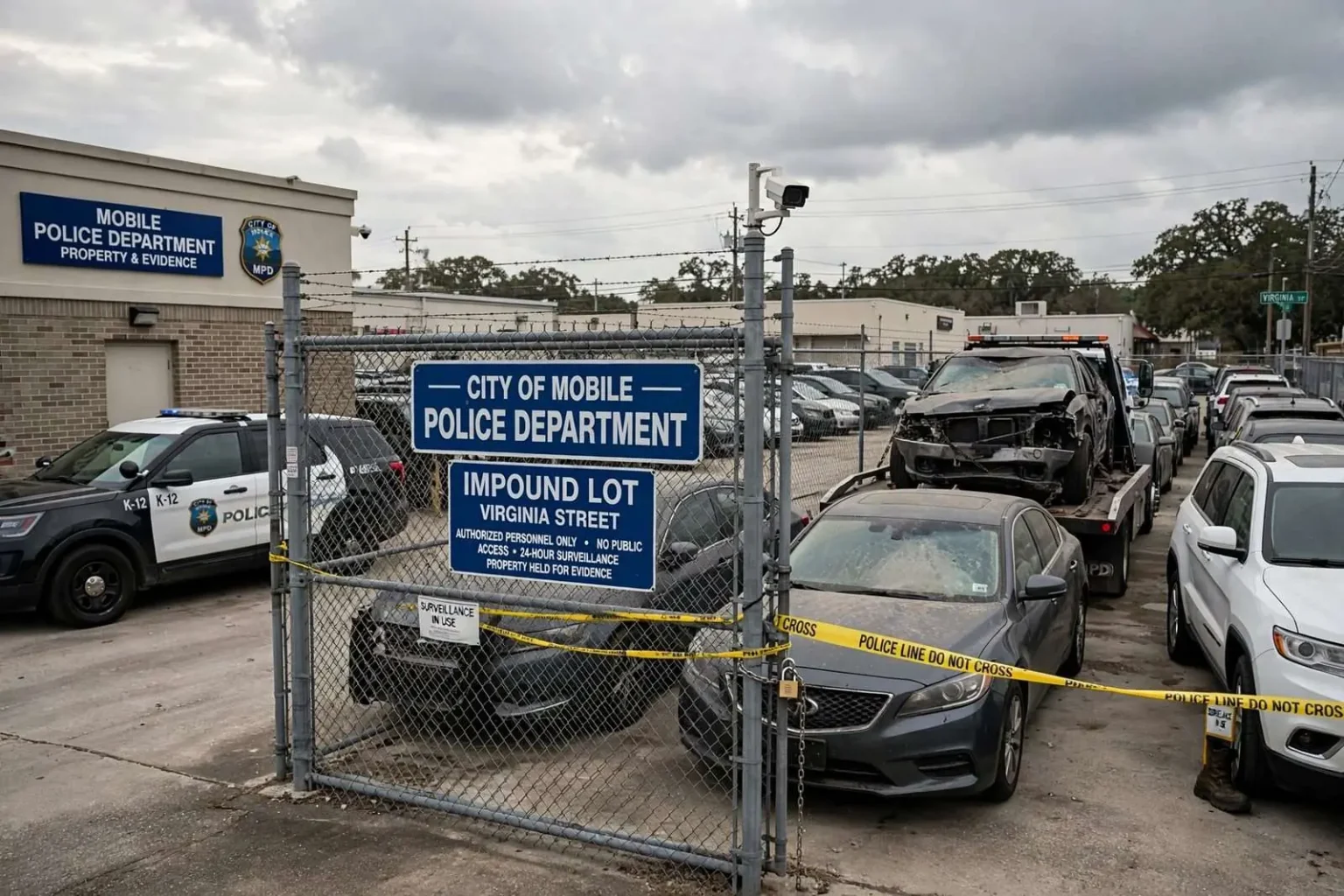
Mobile’s police chief and the county district attorney say they are satisfied with the investigation that led to theft charges against two former Mobile Police officers. Former Sgt. Mark Hearn and former Officer Alex Westry were arrested and charged with stealing items from the department’s impound lot off Virginia Street. The arrests closed out an internal review that stretched across several months and ended with two separate cases rather than one.
Hearn resigned in February while under an internal investigation. Westry was fired by the department earlier in May. By the time charges were announced, both men were already out of the department, but prosecutors determined the evidence supported criminal charges for each of them individually.
Independent Thefts, DA Says
District Attorney Ashley Rich said the two men were not working together. One had worked directly in the impound unit while the other worked in the radio room, and each is accused of taking items from the lot independently. That distinction matters both legally and publicly, because it shows the department was dealing with two separate integrity failures rather than a coordinated scheme inside its ranks.
The impound lot serves as the holding point for vehicles towed after accidents, arrests and other incidents, along with personal property that officers recover during the course of their duties. Property of that kind is supposed to be logged, secured and tracked until it is claimed or disposed of according to procedure, which is why any allegation of theft from the facility draws immediate scrutiny.
The Chief Responds
Chief Lawrence Battiste acknowledged that an officer facing criminal charges reflects poorly on the department, but said he was proud of how the cases were investigated. He stressed that accountability applies inside the department just as it does anywhere else in the city.
“We hold those individuals who swore an oath, to wear the uniform, [to] hold them accountable, by the same standards we would hold the rest of the community,” Battiste said. The message was aimed at both the public and the rank and file: a badge is not a shield from prosecution, and the department intends to act when its own employees cross the line.
The Department’s Internal Safeguards
Rich agreed the department acted appropriately, noting MPD brought the investigation forward and has strong internal affairs measures in place to ensure employees follow the law. That point is central to how city officials want the public to understand the case. The charges did not result from an outside complaint or an external probe; they grew out of the department’s own review of its personnel and property procedures.
Internal affairs divisions exist to investigate misconduct allegations against sworn officers, and their work is often invisible to the public until an arrest or termination results. In this case, the process produced two different outcomes for two employees — a resignation under investigation in one instance and a termination in the other — before prosecutors took over the criminal side.
City officials say that structure is working as designed. When allegations surface, they are documented, investigated and referred to prosecutors when the evidence warrants. The alternative — letting suspicious property discrepancies slide — would cost the department far more credibility than a public arrest ever could.
What Happens Next
The cases now move through the court system, where the two former officers will answer the theft charges filed against them. Prosecutors have not indicated how quickly the cases will proceed, and defense outcomes will be decided in court rather than in the press.
For the department, the immediate work involves continuing to audit property procedures at the impound lot and making sure the chain of custody for stored vehicles and belongings remains airtight. Agencies across the country treat impound property as one of the highest-risk areas for misconduct precisely because of the volume of unattended valuables that pass through such facilities.
Residents who interact with the impound lot — reclaiming a towed vehicle or retrieving personal items from a wreck — depend on the integrity of that system. Officials say the public should expect logged paperwork, supervised access and accountability when something does not add up.
Why Police Accountability Cases Hit Hard
Every police misconduct case carries a double burden: the underlying crime and the erosion of public trust. Mobile’s leadership clearly understands that distinction. Rather than minimizing the arrests, the chief and the district attorney addressed them directly, in public, with a shared message that the system functioned the way it should.
That approach reflects a broader shift among American police departments toward transparency in internal misconduct cases. Agencies have learned that silence breeds suspicion, while open acknowledgment — even of embarrassing facts — tends to preserve credibility. By confirming that the investigation originated inside MPD, both officials pushed back against the notion that officers police themselves only when forced to.
The case also demonstrates the practical role of the district attorney’s office in reviewing police-related offenses. Prosecutors independently evaluated the evidence developed by the department, distinguished between the two defendants’ roles and filed charges accordingly. That separation between internal discipline and criminal prosecution is a key structural safeguard.
The People Behind the Procedure
For the officers and staff who work honestly every day, cases like this carry a personal sting. Thousands of law enforcement employees in Mobile County do their jobs without incident, yet headlines about stolen property affect how the entire profession is perceived. Battiste’s comments were aimed in part at that audience — an assurance that wrongdoing is the exception, and that the department will keep proving it.
Community advocates, meanwhile, tend to view such prosecutions as a benchmark. If the system responds to misconduct by officers as firmly as it responds to misconduct by anyone else, trust has a foundation to build on. If it does not, skepticism deepens. The arrests of Hearn and Westry, and the tone of the announcements that followed, were designed to land on the right side of that line.
What remains to be seen is how the courts resolve the charges and whether any policy changes follow at the impound lot. But the department’s leadership has already stated its position clearly: the uniform comes with a higher standard, not a lower one.
A Closer Look at the Virginia Street Facility
The impound lot off Virginia Street sits near the center of Mobile’s police operations, handling a constant flow of vehicles that arrive after wrecks, arrests, abandonment complaints and evidence seizures. Each one arrives with keys, registration papers and often personal belongings inside, all of which must be inventoried and stored until properly claimed. The volume alone makes strict documentation essential.
When property disappears from a facility like that, the trail is usually discoverable — intake logs, key control records, camera footage and witness recollections all leave traces. It is precisely this kind of paper trail that internal investigators rely on when discrepancies surface, and it is what allowed MPD to build cases against two former employees who held very different assignments.
The Roles at the Center of the Case
According to the district attorney, one of the accused had worked directly in the impound unit, giving him day-to-day access to the lot itself. The other worked in the radio room, a position that put him inside department communications rather than at the facility. Prosecutors say each man is accused of taking items independently, with no cooperation between them.
That detail is important for the public’s understanding of the case. It rules out the most troubling scenario — officers conspiring together to exploit a city facility — and instead points to two individual lapses in judgment that happened to surface in the same investigation window.
It also underscores how the department’s review reached beyond the obvious suspect. Rather than stopping at the impound unit, investigators evidently followed the evidence wherever it led, including to an employee whose job had little direct connection to the lot. Thoroughness of that kind is what internal affairs work is supposed to look like.
Moving Forward
Mobile’s leadership has framed the case as proof that its accountability structure functions. The chief expressed pride in the investigation, the district attorney endorsed the department’s handling, and the cases now belong to the courts. For residents, the takeaway is straightforward: property that enters the city’s impound system is supposed to be protected, and when it is not, the people responsible will face the same justice system as anyone else.
The department will continue its internal reviews, and any procedural changes at the lot will come through the normal chain of command. What began as a quiet internal inquiry has ended, for now, in two arrests and a public statement of standards — a sequence city officials clearly hope residents will remember the next time the subject of police accountability comes up.