Two Killed in Separate Crashes Along Same Stretch of U.S. 43 in Washington County
Alabama troopers say two people died in separate crashes hours apart along U.S. 43 in Washington County's Wagarville community Saturday morning.
Two people died in separate single-vehicle crashes along the same stretch of U.S. Highway 43 in Washington County on Saturday morning, according to the Alabama Law Enforcement Agency. The two wrecks, hours apart and miles from each other, claimed lives in one of southwest Alabama’s most heavily traveled rural corridors.
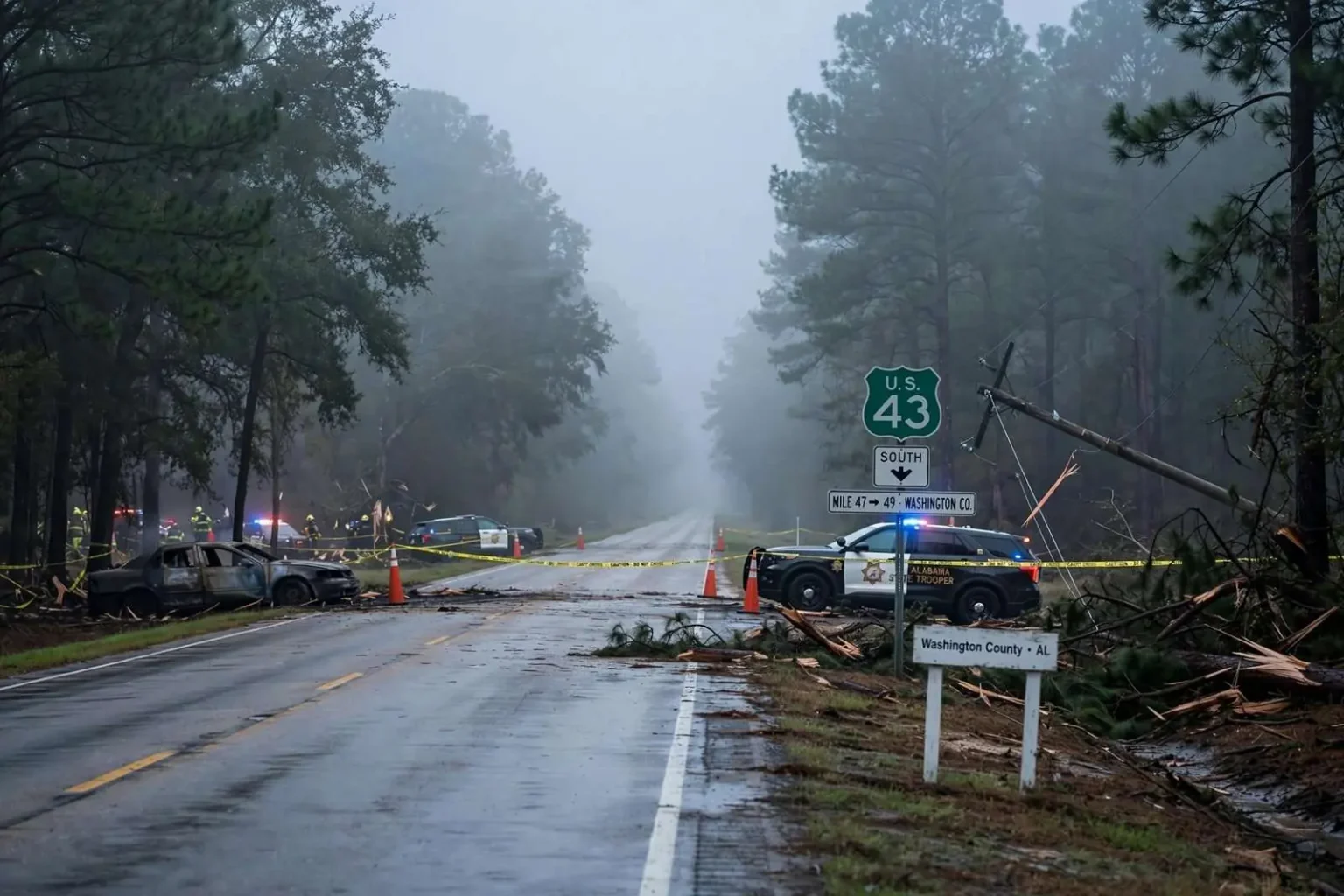
The first crash happened around 5 a.m. in the Wagarville community. Troopers said the driver of a 2007 Mercury Grand Marquis was traveling south near the 47 mile marker when the car left the roadway, struck a tree on the northbound side of the highway, and caught fire. The driver was pronounced dead at the scene, and authorities had not released that person’s name pending identification.
Early-morning crashes on rural highways carry particular dangers that investigators consider in every reconstruction. Darkness limits a driver’s ability to see a curve, a deer or a stopped vehicle in time to react, and drowsiness accumulates in the hours before dawn. When a vehicle leaves the road at highway speed in this corridor, it meets the trees that line most of the right of way, and the outcome is rarely survivable.
The Second Wreck
Roughly four hours later, around 8:45 a.m., troopers responded to a second fatal wreck on the same highway about two miles away, near the 49 mile marker. In that crash, 60-year-old Ricky Timothy Smith of Chatom died after his vehicle left the roadway and struck a power pole and several trees on the southbound side of U.S. 43. He was also pronounced dead at the scene.
The back-to-back timing drew attention to the specific stretch of highway where both crashes occurred. Mile markers 47 through 49 pass through the rural country between Wagarville and Chatom, a section where the road runs straight and fast through wooded right of way, with driveways and side roads spaced miles apart and traffic moving at highway speed for long unbroken stretches.
Single-vehicle run-off-the-road crashes are the most common fatal crash type on rural two-lane highways nationwide. They typically involve a moment of inattention, a mechanical failure or an evasive maneuver, followed by the vehicle crossing the shoulder and striking a fixed object. Trees and utility poles are the objects most often hit, and both appeared in these wrecks.
The Corridor
U.S. 43 is the spine of Washington County. The highway runs north from Mobile through Citronelle and Mount Vernon before turning northwest across the county line, passing through Wagarville and into Chatom, the county seat, and continuing on toward Jackson and the rest of the region. For county residents, it is the road to the doctor, the school and the grocery store, carrying local traffic and heavy through-traffic alike.
The Alabama Law Enforcement Agency’s highway patrol division investigates traffic fatalities across southwest Alabama, where long stretches of two-lane U.S. highways like U.S. 43 carry local and through traffic between communities such as Chatom, Wagarville and Jackson. The road’s traffic mix, commuters, log trucks, farm equipment and long-haul vehicles, compounds the risks of a highway built to older standards without divided lanes or medians.
Sections of U.S. 43 have been improved over the years, with wider shoulders and passing lanes added along parts of the corridor, but the highway through Washington County remains fundamentally a two-lane rural road. Safety engineers measure such corridors by run-off-the-road frequency, and Saturday morning’s two crashes will enter that record for the mile markers where they occurred.
How Fatal Crashes Are Investigated
Both crashes remained under investigation by state troopers. In a fatal crash, that investigation is a meticulous process: the roadway is documented with measurements and photographs, the vehicle is examined for mechanical condition, and investigators reconstruct the path of travel from skid marks, gouges and final rest positions to determine speed and the sequence of events.
The identification process in the first crash reflects standard procedure when a victim’s name cannot be immediately confirmed. Authorities withhold a name until positive identification is complete and next of kin are notified, which can require records or dental comparison. That is why the driver’s name had not been released even as the second crash’s victim, identified at the scene, was named the same day.
Investigators will also consider the ordinary factors present in early-morning rural crashes: darkness, possible fatigue, seatbelt use and whether speed or a medical event played a role. Findings in such cases often take weeks to finalize, and until then, the public record consists of the basics troopers release: location, direction of travel, what the vehicle struck and the victim’s identity where known.
The Human Cost
Two deaths in one morning along the same highway is a heavy toll for a county of Washington’s size. In rural counties, a fatal crash resonates through the community in a way big-city statistics cannot capture: the victim of the second wreck, a 60-year-old Chatom man, was a member of a small town where such news travels by word of mouth before it reaches the news outlets.
The Wagarville community, where the first crash occurred, sits along the highway between Chatom and the county’s southern end, a crossroads settlement whose residents know the road’s rhythms intimately. Both crashes struck within a few miles of each other and within a few hours, a painful coincidence that neighbors processed together.
Single-vehicle crashes also leave questions that families carry for a long time, since no other driver is involved to explain what happened. The investigation’s eventual findings give relatives a factual account, but the emptier possibilities, fatigue, a swerve, a moment of distraction, often remain exactly that.
Rural Highway Safety
Nationally, rural two-lane highways carry a fatal crash rate several times higher than interstates, a statistic driven by the combination of speed, head-on and run-off-the-road geometry, emergency response times and the unforgiving roadside. Southwest Alabama’s U.S. highways fit the pattern, and U.S. 43’s long straight stretches can encourage speeds that leave no margin when something goes wrong.
Countermeasures exist and have been applied along corridors like this one: rumble strips on shoulders, cleared recovery zones, better lighting at intersections and median barriers where four-lane sections exist. The Alabama Department of Transportation evaluates high-crash segments for such improvements, and rural fatality totals feed directly into those priorities.
For the drivers who travel U.S. 43 daily, the practical lessons of a morning like this one are familiar: seatbelts, reduced speed at night, attention to the deer and log trucks that share the road and the awareness that a moment of drift at highway speed meets a tree within seconds. Saturday’s two crashes, hours apart on the same stretch, put those lessons in the starkest terms the county has seen in some time.
Washington County’s Road Network
Washington County remains one of Alabama’s most rural counties, with no interstate within its borders and U.S. 43 serving as its principal artery. State highways like 56 and 17 connect the outlying communities to the corridor, funneling school buses, commuters and freight onto the same two lanes that carry through-traffic between Mobile and the interior counties to the north.
The highway’s mile markers give the county its own geography of reference. Mile marker 47 lies in the Wagarville area, marker 49 in the countryside approaching Chatom, and residents describe locations along the road by those numbers. When troopers report a crash “near the 47,” the whole county knows exactly which stretch is meant, down to the curves and crossroads that surround it.
The Mercury Grand Marquis named in the first crash is a body-on-frame sedan from an era of American cars common on rural roads across the South, a vehicle type that remains numerous in county traffic fleets long after production ended. Vehicle age is a factor investigators weigh, since older vehicles lack modern electronic stability control, which has proven one of the most effective technologies against run-off-the-road crashes.
The Toll on Small Communities
Each fatal crash along the corridor becomes part of the community’s memory of the road. Memorial crosses appear at the sites, drivers slow instinctively as they pass, and the county’s churches and schools absorb the grief. Two crashes in one morning multiply that weight, particularly when one victim remains unnamed in the initial reports, leaving the community waiting to learn who was lost.
Emergency response in the rural stretches also runs long by necessity. Fire and rescue volunteers respond from stations spaced across the county, and the first crash’s fire, reported around 5 a.m., tested that response in the dark. By the time troopers worked the second scene at 8:45 a.m., the same crews were responding again, a familiar pattern on days when the corridor gives up more than its share.
The Alabama Law Enforcement Agency’s troopers who worked both scenes handle such investigations across the region’s counties, and the volume of paperwork and reconstruction that follows two fatalities in one morning continues for weeks after the roadway reopens. Their findings will eventually complete the record of a Saturday that claimed two lives along two miles of the same highway.
Remembering the Victims
Ricky Timothy Smith, 60, of Chatom was identified as the victim of the second crash, which occurred near the 49 mile marker when his vehicle left the roadway and struck a power pole and several trees on the southbound side. The identity of the first driver, whose 2007 Mercury Grand Marquis left the road near the 47 mile marker in Wagarville and caught fire, remained pending identification, with authorities withholding the name pending notification of family.
Both victims were pronounced dead at the scenes, and neither crash involved another vehicle, according to the information troopers released. The investigation continues into what caused each vehicle to leave the highway, and anyone with information about either wreck can provide it to the state’s highway patrol division, which handles such cases across southwest Alabama.
The crashes stand as the county’s starkest recent reminder of what its roads demand. On a highway like U.S. 43, the margin between an ordinary Saturday drive and a fatality is measured in feet of shoulder and seconds of attention, and on this Saturday morning, along the same wooded stretch, that margin failed twice.