
Two Local Planning Boards Hold Veto Power Over Mobile Bayway Toll Plan
Two local planning organizations in Mobile and Baldwin counties must approve the Mobile River Bridge and Bayway plan, giving them power to stop the $6 toll.
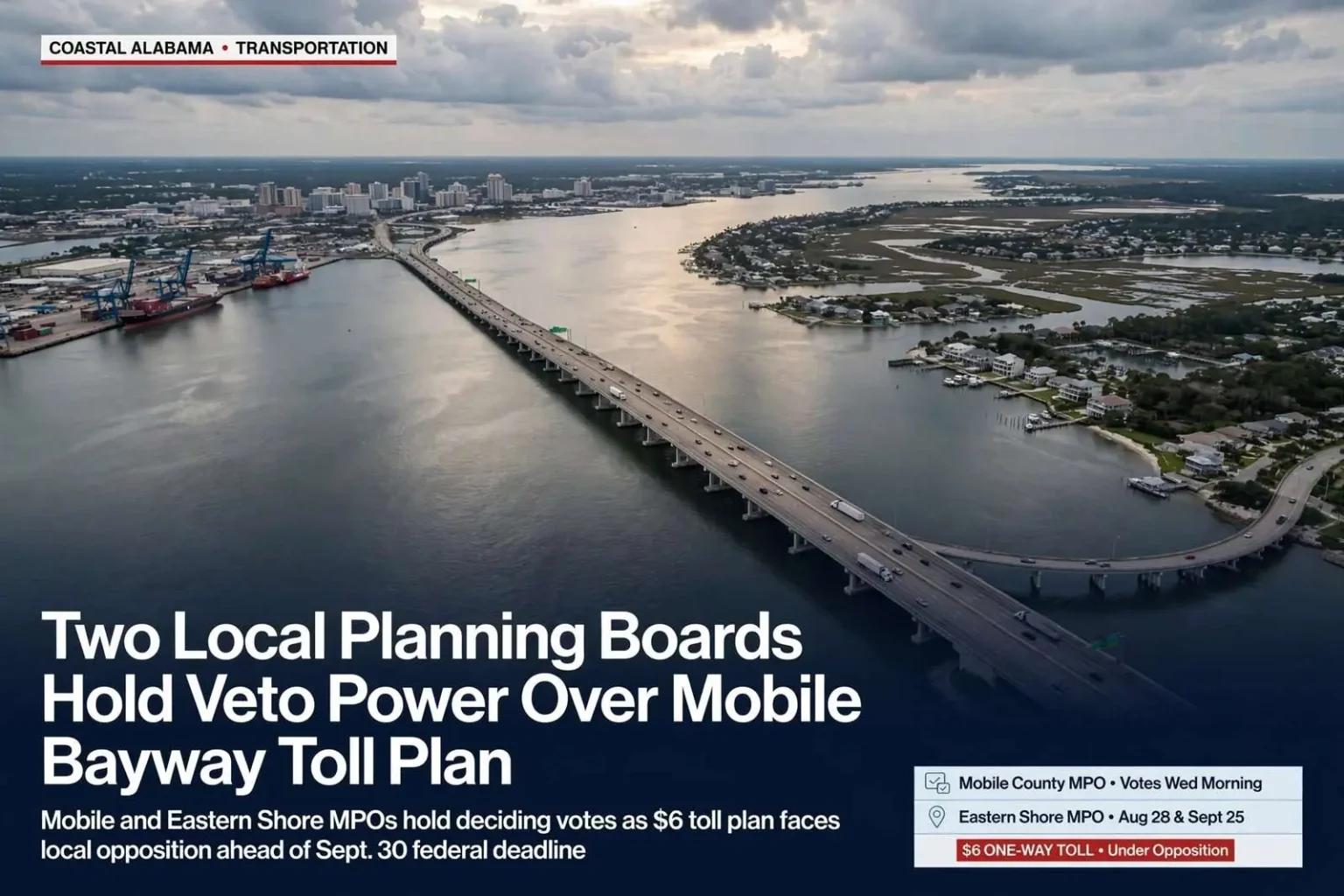
With public opposition building against a proposed $6 one-way toll on a new Mobile River Bridge and Bayway, two local planning boards emerged as the bodies with the practical power to stop the project in its current form. Mobile-based political strategist Jon Gray said the state had failed to lock down that local support in advance. “Somebody dropped the ball,” Gray said of the oversight.
The dispute centers on one of the most consequential transportation projects in coastal Alabama in a generation. The plan calls for a new bridge across the Mobile River and a Bayway crossing along the Interstate 10 corridor, intended to relieve a bottleneck that has squeezed travelers between the Bankhead and Wallace tunnels for decades. That stretch of I-10 funnels heavy commercial and tourist traffic through downtown Mobile, and congestion there has grown along with the port, the shipbuilding industry and the explosive residential growth of Baldwin County across the bay.
Funding for the crossing, however, was built around the very thing driving the backlash: tolling. Under the proposal, drivers would pay $6 each way to use the new span, with the revenue dedicated to retiring the construction debt. Residents of Daphne, Spanish Fort, Fairhope and other Eastern Shore communities who commute daily into Mobile would bear that cost most often, and opposition to the fee has been loud at public meetings and across the two counties.
Why the local boards matter
Gray said a freeway project that uses any federal funding must appear in the transportation improvement program, or TIP, maintained by the relevant local planning organizations. The TIP is the federally required short-range list of projects a region expects to carry out, and no federally supported highway work can proceed to construction without a place on it. For the Bayway project, that means the Mobile County Metropolitan Planning Organization and the Eastern Shore MPO, the two bodies that speak for the counties on either side of the bay.
Those approvals were needed by the end of the federal fiscal year on Sept. 30. While the bulk of the project was to be state funded, primarily through the proposed toll, roughly $140 million in federal money had already been spent across various planning stages, and the state might need to tap a federal bond program to complete the financing. That federal exposure is what triggers the local sign-off requirement, giving the planning boards leverage far beyond what their modest meeting agendas would suggest.
Metropolitan planning organizations are often obscure to the general public, but they occupy a critical position in federal transportation law. Congress deliberately required that federal highway dollars flow through regional bodies where local elected officials sit at the table, a check designed to keep state transportation departments from imposing projects on communities that must live with them. In this case, that structure handed Mobile County and Eastern Shore officials a genuine veto over a project championed in Montgomery.
Gray’s observation was that the state had treated the boards as a formality rather than as the decision points they actually were. By the time public opposition crystallized, the deadline for inclusion in the planning documents was imminent, and the votes had not been secured. “Somebody dropped the ball,” he said, suggesting that earlier engagement with the mayors and commissioners who sit on the boards might have avoided the standoff altogether.
A commissioner says he will vote no
Mobile County Commissioner Jerry Carl, a member of the Mobile County MPO, said he intended to vote against the plan when the board met. Carl said he hoped a no vote would kill the toll without sinking the bridge and Bayway project as a whole, though he acknowledged he could not be certain of that outcome.
“We’re just going to have to take a chance because we can’t take a chance on the tolling itself,” Carl said. “So, we’ll vote it down, hopefully, and then we’ll just address that afterwards.”
Carl’s position captured the dilemma facing many local officials. A new crossing is broadly popular; the toll that pays for it is not. A no vote on the TIP amendment could stall or reshape a project many of the same constituents want, yet voting yes would put board members on record endorsing a $6 fee that their voters have loudly rejected. Carl chose to gamble that the project could survive a rejection of its financing, while conceding he could not promise that result.
The Mobile County board’s membership also included Mobile Mayor Sandy Stimpson, city councilmen John Williams and Fred Richardson, and seven Mobile County mayors. That composition meant the vote would reflect a cross-section of county leadership, from the state’s third-largest city to the smaller municipalities that ring it, each with its own exposure to tolling and traffic questions.
Gray predicted that board would ultimately let the plan through: “Looking at the Mobile County Planning organization, I think you’re going to see it pass through.” In his view, the Mobile County side of the bay had more to gain from the new crossing, since its residents and businesses would benefit from a modern bridge without necessarily paying the toll as often as their Baldwin County neighbors.
Pressure from Montgomery and from voters
Gray attributed part of that expected outcome to lobbying from the state. He said Gov. Kay Ivey and her staff were applying intense pressure on planning organization members. The administration had made the I-10 bridge and Bayway a signature infrastructure priority, and the looming federal deadline gave the state every incentive to press for approval before the window closed.
“I would say there was a full panic coming out of Montgomery when they realized that if the MPOs in both Mobile and Baldwin don’t approve this, this thing could be dead,” Gray said. The observation reflected how quickly the calculus had changed once board members and their constituents grasped the leverage they held. A project that had seemed to be rolling toward construction could, in theory, be stopped by a handful of local votes.
The pressure campaign and the public backlash were pulling board members in opposite directions. State officials argued that the new crossing was essential to the region’s economy, easing freight movement through the port and restoring reliable travel on the Gulf Coast’s main east-west artery. Opponents countered that the financing structure shifted the burden onto the commuters and small communities least able to absorb it, and that alternatives had never been seriously weighed.
In Gray’s assessment, though, pressure from constituents would outweigh pressure from the capital, especially on the Eastern Shore, where the politics of the toll were sharpest. The Baldwin County municipalities whose mayors sat on the Eastern Shore MPO were precisely the places where commuters would cross the new Bayway every weekday, and where the $6 fee had become a defining local issue.
“The mayor of Daphne, the mayor of Fairhope, the mayor of Spanish Fort, the mayor of Loxley, I don’t see how any of those elected officials can vote in favor of this and choose to keep their jobs,” Gray said. The political arithmetic on that side of the bay was unforgiving: each of those mayors answered to a population of daily toll payers, and a vote for the plan in its current form would follow them through the next election cycle.
Daphne, Fairhope, Spanish Fort and Loxley have been among the fastest-growing cities in Alabama, drawing new residents who work in Mobile but live across the bay for the schools and lower costs. That growth is the root of both the congestion problem and the political problem for the project. More cross-bay commuters mean more demand for a new bridge, and more daily crossings would mean more $6 tolls, a cost many residents treat as a new tax on the simple act of getting to work.
Meeting schedule
The Mobile County MPO was set to vote at a Wednesday morning meeting. The Eastern Shore MPO had meetings scheduled for Aug. 28 and again on Sept. 25, leaving little margin before the federal deadline. A single missed cycle could push approval past Sept. 30 and put the project’s federal funding picture in question.
The compressed calendar sharpened every argument. Board members who wanted changes to the financing had almost no time to negotiate; state officials who wanted approval had little room to offer concessions. For residents, the practical window to influence the outcome amounted to a handful of public meetings spread across a few weeks in Mobile and on the Eastern Shore.
What happened in those rooms would shape the region for decades. The I-10 crossing is expected to be the largest transportation investment in the area since the tunnels and the Jubilee Parkway were built, and it will determine how freight, commuters and tourists move between Mobile and Baldwin counties for generations. The toll question, meanwhile, has become a proxy for a broader debate over who pays for growth on the Gulf Coast and who decides.
For now, the fate of the project rested with two small boards whose members had, almost overnight, become the most consequential voters in Alabama transportation policy. Whatever they did, the episode demonstrated a structural reality of federal transportation funding: even a project with the full weight of a governor’s office behind it cannot reach construction without the consent of the local officials who share the road with it. Gray’s verdict on the state’s process was blunt, and the upcoming votes would show whether the oversight could be corrected in time.


