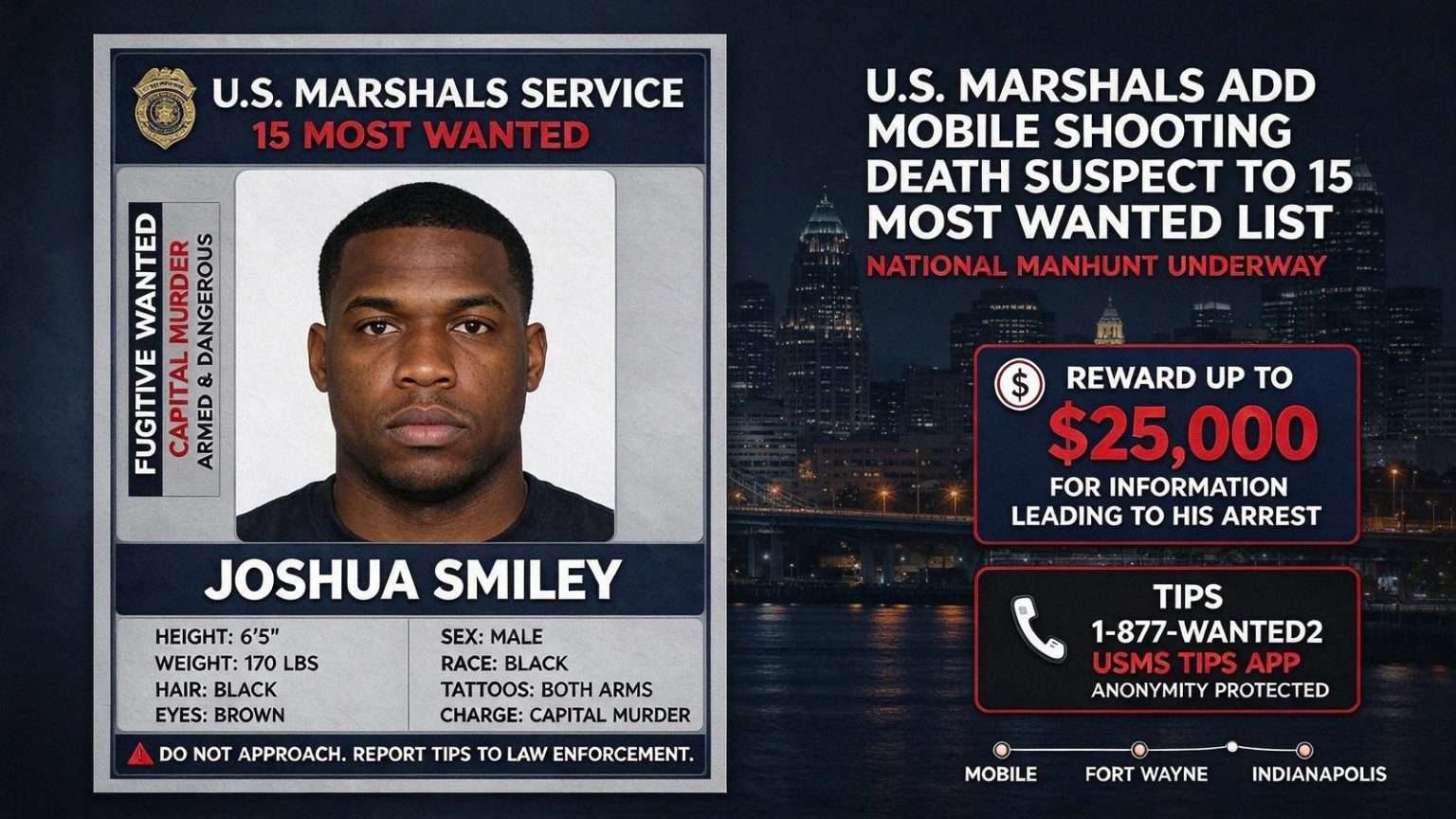
The U.S. Marshals Service has placed an Indiana man wanted on a capital murder charge in Mobile onto its 15 Most Wanted fugitives list, a designation reserved for some of the country’s most dangerous and elusive suspects, and is offering a reward of up to $25,000 for information leading to his arrest. The announcement puts one of Mobile’s most serious open cases on a national stage, where it will compete for attention with a short list of fugitives the agency considers its highest priorities.
Joshua Smiley, 26, is wanted in connection with the August 2021 shooting death of a 30-year-old man on Amsterdam Street in Mobile. In addition to the Mobile case, U.S. Marshals are seeking Smiley for violating the terms of federal bond on a separate federal drug charge out of Fort Wayne, Ind. Investigators believe he may be hiding out in Mobile, Fort Wayne or Indianapolis, and the two-city trail has kept the search alive in both Alabama and Indiana since the shooting.
The capital murder charge means that, if convicted in Mobile County, Smiley faces the most serious penalties Alabama law allows. Capital cases in the state typically involve killings committed in connection with other felonies or under other aggravating circumstances defined by statute, and prosecutors treat the pursuit of defendants facing such charges as a matter of the highest priority — which is precisely the kind of case the Marshals Service builds its most wanted lists around.
A criminal history tied to a prior killing
Smiley’s criminal history includes a prior conviction tied to a fatal shooting. In 2019, he was convicted for his role in a 2018 shooting death in Fort Wayne and received a five-year prison sentence, with two years suspended. That history is a central reason the Marshals Service considers him dangerous: he has previously been involved in a fatal shooting, served time for it, and is now wanted in a second killing in a different state.
The federal bond violation out of Fort Wayne adds a second layer to the search. Federal authorities had released Smiley on bond in the drug case, and his alleged violation of those terms means that, beyond the murder charge, he is wanted for failing to appear as the federal court required. Federal warrants of that kind do not expire, and they give deputy marshals jurisdiction to pursue and arrest him anywhere in the country once he is located.
“Smiley has been added to the U.S. Marshals 15 Most Wanted list due to the heinous nature of his crimes,” said Ronald L. Davis, director of the U.S. Marshals Service, in a news release announcing the addition. “I am confident with the help of the community we can bring this fugitive to justice.”
A description and a three-city search
According to the Marshals Service, Smiley is a Black man standing 6 feet 5 inches tall and weighing approximately 170 pounds, with black hair and brown eyes. He has tattoos on both arms. His height makes him a particularly recognizable figure — at well over six feet and lean, investigators hope the physical description will jog memories in any of the three cities where he might be staying.
Investigators believe he may be hiding out in Mobile, Fort Wayne or Indianapolis. The three-city pattern reflects the geography of the case: Mobile is where the capital murder charge awaits, Fort Wayne is his hometown and the source of the federal case, and Indianapolis is the largest city in his home state, a common destination for fugitives moving between familiar places. Deputy marshals in each of those districts are working the case, and the agency has urged anyone who spots him not to approach but to call in the sighting.
Anyone with information on Smiley’s whereabouts is urged to contact the U.S. Marshals Service at 1-877-WANTED2 or submit a tip through the USMS Tips App. Officials say tips will be kept in strict confidence and tipsters’ anonymity is guaranteed — a promise the agency makes on all of its most wanted cases, where tips from people who knew the fugitive’s habits and haunts have historically been the deciding factor in an arrest.
What the 15 Most Wanted list means
The 15 Most Wanted program, which the U.S. Marshals Service has run since 1983, is designed to draw national attention to fugitives considered the most dangerous still at large. Placement on the list is a decision made at the agency’s highest levels, and it comes with dedicated investigative resources, coordinated publicity and a national network of deputies watching for the fugitive’s name.
Those placed on the list tend to be career criminals with histories of violence who pose a significant ongoing threat to public safety — a group that has historically included murderers, sex offenders, major drug traffickers, organized crime figures and people wanted for high-profile financial crimes. Smiley’s profile, a homicide defendant with a prior fatal shooting conviction and a federal bond violation, fits the pattern the program was built to address.
Since the program’s inception four decades ago, more than 250 15 Most Wanted cases have been closed, according to the agency, underscoring how the added national visibility often plays a direct role in bringing fugitives into custody. The agency credits tips generated by publicity for many of those captures, which is why each new addition to the list is announced with a description, a reward figure and a tip line.
The $25,000 reward offered in Smiley’s case sits at the upper end of what the agency typically posts, reflecting both the capital charge in Mobile and the federal warrant out of Fort Wayne. Reward money in fugitive cases is paid only after an arrest that results from the tip, and claimants’ identities are protected under the agency’s policies.
The marshals’ role in a Mobile homicide
The Marshals Service occupies a distinct position in American law enforcement. As the oldest federal law enforcement agency in the country, it handles federal fugitive investigations, court security, witness protection and prisoner transport, and its Gulf Coast task forces routinely partner with Mobile police and Baldwin County agencies on violent-offender apprehension.
When a suspect in a local killing flees across state lines — or is believed to have done so — local police departments have limited reach beyond their jurisdictions. The marshals fill that gap, tracking fugitives through the federal warrant system and coordinating deputies across districts. In Smiley’s case, the alleged movement between Mobile, Fort Wayne and Indianapolis is exactly the scenario the agency’s district network is designed to cover.
For the family of the 30-year-old man killed on Amsterdam Street in August 2021, the addition to the list is the most significant development in the case since the charge was issued. Capital murder prosecutions in Alabama cannot move forward until the defendant is in custody, which makes the manhunt the critical path toward any trial.
How fugitive manhunts typically unfold
Most wanted fugitives are caught not by dramatic confrontations but through the slow accumulation of small details — a sighting at a relative’s home, a job taken under another name, a phone that pings in the wrong city. Marshals build profiles of a fugitive’s habits, contacts and travel patterns, then work those threads in every city where the person has ties.
The USMS Tips App and the 1-877-WANTED2 line feed that process directly. Each tip is logged, evaluated and routed to the district handling the case, and the agency says anonymity is guaranteed so that people close to a fugitive can report without fear of retaliation. In communities where witnesses to violent crime are reluctant to come forward, that promise is often what makes tips possible.
Publicity itself changes a fugitive’s options. A suspect who can move freely among friends and family suddenly finds that every associate has seen his photograph, and every favor asked becomes a risk of a phone call to the tip line. That pressure, marshals say, is the real function of the 15 Most Wanted list — it shortens the fugitive’s runway until there is nowhere comfortable left to hide.
Capital murder in Alabama
The charge Smiley faces in Mobile County is among the most serious in Alabama’s criminal code. Capital murder applies to killings committed under specific aggravating circumstances written into state law, and it carries the harshest penalties available in the state’s courts. Cases at this level are handled by the Mobile County District Attorney’s Office, with the investigation supported by Mobile police and, in this instance, the federal fugitive apparatus now committed to locating the defendant.
The August 2021 shooting that produced the charge occurred on Amsterdam Street, in one of the Mobile neighborhoods where gun violence has been a persistent concern for residents and police alike. The victim, a 30-year-old man, was killed in a shooting that investigators worked for months before the case reached the point it stands today — a capital murder charge, a fugitive, and a national manhunt.
Alabama’s capital murder statute also means the eventual case, if Smiley is captured, will draw intense procedural scrutiny. Defendants charged capitally in Alabama are entitled to appointed counsel with experience in capital litigation, and the path from arrest to trial typically runs through years of pretrial proceedings. None of that can begin, however, until the defendant is found.
Two states, one fugitive
The dual warrants give the search unusual reach. The capital murder charge out of Mobile County makes Smiley wanted in Alabama on state charges, while the federal bond violation out of Fort Wayne makes him wanted nationwide on a federal warrant. A federal warrant means any law enforcement officer who encounters him — a city patrol officer on a traffic stop, a deputy serving papers, a marshal following a tip — can take him into custody immediately.
Fort Wayne, Indiana’s second-largest city, has been the center of Smiley’s legal history to this point: the 2018 fatal shooting, the 2019 conviction and sentence, and the federal drug case from which he allegedly violated bond. The city’s connection to the case means Indiana investigators know Smiley’s background well, and their files on his habits and associates are part of the hunt.
Indianapolis, the state’s largest city, completes the likely map. Fugitives moving under pressure tend to go where they have family or connections but are less likely to be recognized, and investigators say Smiley’s possible presence there is a working assumption rather than a confirmed sighting. The Marshals Service has offices in all three cities, and the agency’s structure means deputies in each district are working from the same national file.
What comes next in the case
The case remains an active, ongoing investigation, and Smiley’s addition to the list is expected to widen the pool of tips coming into the Marshals Service and local law enforcement partners working the case in Mobile. Each new tip is checked against the agency’s developing picture of his movements, and investigators say the list placement often produces results within weeks as a fugitive’s support network absorbs the pressure of national publicity.
For Mobile, the case is a reminder that the city’s most serious open homicides do not stop at the county line. The partnership between local investigators and the marshals’ task forces has become the standard route for pursuing defendants who flee, and the 15 Most Wanted designation signals that this case has risen to the top of that pipeline.
Officials urge anyone with information to call 1-877-WANTED2 or use the USMS Tips App. Smiley is considered armed and dangerous, as he is known to carry firearms, and the agency’s guidance is unambiguous: do not approach him. Report what you know, let the anonymity protections work, and allow deputies to make the arrest.
Until he is in custody, the capital murder charge on Amsterdam Street remains an open promise — to the victim’s family and to the city — that the case will be resolved. The 15 Most Wanted list, the reward and the three-city manhunt are the machinery now working to keep it.