Ultralight plane crashes into yard near Atmore, pilot injured
A pilot was injured when an ultralight plane crashed into a yard on Howard Paige Lane near Atmore after the engine failed and struck a tree and power line.
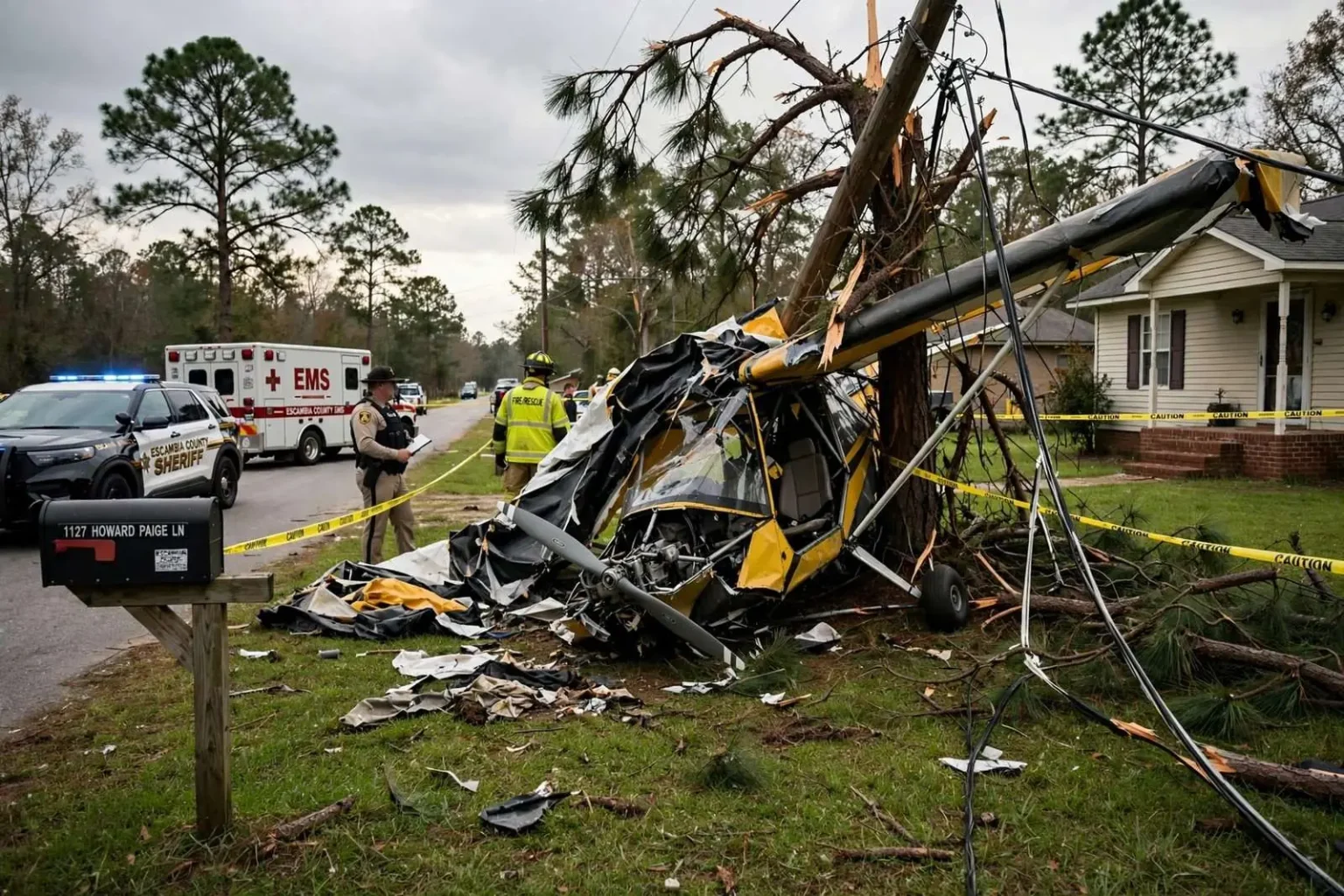
ROBINSONVILLE, Ala. — A pilot was injured Friday afternoon when an ultralight aircraft crashed into the front yard of a home in the Robinsonville community outside Atmore, according to the Escambia County Sheriff’s Office.
The crash happened in front of a residence on Howard Paige Lane, a short residential street in the rural community that sits north of Atmore near the Escambia County line. Chief Deputy Mike Lambert said the aircraft struck a tree and a power line after its engine failed, bringing the small plane down in the yard rather than in the roadway or nearby woodlands.
The pilot was identified as Matthew Scott Nelson. He suffered a leg injury in the crash and was initially taken to Atmore Community Hospital for treatment. Because of the nature of his injuries, he was later flown to Sacred Heart Hospital in Pensacola, Florida, where he was listed as recovering after the accident.
News of the crash spread quickly through the small community, where residents reported hearing the aircraft sputtering before impact. Rural Escambia County has long been home to small aviation enthusiasts, with open fields and lightly populated tracts making the area a familiar setting for recreational flying. Emergency responders from the area arrived to find the aircraft down in the yard with the pilot still conscious and awaiting help.
A Close Call in a Quiet Neighborhood
The fact that the plane came down in a front yard — and not on top of the house itself or on one of the children who play in yards along the lane — was described by those familiar with the response as fortunate. Ultralight aircraft are among the smallest and slowest powered aircraft in the sky, but a falling airframe still carries enough weight and speed to cause serious damage to people and property below.
Striking a power line during an emergency descent adds another layer of danger, both for the pilot and for anyone nearby. Downed or damaged lines can leave homes along the street without electricity until utility crews arrive, and any line knocked from its pole is treated as live until it can be inspected and de-energized. Residents in the immediate area were advised to stay clear of the wreckage and any damaged lines while crews secured the scene.
Engine failure is among the most serious emergencies a pilot of a small craft can face, because there is rarely altitude or time to restart the engine or glide to an airport. Pilots are trained to pick the least dangerous landing zone available, and in this case the open front yard appears to have offered the best option once the engine quit. The tree and power line the plane struck likely slowed the aircraft before it reached the ground, which may have limited the severity of the pilot’s injuries.
What Makes Ultralights Different
Ultralight vehicles occupy a unique corner of American aviation. Under Federal Aviation Administration rules, a true ultralight is a single-seat craft weighing less than 254 pounds empty, carrying a small fuel load and flying at low speeds. Because of their minimal weight and simple two-stroke engines, they are far less expensive to buy and operate than certified light aircraft, which has made them popular with hobbyists across rural Alabama and the Gulf Coast.
That simplicity comes with trade-offs. Ultralights generally lack the redundant systems, rigorous certification standards and required maintenance schedules that govern conventional aircraft. Their small engines are sensitive to fuel quality, carburetor icing and mechanical wear, and engine-out landings are a familiar scenario in the ultralight community. Training requirements for ultralight pilots are lighter than those for private pilots, and the aircraft often operate from grass strips, pastures and small private fields rather than paved airports.
Atmore Municipal Airport serves the area’s general aviation needs, but recreational ultralight flying in the region often takes place away from established airfields, over fields and fence lines like the ones around Robinsonville. When an engine fails at low altitude over a developed area, the pilot has only seconds to choose where to set the craft down, and houses, trees and power lines narrow the options quickly.
The Investigation Moves to Federal Hands
Because the crash involved an aircraft, the response quickly grew beyond the county sheriff’s office. A camera mounted on the plane was turned over to the Federal Aviation Administration and the National Transportation Safety Board, both of which investigate aviation accidents. The footage captured by such cameras can be a decisive piece of evidence, showing engine instruments, the pilot’s actions and the final moments of flight in a way that wreckage alone cannot.
The FAA handles the regulatory side of aviation accidents, checking registration, pilot qualifications, airworthiness and compliance with operating rules. The NTSB, an independent federal agency, determines the probable cause of accidents and issues safety recommendations aimed at preventing similar events. In crashes involving ultralights, the NTSB’s findings often focus on engine maintenance, pilot decision-making and the inherent limitations of very light aircraft flying at low altitudes.
Investigators typically document the wreckage position, examine the engine and fuel system, interview witnesses and review weather conditions at the time of the flight. The path of damage through the tree and the power line will help them reconstruct the aircraft’s final trajectory and descent angle. Findings in cases like this can take months to finalize, but the on-scene work generally begins within a day or two of the crash.
Sheriff’s officials said the local role is to secure the site, account for everyone involved and hand off the aviation-specific evidence to federal investigators. Once the aircraft and its mounted camera were collected, the crash site itself reverted to the property owner and the utility to repair the damaged line.
Hospitals and Trauma Care Along the State Line
The pilot’s medical route reflects how emergency care is organized in that corner of Alabama. Atmore Community Hospital provides initial emergency treatment for the city and the surrounding rural county, but patients with significant trauma are frequently transferred to larger facilities in Pensacola or Mobile. Sacred Heart Hospital in Pensacola serves as a regional referral center for Northwest Florida and South Alabama, and air ambulance transport is a routine link between the two systems.
Escambia County’s emergency medical crews coordinate with helicopter services when a patient’s injuries exceed what a small rural hospital can stabilize. Leg injuries from aircraft accidents can involve fractures, arterial damage and crush injuries that require surgical care unavailable locally, making the quick flight across the state line a standard rather than exceptional step.
Residents of the Robinsonville area who called in the crash were credited with helping responders reach the pilot quickly. In rural communities, where houses can sit far apart and cell coverage is uneven, a neighbor’s 911 call is often the difference between a rapid response and a long wait. Escambia County dispatchers routed the call to sheriff’s deputies, firefighters and emergency medical crews simultaneously, the standard multi-agency response for aircraft accidents in the county.
A Community’s Familiarity With Small Aircraft
North Escambia County and the Atmore area sit under common flight paths for small aircraft moving between Mobile, Pensacola and the interior of the Gulf Coast. Crop dusters, banner planes and recreational flyers are routine sights in the summer months, and most rural landowners in the region have watched agricultural aircraft work fields adjacent to their homes for decades. A crash landing in a front yard, however, is a different order of event, and Friday’s accident drew steady attention from neighbors as word traveled through the community.
Sheriff’s officials did not release additional details about the flight’s origin or destination, noting that those questions fall to the federal investigators now reviewing the mounted camera’s footage and the aircraft itself. No one on the ground was reported injured.
For the residents of Howard Paige Lane, the afternoon left a yard marked by wreckage removal, a power line awaiting repair and a story that will be retold in the community for years. For the pilot, the crash ended with a leg injury, a flight to Pensacola and a recovery that, by all accounts available Saturday, was progressing as expected.
What Comes Next
The FAA and NTSB investigations will proceed on their own timelines. Federal crash reports are public documents once finalized, and the probable-cause finding for the Robinsonville crash will be published when the review is complete. In the meantime, the Escambia County Sheriff’s Office said it considers the incident closed from a local standpoint, with no criminal inquiry attached to the accident.
Ultralight enthusiasts across the region will likely discuss the crash at area airfields for months, in the familiar shorthand of pilots weighing engine reliability against the freedom of low and slow flight. The lesson drawn in similar cases is consistent: altitude is a pilot’s greatest resource, and when an engine fails over a neighborhood, the choices remaining are measured in seconds and feet.
Anyone with information about the crash who has not already spoken with investigators was directed to contact the Escambia County Sheriff’s Office, which can pass details along to the federal agencies reviewing the accident.