University of Mobile Extends Spring Break Through March 20 Over Coronavirus Concerns
The University of Mobile has extended spring break through March 20 and will decide by March 18 whether to move classes online as a precaution against.
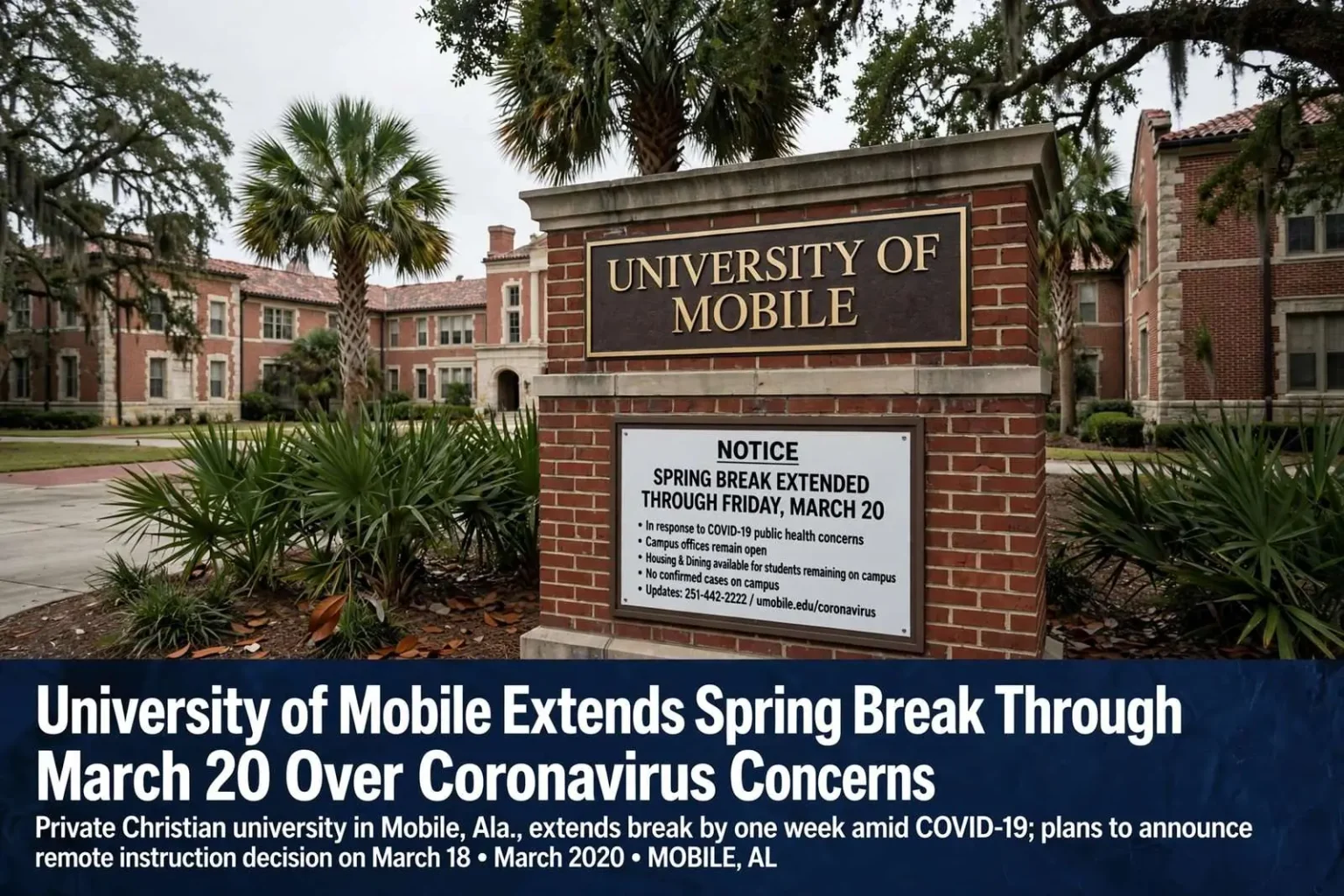
The University of Mobile will extend spring break for students and faculty by one week, through Friday, March 20, in response to public health concerns about the spread of COVID-19. The decision places the private Christian university alongside the colleges and universities across the country that moved in the same week of March 2020 to pull students out of classrooms as the new coronavirus spread across the United States.
The university said it will announce on Wednesday, March 18, whether it will shift to alternative modes of course delivery, which would begin Monday, March 23 if implemented. Any change in delivery would be temporary — a phrase that, in the first weeks of the pandemic, meant administrators were preparing for a disruption they hoped would be measured in weeks rather than semesters.
What happens on campus in the meantime
Other university operations will continue and offices will remain open during the extended break. The university is providing housing and food service for students who must remain on campus — a group that includes international students, student-athletes and others for whom the Mobile campus is home regardless of the academic calendar. Residential students who left for the break were not ordered back, and the extended week gave students and families time to plan for either a return to classes or a transition to remote instruction.
Faculty spent the week preparing for either outcome. Alternative course delivery — online lectures, recorded sessions and revised assignment schedules — requires instructors to rework courses on short order, and the March 18 announcement date gave the university’s faculty a defined deadline for finishing those preparations.
The decision behind the extension
While there are no known cases of coronavirus on the University of Mobile campus, officials said the move is being made out of an abundance of caution, with the health and safety of students, employees and the community as the primary concern. The phrase “abundance of caution” became the defining language of American institutional life in March 2020, and the university’s framing reflected its situation: a campus of a few thousand students with no identified cases, acting before any case appeared rather than after.
The calculation behind such a decision weighed several factors at once — the density of residential campus life, the movement of students through airports and highways during spring break travel, the vulnerability of older faculty and staff, and the position of the university within a region whose hospitals and public health resources would be strained if an outbreak took hold. Extending the break reduced the campus population immediately and bought the administration a week to decide the next step with better information.
Who the University of Mobile is
The University of Mobile is a private university affiliated with the Alabama Baptist State Convention, located in the Ramer neighborhood of west Mobile, south of the city’s main population corridors. Founded in the early 1960s as Mobile College, the school grew into a comprehensive university offering undergraduate and graduate programs in nursing, business, education, music, Christian ministries and the liberal arts, with a residential student body drawn heavily from the Gulf Coast region.
Its students come from across south Alabama, the Florida Panhandle and Mississippi — the same three-state region whose public schools, community colleges and universities were all wrestling with the same decisions in the same week. For university families, the extension meant rearranged travel, childcare and work schedules on short notice; for students, it meant an extra week at home with the semester’s fate unannounced.
The week of March 2020
The university’s announcement came in the extraordinary week when American higher education changed course almost overnight. College athletics seasons had been suspended, conference tournaments canceled, and campus after campus had called students home or moved instruction online — decisions that cascaded across the country within days of each other. Institutions that had never taught a remote course were preparing to deliver entire semesters through learning-management systems, and students were discovering that “temporary” was the one word no one could define.
In Mobile, the university’s move paralleled decisions across the region as public school districts, community colleges and other universities weighed closures. The University of South Alabama, Spring Hill College, Bishop State and the public school systems of Mobile and Baldwin counties all faced the same calculus during the same days, and each institution’s announcement rippled through the same networks of families with students in more than one school.
What alternative delivery means
Should the March 18 announcement confirm the shift, alternative modes of course delivery would begin Monday, March 23. The term covers the range of options universities adopted that spring: fully online instruction through course platforms, live video sessions, hybrid arrangements and revised schedules for clinical rotations, studios and labs that cannot move to a screen. For a university with significant programs in nursing, music and education — fields built on supervised practice and performance — the transition carried particular complications, and “temporary” status left institutions free to return to classrooms when conditions allowed.
The extension week served a practical purpose in that transition: it kept students away from campus while faculty finalized delivery plans, gave IT staff time to scale remote systems, and avoided bringing the community back together before the university knew what it was returning to.
Communication with students and families
Information is being updated on the university’s coronavirus information page, and questions can be directed to the university at 251-442-2222. The page became the single source of truth for the campus community — announcement dates, delivery decisions, housing guidance and health information all routed through one place, an approach universities adopted across the country as the volume of pandemic communication overwhelmed ordinary channels.
The phone line and the page served two audiences with different needs: current students and their families trying to plan their semesters, and the parents of prospective students watching how the institution responded. Clear, dated announcements were the currency of institutional credibility in that week, and the university’s decision to name its announcement day — Wednesday, March 18 — rather than leave students guessing reflected that new standard.
The students who stayed
The provision of housing and food service for students who must remain on campus addressed the population easiest to overlook in closure announcements. Every residential campus has students who cannot simply go home — international students facing travel restrictions, students from troubled households who regard campus as their stable environment, athletes whose seasons had just been suspended and whose housing depended on enrollment. For them, the extended break meant an emptied campus with dining operations running at skeleton staffing, a version of college life none of them had planned for.
Campus offices remaining open kept the institution’s practical machinery running through the disruption: residence life managing the reduced population, financial aid and registrar staff fielding questions about grades and billing, facilities continuing the cleaning routines that took on new significance as public health guidance emphasized disinfection of shared surfaces.
Cautious before the first case
The emphasis on the absence of known campus cases is worth reading carefully. Institutions that closed before their first identified case did so to keep it that way — to disperse the campus population before a virus moving through spring break travel networks could arrive and spread in residence halls, dining halls and classrooms. Public health officials that week were urging exactly this posture: act on the projections, not on the confirmed case counts, because by the time cases appear the transmissions that produced them happened days earlier.
The university’s stated priorities — the health and safety of students, employees and the community — track the three populations such decisions actually protect: the residential students, the faculty and staff who would have taught and worked among them, and the wider Mobile community whose hospitals and households share the risk of any campus outbreak.
An uncertain semester
What the announcement left undecided was everything students most wanted to know: whether they would return to classrooms, to residence halls, to graduation ceremonies and spring athletics. The March 18 announcement was positioned to answer the immediate question — where and how classes resume on March 23 — while the longer questions about commencement, housing contracts and the summer schedule waited on events no administrator could yet predict.
For now, the university’s plan is concrete: spring break extended through Friday, March 20; a delivery decision announced Wednesday, March 18; any alternative instruction beginning Monday, March 23; campus operations continuing; housing and food service available for those who must stay; and updates flowing through the university’s coronavirus information page and the 251-442-2222 information line. It is a plan built for a temporary disruption — by an institution, like every other in the country that week, hoping the word proves accurate.