University of South Alabama Mobile
University of South Alabama Student Free Clinic Expands Services to Women at McKemie Place
A University of South Alabama student-run free clinic that has served men at the Salvation Army for seven years is now also offering monthly care to women at McKemie Place, a Mobile shelter for battered women.
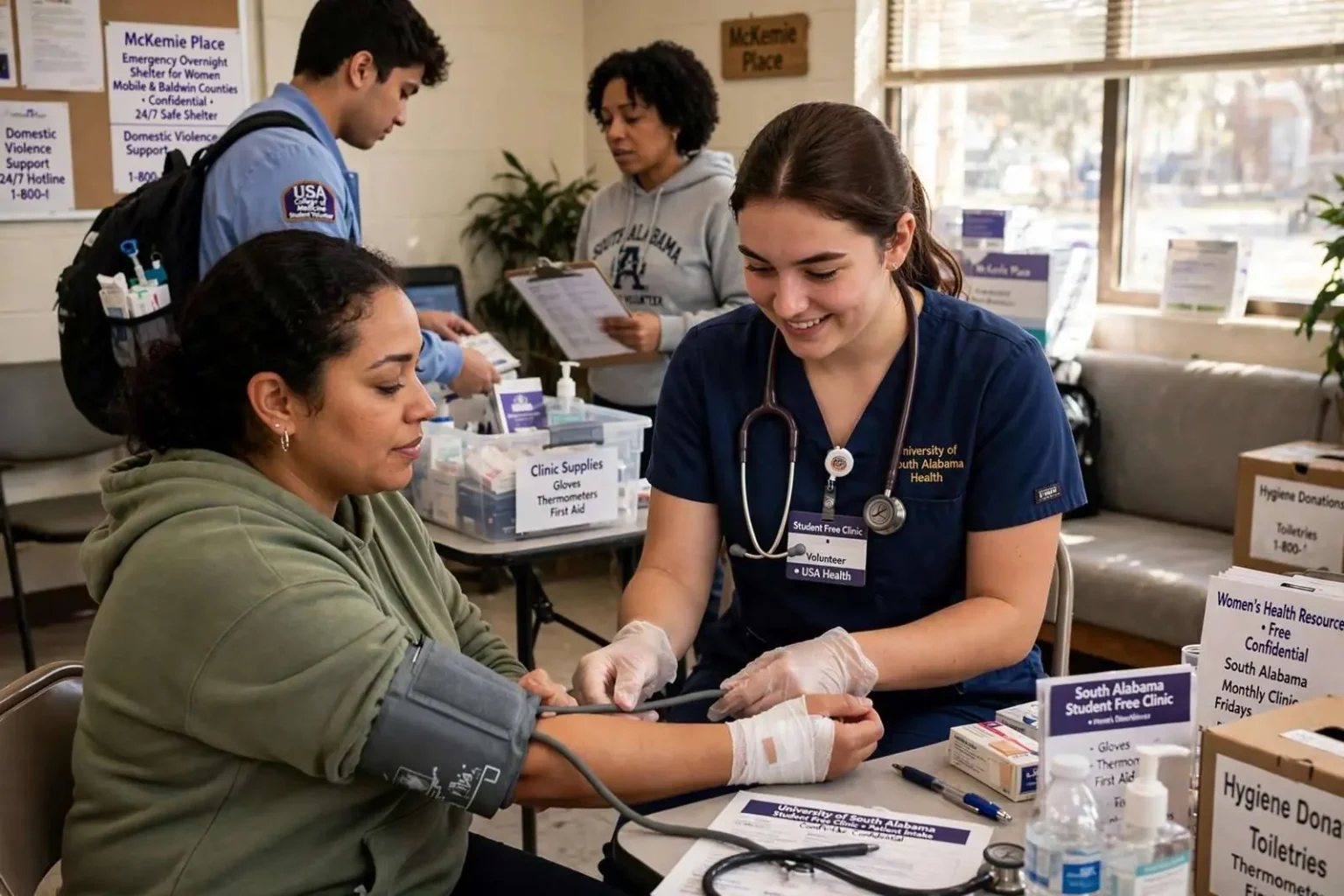
A long-running student-led free clinic at the University of South Alabama is broadening who it serves, adding new monthly services for women at a Mobile emergency shelter after years of focusing solely on men. The expansion marks a significant shift for the volunteer program, which has built its reputation on steady, no-cost care delivered by students training for careers in medicine and the health professions. For the organizers, the move reflects a simple calculation: the need in Mobile extends beyond the population they have been able to reach so far.
For the past seven years, students with University of South Alabama Health have volunteered weekly at the Salvation Army, providing free medical services to men at no cost. Over that span, the clinic has become a fixture of the shelter’s weekly rhythm, with a core group of student volunteers returning Friday after Friday to take blood pressures, answer health questions, and connect shelter residents with whatever care they could provide on site. The program has also served as a training ground of sorts for a generation of South Alabama students, giving them early, hands-on exposure to patients whose health needs are often shaped by poverty, housing instability, and limited access to primary care.
Recently, the group decided the need in the community extended further and began offering the same kind of care to women once a month on Fridays at McKemie Place, an emergency overnight shelter serving battered women in Mobile and Baldwin counties. The decision to add a second site did not come quickly, according to those involved. The students weighed their capacity carefully, knowing that taking on a new population would stretch the same pool of volunteers who already staff the weekly men’s clinic.
“But we felt that there was a bigger need in the community, especially since we’ve been serving the gentleman long enough,” said Chandler Hinson, president of the student-run clinic. In Hinson’s telling, the expansion was less a reinvention of the program than a natural next step for a group that had found its footing at the Salvation Army and was ready to do more.
A Second Site With a Different Mission
McKemie Place occupies a distinct niche in Mobile’s network of shelters and social services. While many area facilities serve the homeless population broadly, McKemie Place exists specifically to provide emergency overnight shelter for women fleeing domestic violence, drawing residents from both Mobile and Baldwin counties. That focus shapes nearly everything about how the shelter operates, from security and intake to the sensitivity required of anyone who walks through its doors.
It also shapes what medical care looks like when the students arrive. Many of the women who seek shelter at McKemie Place arrive after experiencing sexual abuse or sexual violence, giving the volunteer clinic’s work there a distinct character compared with its services for men. The students are dealing not only with routine health concerns but with patients whose medical needs are often intertwined with trauma, and the setting demands patience, discretion, and a gentler touch than a typical clinic visit.
Hinson said the same core group of volunteers who serve at the Salvation Army each week now also travels to McKemie Place to meet whatever medical needs the women there may have. “Basically the same group of volunteers that go to the Salvation Army – we also now go over to the women’s clinic and we provide whatever they need. So they can come in with whatever issue that they had and we’ll make sure to take care of them,” Hinson said.
Seven Years of Weekly Service
The University of South Alabama’s student clinic grew out of the university’s health programs, which include the College of Medicine and allied health disciplines on the university’s Mobile campus. Student-run free clinics are a common feature at medical schools across the country, but they depend entirely on volunteers willing to give up evenings or weekends, and on institutional support from the university and the host facility. The South Alabama group’s seven-year run at the Salvation Army represents the kind of sustained commitment that is rare among student organizations, whose membership turns over completely every few years as students graduate.
That continuity has been maintained, in part, through structure. Students interested in joining the effort must complete training before they can begin volunteering, a requirement that ensures new arrivals understand both the clinical protocols and the particular etiquette of working with vulnerable populations. The training also helps the program maintain consistent quality even as each graduating class hands off responsibility to the next.
The Salvation Army’s presence in Mobile dates back more than a century, and the organization operates shelters, feeding programs, and social services across the Gulf Coast. Housing a free student clinic at the shelter gave the men there access to basic health monitoring they might otherwise never receive, and it gave students a reliable, recurring patient population. Over seven years, that arrangement matured into the kind of partnership that both sides came to depend on.
By the time the students began looking at expanding, the men’s clinic was running smoothly enough that the group’s leadership felt comfortable taking on a second commitment. The question was not whether there was a need — student volunteers and shelter staff alike could see that there was — but whether the group could meet it without shortchanging the men they had served for years.
Meeting Women Where They Are
The answer, ultimately, was to schedule the women’s clinic monthly rather than weekly, on Fridays, so the same volunteers could cover both commitments. Hinson said he and his fellow volunteers plan to continue both commitments moving forward, serving men every Friday at the Salvation Army while adding the monthly Friday visits to McKemie Place for women.
The model keeps the volunteer burden manageable while still guaranteeing the women at McKemie Place a regular, predictable point of contact with the health care system. For shelter residents, whose lives are often in upheaval, predictability matters: knowing that the students will be there on a particular Friday each month gives women a chance to think about their health, note questions or symptoms, and bring them to the clinic when it arrives.
The services themselves are basic but consequential. Students take vital signs, perform screenings, and evaluate whatever concerns residents raise. In many cases, the clinic’s most valuable contribution is simply detecting a problem early — elevated blood pressure, an untreated infection, a hearing issue — and steering the patient toward follow-up care before it becomes something worse.
Small Moments That Matter
Hinson said working with this population has been meaningful, describing moments such as performing hearing exams for residents who had never had one before. “Being able to test for hearing a lot of these, you know, individuals they have never had hearing exam before and that’s something that’s unique,” Hinson said.
The comment underscores a reality that free clinic volunteers encounter repeatedly: many patients living in poverty or crisis have never received even the most routine preventive care. A hearing exam takes minutes, but for a woman who has spent a lifetime without access to one, it can reveal a treatable problem or simply provide the reassurance that nothing is wrong. Those small interventions, repeated month after month, are what the students say make the work worthwhile.
The experience also shapes the students themselves. Volunteers in student-run clinics routinely describe the work as formative, exposing them to patients and circumstances far removed from a textbook or a teaching hospital. At McKemie Place, the lessons are particularly stark: students see firsthand how domestic violence, housing instability, and gaps in the social safety net show up in a patient’s health, and they learn to treat medical concerns in that fuller context.
For the shelter, the clinic adds a health service that a small nonprofit would struggle to provide on its own. Emergency shelters operate on thin margins, and medical care is rarely among the services they can staff directly. By bringing care directly to the residents, the student volunteers remove the transportation, cost, and scheduling barriers that often keep shelter populations from seeing a provider at all.
A Model Built on Volunteers
University of South Alabama students interested in joining the effort must complete training before they can begin volunteering, and can reach out to the clinic by email to sign up. The training requirement is not a formality. Working with survivors of domestic violence, in particular, requires an understanding of confidentiality, trauma-informed communication, and the boundaries of what student volunteers can and cannot provide.
The clinic’s leaders say the pipeline of interested students has remained strong, helped by the program’s longevity and reputation on campus. Health professions students at South Alabama — whether bound for medical school, nursing, or other clinical fields — gain experience that is difficult to replicate in a classroom, and the shelter residents gain consistent access to care. The exchange is the foundation on which the program has operated for seven years, and it is what makes the expansion to women possible.
The group’s structure also reflects practical realities of student life. Exam schedules, clinical rotations, and breaks mean that volunteer availability fluctuates through the academic year, which is part of why the women’s clinic was set up monthly rather than weekly. The schedule gives the program room to absorb the natural turnover of a student organization while keeping both commitments running without interruption.
Why the Expansion Matters for Mobile
The expansion arrives at a time when the need for services for survivors of domestic violence in Alabama remains substantial. Advocates across the state have long noted that shelter space for battered women is limited, particularly outside major metropolitan areas, and that women in the region often travel significant distances — sometimes across county lines — to reach safety. Facilities like McKemie Place, which draw from both Mobile and Baldwin counties, fill a role that no other single service in their immediate area duplicates.
Health care is woven through that picture. Women leaving abusive situations frequently arrive at shelters with untreated medical conditions, injuries, chronic diseases that have gone unmanaged, and significant gaps in preventive care. A shelter that can connect residents with even basic medical attention on site closes one of the many gaps a woman faces as she works to stabilize her life.
The students’ monthly presence also carries a less tangible benefit: trust. Survivors of violence often have complicated relationships with institutions, and repeated, voluntary, no-strings-attached contact with the same familiar faces can build a comfort level that a single emergency-room visit never will. Over time, that trust can translate into residents raising health concerns they might otherwise keep to themselves.
What Comes Next
For now, the clinic’s leadership says the priority is to keep both operations running steadily — the weekly men’s clinic at the Salvation Army and the monthly Friday visits to McKemie Place. Hinson and his fellow volunteers plan to continue both commitments moving forward, and the group has made clear that the women’s clinic is intended to be a permanent part of its mission rather than a pilot.
Whether the program expands further will depend on volunteers and capacity, the same constraints that shaped the original expansion decision. But the seven-year history at the Salvation Army suggests the organization has learned how to endure beyond any single cohort of students. Each year’s leaders inherit a working program, a trained volunteer base, and established partnerships with the facilities they serve.
For the women of McKemie Place, the practical meaning of the expansion is straightforward: once a month, a group of trained, caring volunteers will set up in their shelter and take care of whatever they can. For the students, it is another step in the kind of education that cannot be graded — learning to see patients not as cases but as people, many of them carrying burdens far heavier than any chart can capture. Both sides, by every account so far, consider the arrangement well worth the drive across Mobile Bay’s communities it serves.