University of South Alabama Mobile
University of South Alabama’s JAG Radio Launches Online Streaming
South Alabama's student-run JAG Radio began streaming live online, offering local music and student-hosted shows at jagradio.net.
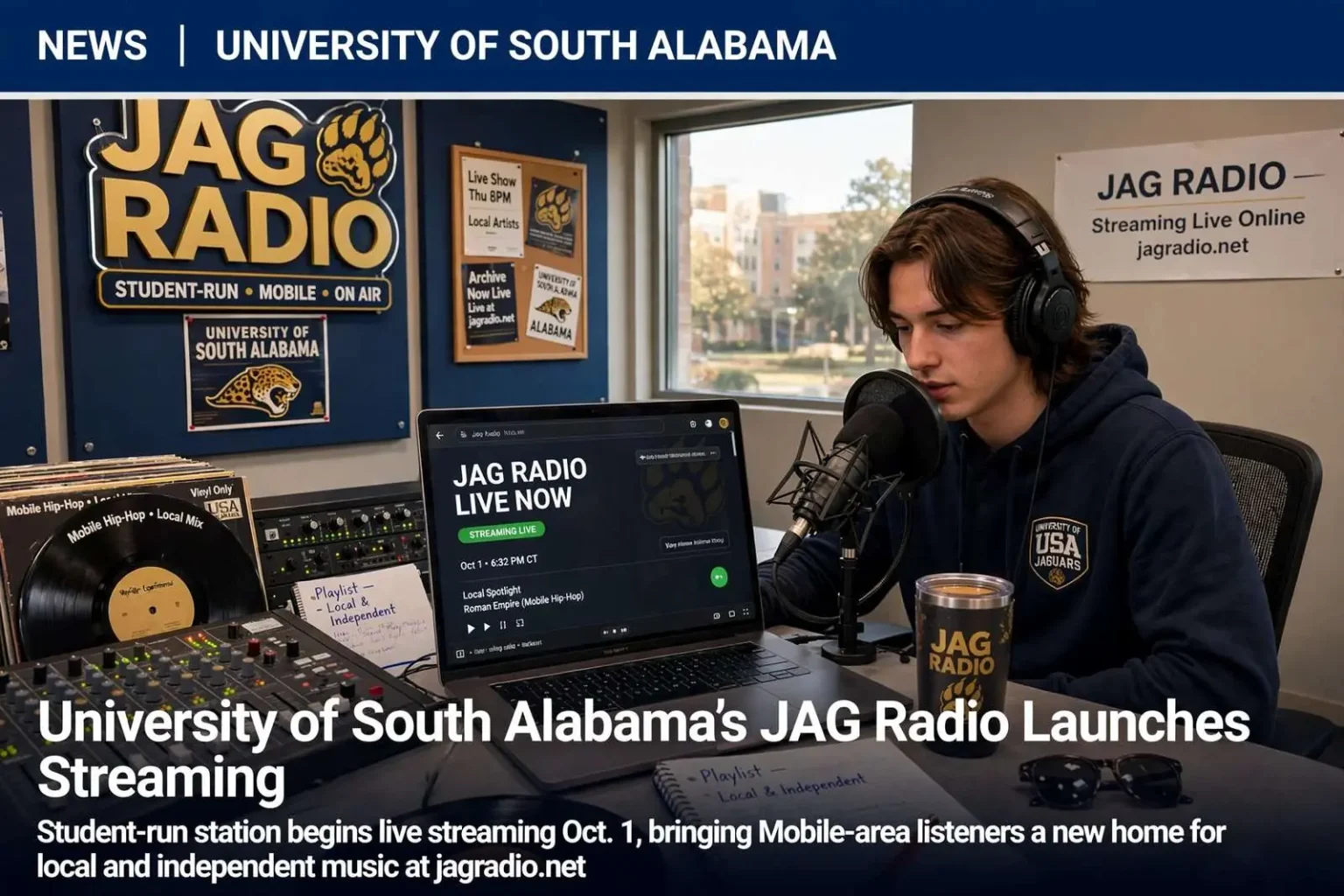
The University of South Alabama’s student-run station, JAG Radio, began streaming live online on October 1, giving Mobile-area listeners a new outlet for local and independent music not typically found on commercial radio. The station, accessible at jagradio.net, offers live streaming as well as an archive of past shows, allowing listeners to catch programs they may have missed — and giving Mobile’s music community a new home base online.
JAG Radio is produced and hosted entirely by USA students, giving them hands-on experience in broadcasting while providing a platform for local artists. Every element of the operation, from selecting music and planning shows to running the board and promoting the station, is handled by students learning the craft from the inside. For many of them, the station is their first experience speaking to a live audience, managing a playlist, or producing a program from start to finish, and those skills follow them into careers in media, marketing and communications.
A mix of local and independent sound
Among the station’s offerings is regular airtime for local acts, including the Mobile hip-hop artist Roman Empire, whose show highlights local rap and hip-hop. The slot gives Mobile’s hip-hop scene a dedicated broadcast home — something commercial radio in the market has rarely provided at any consistent level — and introduces listeners to artists working in their own city.
Other student-hosted programs span genres from alternative rock to experimental noise, vinyl-only sets and old-school hip-hop and R&B mixes, reflecting the range of musical interests among USA’s student body. That eclecticism is a signature of college radio generally, and JAG Radio’s schedule makes room for formats that would never survive a commercial ratings meeting. A listener moving through a week of programming might hear a deep cut from an independent rock record, an all-vinyl set assembled from a student’s personal collection, and a block of classic R&B that commercial stations stopped playing decades ago.
The station’s emphasis on local and independent music fills a real gap in the Mobile market. Commercial radio formats are built around national playlists and syndicated programming, which leaves local artists with limited broadcast options. A student station with no ratings pressure to answer to can put a Mobile rapper, a Gulf Coast indie band or a campus DJ in rotation on merit and enthusiasm alone, and that openness is part of what college radio has always offered its communities.
Why streaming changes the equation
The move to online streaming lets JAG Radio reach listeners beyond the reach of a traditional campus signal, part of a broader trend of college radio stations turning to internet platforms to grow their audiences and preserve archived programming for on-demand listening. For decades, the audience for a student station was limited to whoever could pick up its signal — typically campus buildings, the surrounding neighborhood, and a fringe of the city on a good receiver. A stream erases that boundary: a USA student studying abroad, a Mobile native who moved away, or a music fan anywhere in the world can tune in on the same terms as someone walking across the campus quad.
The archive of past shows may matter just as much as the live stream. Traditional radio is ephemeral — a show airs once and is gone. An on-demand archive turns each program into a lasting artifact, which serves students building portfolios, fans who missed a favorite show, and artists whose sets remain discoverable long after broadcast day. For a station staffed by students who graduate and rotate out every few years, the archive also builds a running record of the campus music scene across time.
Streaming also simplifies the station’s technical demands. An LPFM signal requires a tower, transmitter, and Federal Communications Commission licensing and compliance, while an internet stream requires studio equipment, encoding software and bandwidth. Many student stations across the country have made the same pivot JAG Radio has, either supplementing or replacing over-the-air signals entirely, redirecting the resources that equipment and licensing would consume into programming and training instead.
The long tradition of student radio on campus
Student broadcasting has deep roots at universities across the country, and campus stations have historically served two purposes at once: a laboratory for students and a cultural institution for the community. Programming that commercial radio cannot justify — long-form DJ sets, local music spotlight shows, experimental formats — has always been the college radio niche, and listeners have come to expect that freedom from the format. Stations of this kind have launched careers in music, journalism and entertainment for generations of students, and the station at the University of South Alabama continues that tradition for Mobile.
The hands-on element is what separates working at a station from taking a class about media. Students at JAG Radio learn to fill dead air, recover from a technical glitch on the fly, interview guests, and build a show that holds an audience — experiences that no lecture course can replicate. The station’s operations also teach the behind-the-scenes work of scheduling, promotion and station management that keeps a broadcast operation running week after week.
Those lessons are exactly why universities keep investing in student media even as the industry around it changes. The specific technologies come and go — turntables gave way to CD decks, CD decks to digital audio workstations, terrestrial transmitters to online streams — but the underlying craft of communicating with an audience does not. A student who has hosted a weekly show, tracked down guests, promoted the program and answered for it when it fell flat has gained something durable, whatever medium their career eventually lands in.
The rotation of student staff also keeps the station’s programming fresh in a way that professional stations cannot easily match. Each new class of hosts brings new tastes, new record collections and new ideas about what a radio show can be, and the station’s schedule shifts with them. The experimental noise program, the vinyl-only sets and the old-school hip-hop mixes on JAG Radio’s lineup are all products of that constant renewal — a station that sounds like its students because, quite literally, it is.
What it means for Mobile listeners and artists
For Mobile’s music community, a platform like JAG Radio functions as a bridge between the campus and the city. The University of South Alabama sits in the middle of a metropolitan area with an active but underexposed music scene, from the hip-hop artists recording in home studios to the indie bands playing downtown venues to the vinyl collectors who never stopped digging through crates. A student station willing to put those artists on the air gives them an audience they cannot buy on commercial radio.
Listeners get something equally valuable: programming with a point of view. The station’s mix of local hip-hop, alternative rock, experimental noise, vinyl-only sets and old-school R&B reflects the actual tastes of the students behind the microphones rather than a consultant’s demographic spreadsheet. That character is what draws people to college radio in the first place, and it is what the station’s stream now delivers on demand, anywhere.
The October 1 launch of live streaming also arrives at a moment when listening habits have shifted decisively toward internet platforms. Audiences increasingly expect to hear what they want, when they want it, on whatever device is at hand, and stations that adapt reach listeners that over-the-air signals alone never will. For a student station, the same shift is an opportunity — the technology required to stream is within reach of a campus organization, and the potential audience is effectively unbounded.
The timing also benefits local artists looking for exposure. A stream and an archive mean a Mobile artist’s interview or in-studio set does not vanish when the show ends; it stays online, searchable and shareable, turning a single broadcast into a lasting promotional asset. For artists who handle their own marketing with limited budgets, that kind of durable exposure is a meaningful resource, and it gives fans an easy way to discover the scene without knowing where to start.
The station’s place in campus life rounds out the picture. A student station supplies the soundtrack for everything from move-in week to campus events, and it gives the university a creative outlet that connects students across majors — broadcasting draws future journalists, musicians, marketers and engineers into the same room. As the stream grows its audience beyond campus, that mix of voices becomes a calling card for the university itself, reflecting the energy of its student body out to anyone listening.
Students interested in getting involved with JAG Radio, or listeners wanting to hear locally produced shows and Mobile-area music, can find the station’s live stream and show archives at jagradio.net. Whether the interest is hosting a show, learning production, supporting local artists or simply hearing something that commercial radio will never play, the station’s new streaming presence puts all of it a click away — a student-run signal from midtown Mobile with a reach that now extends as far as the internet itself.