University of West Florida Community Grieves Loss of Student-Athlete to Cancer
The University of West Florida is mourning a student-athlete who died after a battle with cancer, with the Pensacola campus community rallying around grieving teammates and classmates.
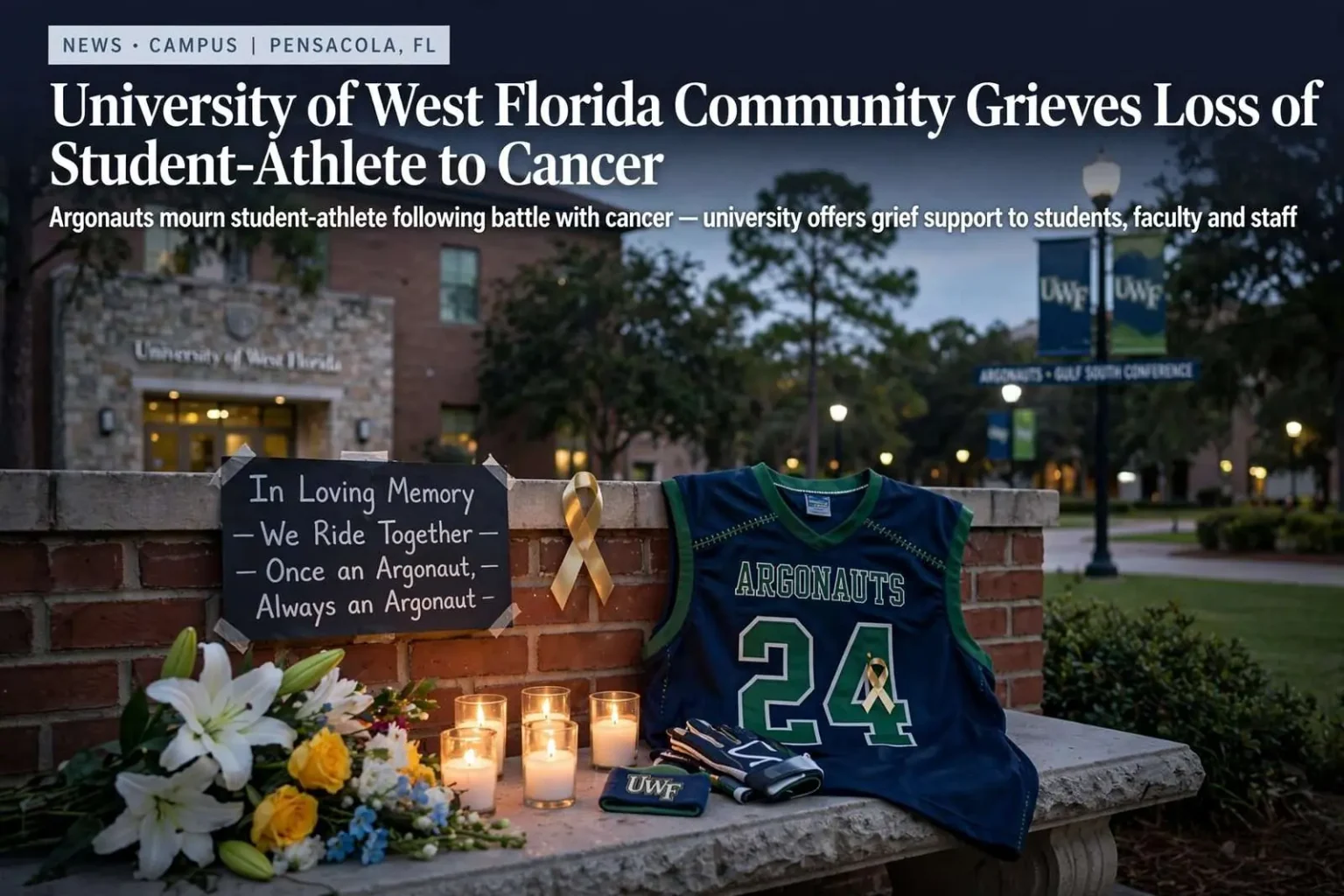
The University of West Florida is mourning the loss of one of its own after a student-athlete died following a battle with cancer, the university announced this week.
News of the death has rippled through the UWF campus community in Pensacola, with coaches, teammates, classmates and administrators expressing grief over the loss of a fellow Argonaut. The university confirmed the student-athlete had been fighting cancer before their death.
While details surrounding the athlete’s specific sport, team and cause of death beyond the illness have not yet been released publicly, university officials indicated that support resources are being made available to students, faculty and staff who are processing the loss.
A Close-Knit Athletics Community
UWF competes as the Argonauts in NCAA Division II, fielding teams in the Gulf South Conference across a range of men’s and women’s sports. Because the athletic department is relatively small compared to larger Division I programs, losses like this one are often felt deeply across the entire student body, not just within a single team.
Universities across the country frequently lean on campus counseling centers, chaplains and athletic department support staff during moments like these, helping teammates and classmates cope with grief while continuing their academic and athletic commitments.
A Reminder of the Fight Against Cancer
The loss also serves as a somber reminder of how cancer can affect even the young and athletic, cutting short promising careers and futures. College athletes, despite being among the fittest members of their communities, are not immune to serious illness, and stories like this one often prompt renewed attention to the importance of early screening, awareness and support for those undergoing treatment.
The University of West Florida community is expected to continue honoring the student-athlete’s memory in the days ahead as more details become available.
A small department, a wide grief
UWF’s size as a Division II school shapes how a loss like this moves through campus. The Argonauts field teams in the Gulf South Conference, and the athletic department is close enough that athletes in one sport know those in another, share weight rooms, travel together and take many of the same classes. When a teammate dies, the grief is not confined to a locker room; it spreads across a community that measures itself in hundreds rather than thousands. That closeness is a strength in ordinary times and a heavy burden in moments like this one, when the same smallness that builds camaraderie also concentrates the sorrow.
How a campus responds
Universities have built formal machinery for exactly this kind of loss: counseling centers staffed for crisis, chaplains who can meet students where they are, and athletic-department staff trained to spot when a teammate is struggling to keep up with school or practice while grieving. UWF’s indication that support is available to students, faculty and staff reflects that standard response, and the challenge is always the quiet sufferers — the ones who will not walk into a counseling office but who need the check-in anyway. Coaches often become the first line of that support, simply by noticing who is not themselves at practice.
Why the story reaches beyond campus
A college athlete dying of cancer lands differently than another obituary because it upends the assumption that fitness is protection. The fittest people on a campus are not exempt from the diseases that take the rest of us, and a death like this one nudges classmates, teammates and readers toward the unglamorous protections — screening, noticing changes, asking for help — that the athletic image can make seem unnecessary. It is a somber reminder, as the original report notes, and one that loses none of its force for being familiar.
Honoring the memory
The university said it expects to continue honoring the student-athlete as more details emerge, and at schools like UWF that often takes the form of a moment of silence before a game, a memorial at a match, or a team wearing a patch or ribbon. Because the athlete’s sport and identity had not been released at the time of the announcement, the early response is necessarily general — support for the community, space to grieve — with more specific tribute likely to follow once the family’s wishes are known. What is certain is that a small athletics community will carry this loss well past the news cycle.
The larger context of athlete health
Collegiate athletics departments have in recent years expanded their health missions beyond the playing field, recognizing that the same students who appear invincible on game day face the same vulnerabilities as any peer. UWF’s athletic training and sports-medicine staff work with student-athletes through injury and illness alike, and a cancer diagnosis intersects that support system at its most serious edge. The grief on a campus like Pensacola’s is also a reminder to readers that behind every roster is a person, and that the Argonaut community’s response — quiet, sustained, communal — is the human scale of a story the numbers cannot capture.
Grief as a campus-wide lesson
For the classmates and teammates who knew the student-athlete, the loss is personal; for the wider UWF community, it is a lesson in how a small university holds itself together. The Argonauts’ identity as a Division II program, with its intimacy and its pride, is the same quality that makes a death here land hard and heal slowly. The university’s promise to keep honoring the memory as details emerge is the beginning of that healing, and the quiet work of counselors, coaches and friends in the weeks after will be the rest of it. A campus mourning together is, in the end, a campus reminding itself what it is.
Remembering without details
Because the university withheld the athlete’s sport, team and specifics, the early public response is necessarily about the community rather than the individual, and that restraint respects the family’s privacy during a raw moment. It also means the fuller tribute — a named remembrance, a team’s gesture, a scholarship or memorial — will come later, once those wishes are known. Until then, the campus does the quiet work of grieving together, and readers do the humbler work of remembering that behind every such announcement is a person whose absence will be felt most by the few who shared a locker room, a classroom and a season.
The Argonaut identity
“Argonaut” is UWF’s chosen name, drawn from the Greek myth of the voyagers who sailed with Jason in search of the Golden Fleece, and it is the kind of identity a small Division II school wears with particular pride. The name implies a journey taken together, and a loss like this one is a moment when the metaphor turns literal: the crew continues without a member, and the voyage goes on. For Pensacola, where UWF is a growing presence, the grief is also a reminder that the university is woven into the city’s life — its students are the city’s neighbors, and its losses are the city’s losses too. The campus will mourn, and then, as campuses do, it will carry the memory forward in the ordinary work of the next semester.
A community that shows up
The measure of a university in a moment like this is whether the people around the loss feel held, and UWF’s response — opening support to students, faculty and staff alike — signals an institution trying to do exactly that. Grief on a campus is not confined to those who knew the athlete personally; it touches classmates who share the halls, professors who taught them, and strangers who feel the weight of a young life cut short. The Argonaut community’s gathering to mourn is the oldest human response to loss, and in a small athletics department it happens in the open, where the whole school can take part. That shared mourning is itself a kind of honor, and it is the one the university can offer immediately, before any memorial is planned.
Carrying the memory forward
When a college athlete dies, the teammates left behind often carry the loss into the next season, playing with a number, a patch or a moment of silence that keeps the absent player present. UWF’s Argonauts will do that in their own way, and the university’s promise to keep honoring the student-athlete as details emerge points to tributes yet to come. For now, the community’s task is the simple, hard one of continuing — classes, practices, games — while holding space for grief. That is what a small, close department does best, and it is the quiet form the memory will take in the weeks and semesters ahead, long after the announcement has faded from the news.
The wider Argonaut family
UWF’s student-athletes are part of a broader Pensacola community that shows up for its university, and a loss like this one reaches past the campus gates. Coaches, classmates and the city itself absorb the grief, and the support resources the university opened are the formal acknowledgment of that reach. In a Gulf Coast region where the university has grown into a civic anchor, the mourning is shared, and the memory of the student-athlete will be kept not only by a team but by a town that considers the Argonauts its own.