USA Alumnus Gives $1.5 Million to Rename Mechanical Engineering Department
University of South Alabama alumnus Bill Burnsed has donated $1.5 million to the College of Engineering, prompting the school to rename its mechanical engineering department in his honor.
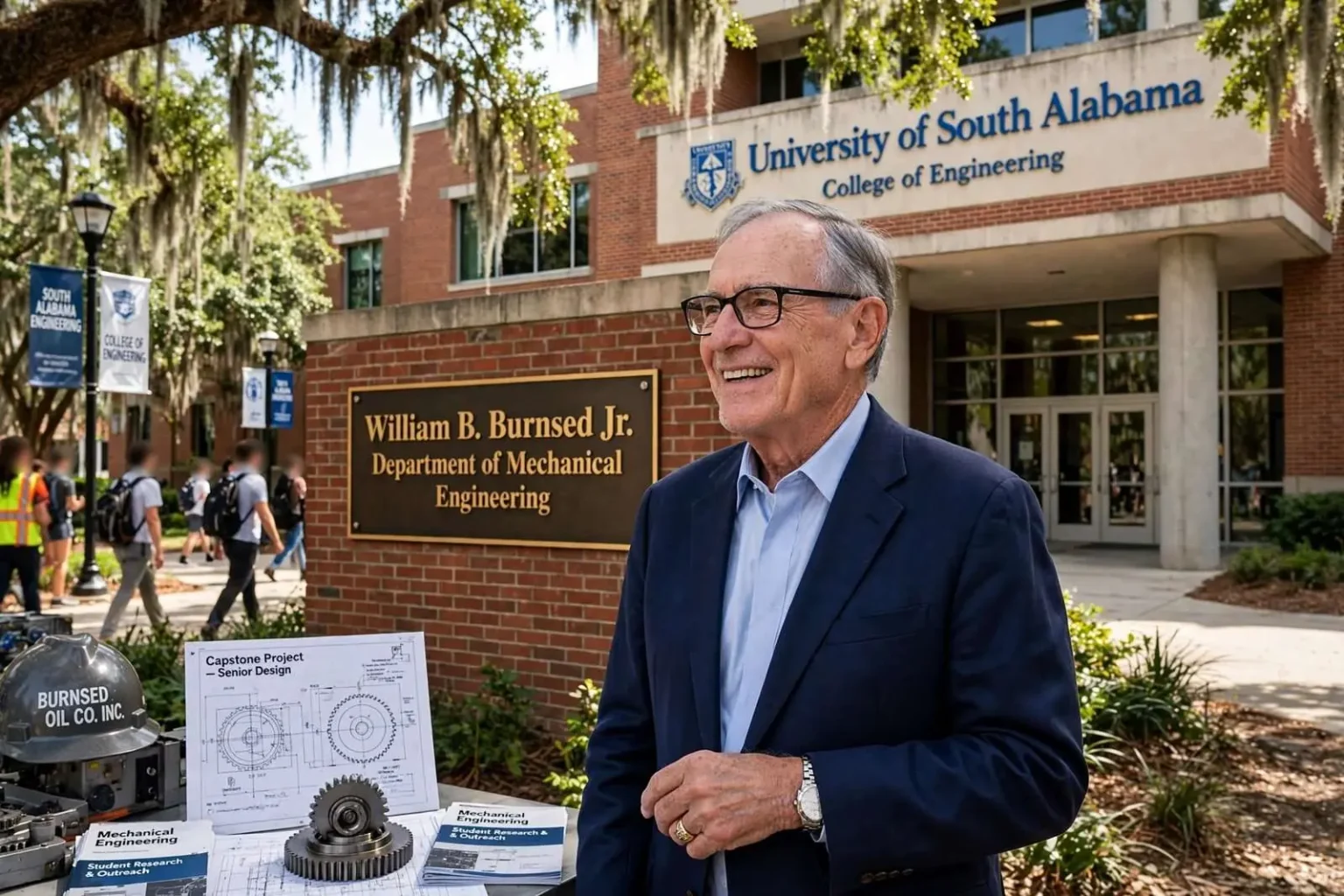
A University of South Alabama graduate has made a $1.5 million gift to the school’s College of Engineering, a donation large enough that the department of mechanical engineering will now carry his name. The gift stands among the more visible expressions of alumni support in the college’s history and marks a milestone for a program that has grown alongside the university itself since the 1960s.
William B. “Bill” Burnsed Jr., who earned his engineering degree from the university in 1972, made the gift to support instruction, research and community outreach within the department. In recognition of the contribution, the program will be renamed the William B. Burnsed Jr. Department of Mechanical Engineering — a permanent marker of the connection between one of Mobile’s homegrown universities and a graduate who built an industry career on the training it gave him.
Burnsed spent 20 years working as an engineer for South Central Bell and BellSouth before leaving the telecommunications industry to start his own company, Burnsed Oil Co. Inc., which explores for and produces crude oil. He has said his engineering training at South Alabama gave him the foundation to build that later career — a path that ran from classroom problem sets in Mobile to corporate engineering work and ultimately to the independent risk of running an oil exploration company.
“I had always planned on giving back to South,” Burnsed said in a statement announcing the gift. “I never would have gotten to where I am today if I had not received my engineering degree, and South best fit my needs to be able to accomplish this.”
His story mirrors that of the university itself. South Alabama enrolled its first students in the mid-1960s as one of the state’s newest public universities, created to serve the Gulf Coast region that had long sent its students elsewhere. Burnsed’s class — the early 1970s — graduated into a university still proving itself, and gifts like his are the sort of full-circle moment administrators point to when they describe what the school has become.
What the Gift Supports
University of South Alabama President Tony Waldrop said the donation would have a lasting effect on students and faculty in the College of Engineering. “This generous gift will allow our College of Engineering faculty to continue to provide exceptional academic curricula, and it will lay the foundation for transformational growth in the department of mechanical engineering,” Waldrop said. “Through Mr. Burnsed’s generous support, South’s engineering students will continue to become the problem solvers and leaders of tomorrow.”
Gifts of this size typically touch every layer of an academic department. For students, they translate into scholarships that keep strong students in the program and endowed funds that support design competitions, student organizations and senior capstone projects. For faculty, they mean research support, equipment and the resources that make recruitment of quality professors possible against competition from larger institutions. And for the department as a whole, a named endowment provides a stable foundation that state appropriations — which fluctuate with every budget cycle — cannot guarantee.
Mechanical engineering, one of the core disciplines of the college, prepares students for work across industries from manufacturing and energy to aerospace and biomedical technology. Its graduates fan out across the Gulf Coast economy, where shipbuilding, petrochemical processing and aerospace suppliers all compete for engineering talent. A named, well-funded mechanical engineering department strengthens that pipeline at both ends, drawing better students into the program and sending better-prepared graduates into the region’s workforce.
John Steadman, dean of the College of Engineering, called the gift a turning point for the department. “Bill Burnsed represents the epitome of what engineers do,” Steadman said. “He uses his knowledge of science and mathematics to create systems and a business that make life better for everyone. His achievements and generosity have brought honor and recognition to the College of Engineering and the university.”
Steadman’s framing — the engineer as builder of businesses as well as systems — tracked the career of the man whose name will now sit above the department’s doors. Burnsed’s two decades at South Central Bell and BellSouth came during the era when the Bell System anchored technical employment across the South, giving thousands of engineers steady, demanding careers in a rapidly evolving industry. His leap from corporate engineering to independent oil exploration reflected the entrepreneurial turn that engineering training makes possible: the same analytical toolkit applied to a very different set of risks.
Philanthropy and the Rise of South Alabama
Named gifts have played a growing role in American higher education as public universities navigate flat or uncertain state funding, and South Alabama is no exception. A $1.5 million gift from an alumnus carries particular weight for a young university still building its philanthropic tradition, and the naming of an academic department — rather than a building or a scholarship fund — signals a donor who wants his support aimed squarely at the classroom experience.
For the College of Engineering, the announcement also serves a recruiting purpose that goes beyond money. Prospective students and their parents take named departments as evidence of institutional strength and alumni confidence, and the story of a 1972 graduate who built an oil company on his USA degree is the kind of narrative admissions materials run on for decades. The gift effectively makes Burnsed’s career part of the department’s sales pitch to every future class.
Community outreach, one of the three areas the gift supports, has become an increasingly central mission for engineering programs nationwide. Departments increasingly send students into local schools to promote science and engineering careers, partner with industry on practical projects, and apply student design work to community needs. For a metropolitan university like South Alabama, that outreach connects the campus to the same Mobile-area industries — manufacturing, energy, shipbuilding — where its graduates will spend their careers.
A Degree That Built a Career
Burnsed’s own account of his education — that the university “best fit my needs” — speaks to the practical appeal that built South Alabama’s enrollment from its founding days. The university grew up serving commuter students and working families from Mobile and Baldwin counties, students who wanted a rigorous degree close to home at a price their families could manage. Engineering was among the programs that anchored that promise, sending graduates into the region’s technical workforce year after year.
Five decades after Burnsed walked the campus as a student, the department that trained him will bear his name, its classrooms and labs supported by the proceeds of the career his degree made possible. University officials describe the gift as an investment in generations of engineers to come; Burnsed describes it as paying a debt. Both descriptions amount to the same thing: a homegrown university and a homegrown graduate, each confirming the other’s bet on Mobile.
The renaming takes effect as the College of Engineering continues its push to grow enrollment, expand research and deepen its ties to Gulf Coast industry. With the William B. Burnsed Jr. Department of Mechanical Engineering now part of the campus map, the university has a permanent reminder of what its graduates can do — and, thanks to the man whose name is on the door, a growing endowment to help the next ones do it.
The announcement also lands at a moment of expansion for the engineering professions across the Gulf Coast. Shipbuilding along the Mobile River, chemical and energy facilities across the region, and the aerospace suppliers that have clustered along the Interstate 10 corridor all compete for mechanical engineers, and local employers have long pressed the region’s universities to produce more of them. A strengthened, named mechanical engineering department gives those employers another reason to look first to South Alabama’s graduates.
The Economics of a Named Department
Behind the ceremony, the mechanics of the gift matter to the department’s future. Endowed gifts are typically invested, with the earnings supporting the donor’s stated purposes year after year — which is why university leaders describe them as permanent. The $1.5 million commitment provides a recurring stream of support that the department can plan around: scholarship awards announced each spring, research funds allocated each fall, outreach programs sustained through years when budgets tighten elsewhere.
Named-gift philanthropy also tends to compound. A flagship commitment from a respected alumnus often encourages other graduates to follow, and development officers will tell you that the second million is easier to raise once the first has a name attached. For a college still building its donor base, the Burnsed gift may prove most valuable not as a single transaction but as a template — proof that a USA engineering degree is worth investing in, and that the university will honor such investments with real, visible recognition.
Students in the department will encounter the Burnsed name daily, on letterhead and classroom doors, and the university hopes they will absorb the lesson it carries: that a Mobile engineering education can lead to a corporate career, an independent company, or both, and that the people who walk out of the program have a habit of looking back to help the ones still inside it.
From Campus to Oil Patch
The story of Burnsed Oil Co. Inc. also reflects a broader Alabama tradition of independent energy entrepreneurship. The state has produced independent oil and gas operators for decades, businesses that grew from the persistence of founders who understood both the geology and the engineering of extraction. Burnsed’s move into exploration and production placed him in that world — one where an engineer’s judgment about systems, pressures and risk determines whether a company survives its first decade.
That career arc, from Bell System engineer to independent operator, is precisely what Steadman meant by the epitome of what engineers do. The discipline’s promise has never been confined to any single industry; it is the habit of applying science and mathematics to whatever problem pays the rent, builds the business and serves the community. Burnsed applied it first to telecommunications, then to oil, and now to education.
The university, meanwhile, gets what every developing institution needs most: a story with a name on it. When the next Mobile teenager weighs an engineering program against a school in another state, the department that now bears William B. Burnsed Jr.’s name can point to a graduate of the class of 1972 who built a company and gave back $1.5 million — evidence, written in endowment, that the road from South Alabama goes wherever an engineer is willing to take it.