University of South Alabama Gulf Shores
USA Archaeologist to Discuss 1,400-Year-Old Canoe Canal Found Near Gulf Shores
A University of South Alabama archaeologist will discuss the excavation of a 1,400-year-old Native American canoe canal discovered on the Fort Morgan Peninsula near Gulf Shores.
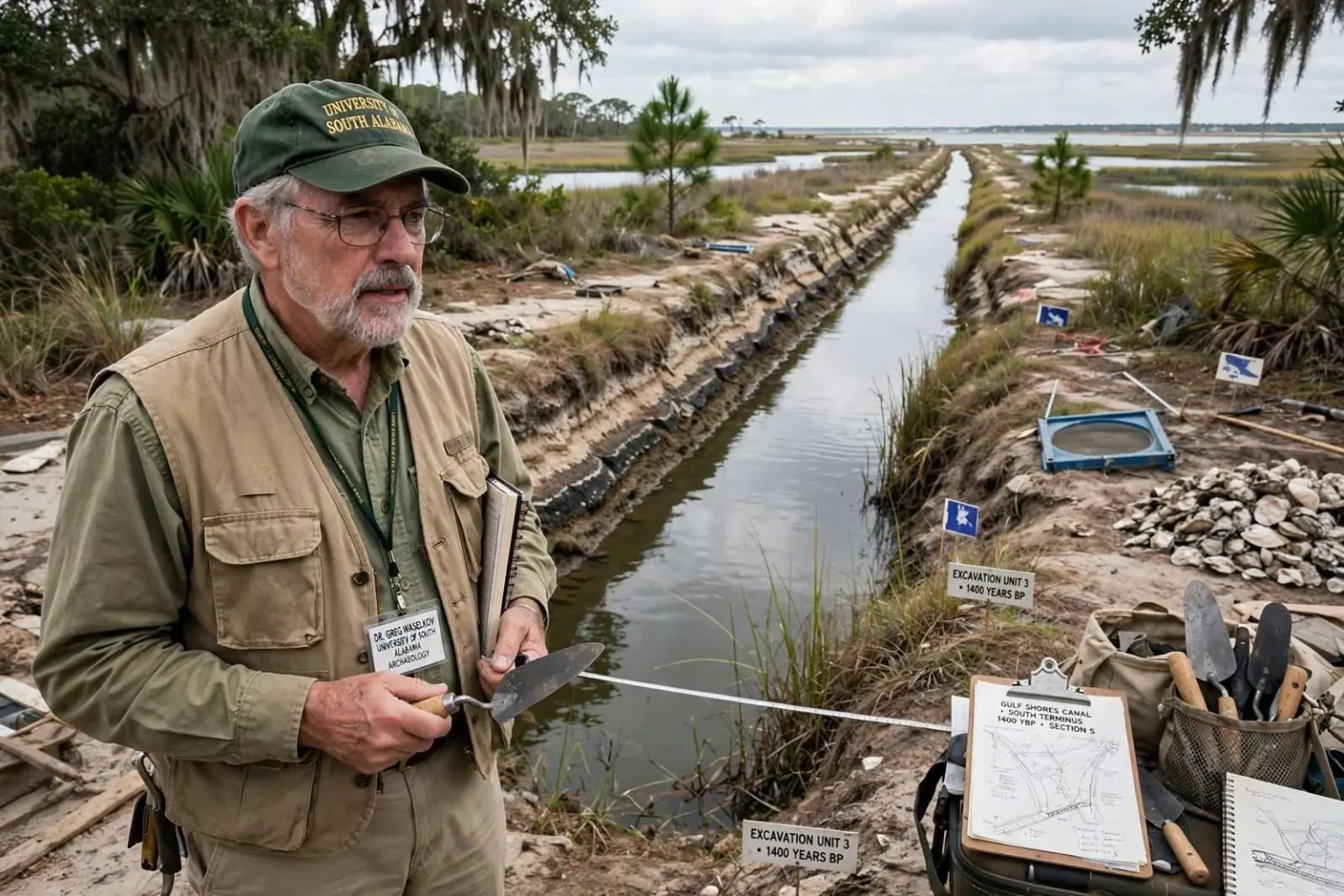
Long before European settlers arrived on the Gulf Coast, Native American tribes living along the Fort Morgan Peninsula found an ingenious way to shorten one of their toughest journeys. Rather than paddle a dugout canoe around the peninsula through open Gulf waters, they dug a canal — a half-mile-long channel connecting Oyster Bay to Little Lagoon that offered a direct, safer route between Mobile Bay and the Gulf. The earthwork, now estimated to be roughly 1,400 years old, stands as one of the most remarkable pieces of pre-contact engineering ever documented on the northern Gulf Coast.
Dr. Greg Waselkov, professor emeritus at the University of South Alabama, led the excavation of the canal and will present his findings in a public talk, “An Ancient Canoe Canal in Gulf Shores, Alabama,” Thursday, Feb. 7, at 6 p.m. at the USA Marx Library in Mobile. The event, free and open to the public, was moved from the Archaeology Museum after drawing more interest than that venue could accommodate
“We know ancient Native Americans had extensive trade and travel routes around the continent,” Waselkov said. Canals like the one in Gulf Shores were part of that larger network, built to save time and reduce risk for people relying on dugout canoes to move goods and people along the coast. “This canal would have saved many hours of paddling for those wishing to go from Mobile Bay to the Pensacola or Biloxi areas and beyond,” Waselkov said. “And it would have made for much safer travel in the back bays, by avoiding the open waters of the Gulf. This was one exceptional piece of a very large transportation system of great antiquity.”
A shortcut through the peninsula
The geography explains the engineering. The Fort Morgan Peninsula extends westward from Gulf Shores like a barrier between Mobile Bay and the open Gulf, and its western tip guards the bay’s main pass. A traveler paddling from Mobile Bay toward communities along the coast to the west — or toward Pensacola and Biloxi — faced a choice: round the peninsula through the surf of the open Gulf, a stretch of water that can turn dangerous with little warning, or take the long way through the back bays. Digging a channel across the neck of the peninsula turned a hazardous open-water passage into a sheltered inland route.
At its peak, the canal ran about 30 feet wide and six to eight feet deep — dimensions that would have accommodated the dugout cypress canoes Native boatbuilders made by burning and hollowing large logs. Centuries of shifting sand have erased most of it, but two roughly 400-foot sections remain well preserved. “There are two well-preserved sections of the Gulf Shores canal, each about 400 feet long,” Waselkov said. “The southernmost section is the canal’s southern terminus where it entered Little Lagoon, and this part is owned by the city of Gulf Shores, so its preservation seems assured. This may be the westernmost ancient canoe canal yet identified in the Southeast.”
The city of Gulf Shores plans to highlight a preserved section of the canal in a heritage trail, giving residents and visitors a chance to stand beside a piece of infrastructure that is more than a millennium older than any road on the peninsula. City officials have said they intend to incorporate the preserved canal section into the planned trail, and the site’s ownership by the city protects it from the development pressure that has swept across the barrier coast.
How the excavation came about
Long before archaeologists took an interest, locals already knew the feature existed. “People living in the area of Fort Morgan Peninsula have always known about the feature and have long attributed it to ancient Native Americans,” Waselkov said. “It was known as the ‘Indian ditch’ in the 20th century.” The name passed down through generations of peninsula families.
Longtime Gulf Shores resident Harry King first urged Waselkov to investigate the site, and in February 2017 the team began small-scale excavations with volunteers at the canal and an adjacent shell midden, following up with a full cross-section excavation last fall. The work — careful, incremental digging through layered sand and preserved organic material — allowed the team to establish the canal’s dimensions, construction method and approximate age, and the shell midden alongside it helped date the periods of human activity at the site.
The canal’s age places its construction in the centuries well before European contact, in an era when coastal peoples across the Southeast were building extensive networks of trade and travel. Archaeologists studying the Gulf Coast have documented mound centers, shell middens and village sites stretching from the Mississippi Sound to the Florida panhandle, and the movement of pottery, stone tools and marine shell between them shows that goods and people were constantly on the move. A canal like Gulf Shores’ fits that picture precisely: it is the kind of infrastructure a well-organized coastal community builds when the traffic between two bodies of water justifies the enormous labor of digging through sand.
Why the discovery matters
Finds like this are exceedingly rare along the Gulf Coast, where erosion, hurricanes and development have erased most physical traces of pre-contact Native American engineering. Earthworks in particular are fragile things — a channel dug through sand begins filling in the moment it is abandoned, and barrier peninsulas like Fort Morgan are among the most dynamic landscapes on the coast, reshaped by every storm season. That any section of a 1,400-year-old canal survived, and that two sections remain well preserved, is extraordinary in itself.
“The only other similarly well-preserved portion of an ancient dugout canoe canal is in Everglades National Park, so the existence of one in our own backyard is pretty extraordinary,” Waselkov said. The comparison underscores the point: the Everglades sites, preserved inside one of the nation’s largest national parks, were long thought to be the only surviving examples of their kind, and the Gulf Shores canal gives the Southeast a second and possibly the westernmost yet identified in the Southeast.
For Alabama, the find adds a significant entry to the record of Native American achievement in the state. Alabamians are familiar with the great mound centers of the Black Belt and the Tennessee Valley, but coastal engineering of this kind is far less widely known. The canal demonstrates sophisticated knowledge of local hydrology — an understanding of tides, water levels and the connection between Little Lagoon and the Gulf — along with the ability to organize community labor on a scale that a half-mile channel implies.
It also carries lessons for how the modern coast is used. The same route logic that made the canal valuable — sheltered water instead of open Gulf — still governs navigation along the peninsula today, where recreational boaters thread the same bays and lagoons. The ancient builders chose the same shortcut a modern mariner would, with the same prize in mind: hours saved and open water avoided.
The public talk and what comes next
Waselkov’s talk at the USA Marx Library will walk the audience through the excavation and what it revealed, from the first volunteer digs in early 2017 to the full cross-section completed last fall. Cross-section excavations are the standard method for reading an earthwork’s history: by cutting a narrow trench through the canal and examining the layers of sediment, archaeologists can identify the original channel profile, subsequent episodes of clearing or re-digging, and the material left behind by the people who used it.
The presentation is free and open to the public, and organizers moved it to the library after the Archaeology Museum’s capacity proved insufficient — an unusual problem for a weekday evening lecture, and one that reflects the breadth of local interest in the peninsula’s deep history. Gulf Shores officials have said they intend to incorporate the preserved canal section into a planned heritage trail, giving residents and visitors a rare, accessible look at nearly 1,400 years of South Alabama history, and the city’s ownership of the southern terminus section means the site’s preservation seems assured.
For the archaeologists and volunteers who worked the site, the canal is also a reminder of how much of the past sits in plain sight. The feature was never lost — peninsula residents had always known it and always attributed it to the region’s first peoples. What changed was that a local resident’s persistence, a university archaeologist’s attention and a few seasons of careful digging turned a familiar landmark into a scientific discovery with a place in the record of Native North America.
Volunteers played a central role in the Gulf Shores work, continuing a long tradition of community archaeology on the Alabama coast. Small-scale digs at the canal and the adjacent shell midden in February 2017 gave residents a hands-on role in documenting their own landscape, and the full cross-section excavation that followed built on what those early seasons revealed. The midden — a accumulated mound of discarded shells and everyday debris — served as a companion to the canal itself, preserving evidence of the meals, tools and trade goods of the people who lived and worked along the waterway.
The heritage trail plan would connect the preserved sections into a route visitors can follow, turning an archaeological site into a public landmark of the kind usually found only in national parks. For Gulf Shores, a city better known for beach tourism, the canal offers a second story to tell about the same stretch of sand: that long before the first hotel or fishing pier, this coast was already a highway, and its builders were already engineers.