USA Archaeology Museum lecture series opens with talk on Gulf Islands National Seashore history
The University of South Alabama Archaeology Museum opens its fall lecture series with a talk on Gulf Islands National Seashore's shipwrecks and Spanish colonial history, while Mobile's arts calendar also features a comedian's cancer-inspired one-man show and a guest trumpet recital at USA.
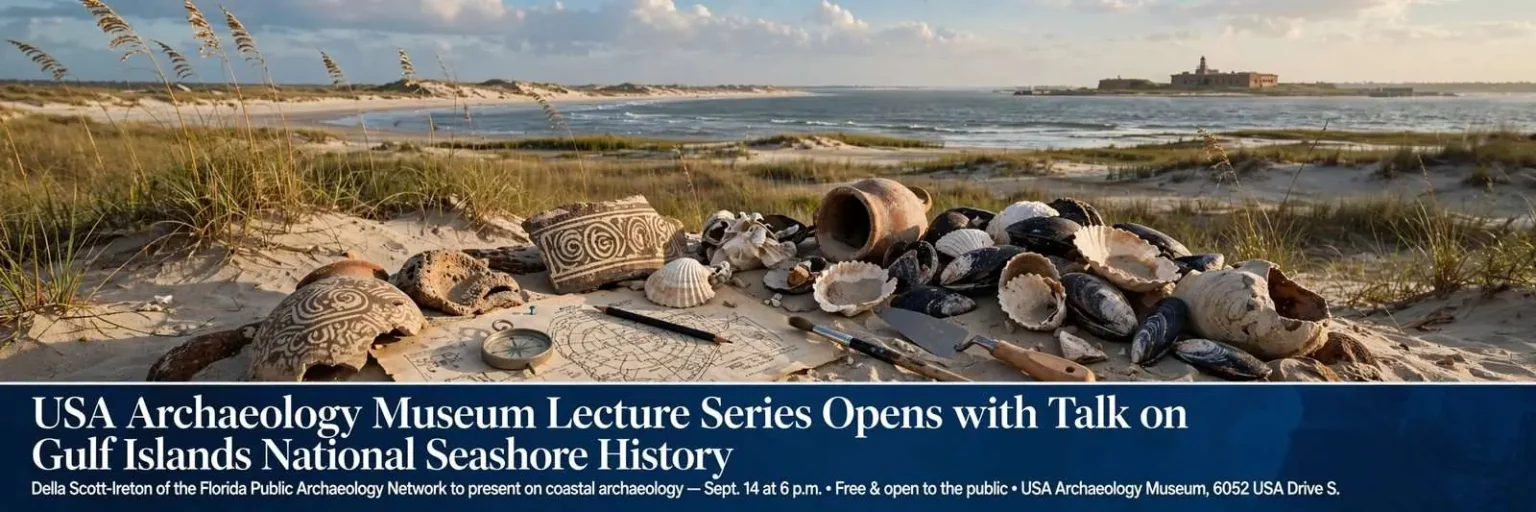
The University of South Alabama Archaeology Museum is opening its fall lecture series with a look at one of the Gulf Coast’s most storied stretches of shoreline. Della Scott-Ireton of the Florida Public Archaeology Network will speak on the archaeology of Gulf Islands National Seashore on Sept. 14 at 6 p.m. at the museum, located at 6052 USA Drive S. on the University of South Alabama campus.
The lecture is free and open to the public and is aimed at general audiences as much as at students and professionals. Scott-Ireton, a maritime archaeologist whose organization works to make Florida’s buried and submerged past accessible to residents and visitors, has spent much of her career on the underwater sites of the northern Gulf, which makes the seashore’s story — part colonial frontier, part maritime graveyard — a natural subject for the series opener.
For Mobile audiences, the talk is also a look across the state line at the shared history of the northern Gulf coast. The same Spanish colonial currents, the same shipping lanes, and the same hurricanes shaped both Pensacola Bay and Mobile Bay, and the archaeological record preserved on the barrier islands reads as a companion volume to the one being studied on the Alabama side of the border.
A park built on deep history
Gulf Islands National Seashore, managed by the National Park Service, stretches across barrier islands and coastal areas near Pensacola, including Santa Rosa Island. The park is known for its undisturbed beaches, dunes and marshes that provide habitat for a wide range of wildlife, but the land and surrounding waters also hold a deep and often overlooked archaeological record.
Established by Congress in 1971, the seashore protects one of the longest uninterrupted chains of barrier island habitat in the United States, running from Santa Rosa Island in Florida west to the Mississippi Sound. Visitors know it for the white sand and the forts — Fort Pickens on the western end of Santa Rosa Island and the fortifications around Pensacola Bay among them — but beneath the dunes and beneath the waves lies a record of human presence that stretches from Native American campsites through the Spanish colonial era, the antebellum military buildup, and the shipwrecks of the steam and industrial age.
That layered quality is what archaeologists find compelling. A single stretch of shoreline can hold a prehistoric shell midden a few feet from the remains of a colonial structure, while the waters offshore hold vessels that sank in storms a century apart. Because the islands have seen relatively little development since the park was created, the sites survive in a condition that is increasingly rare along the developed stretches of the Gulf Coast, where beach renourishment, seawalls and construction have erased much of the shallow record.
Scott-Ireton’s presentation will cover several of the seashore’s most significant sites, including the remains of a Spanish colonial presidio and multiple shipwrecks spanning different eras of Gulf Coast history.
The presidio remains speak to the period when Spain contested the northern Gulf with France and Britain, and when Pensacola Bay served as a colonial settlement and garrison site centuries before tourism reached the islands. The shipwrecks tell a different story: the northern Gulf’s shallow waters, hidden sandbars and hurricane seasons have claimed vessels since European ships first entered the region, and each wreck is a time capsule of the trade, warfare and daily life of its moment. Underwater archaeology on such sites is slow, technical work — mapping, remote sensing, careful excavation beneath sand — and Scott-Ireton’s talk is expected to walk audiences through how that work is done and what it has found.
The Florida Public Archaeology Network, headquartered in Pensacola with regional centers around the state, exists to bring that kind of research to the public — supporting local governments on buried archaeological sites, helping divers and boaters understand the laws around submerged sites, and running education programs for schools and civic groups. Its partnership with institutions across the state line, including museums like USA’s, reflects how little regard the archaeological record pays to modern borders.
The talk kicks off what organizers hope will be a well-attended series of programs at the museum through the fall semester, drawing on researchers and specialists from across the region to speak on archaeological topics tied to the Gulf Coast. Admission information and future dates in the series are available through the museum. Those interested in attending or learning more can call 251-460-6106 or email Candice Cravins at [email protected].
The museum, which houses artifacts from sites across south Alabama and the central Gulf Coast, has built its public programming in recent years around exactly this kind of accessible evening lecture — short, illustrated talks that let students, retirees and curious residents hear directly from working archaeologists. Fall is the museum’s busiest season, when student groups and community organizations return to campus and lecture attendance is at its strongest.
A comedian takes on cancer
Also on the local arts calendar this month, Mobile native Steve Evans is finding an audience online for his one-man show tackling his own cancer diagnosis with dark comedy. Evans’ act, titled “Brother Luther Powell vs. Cancer,” debuted this summer at Yippie Fest in Chicago, a successor to the long-running Abbie Hoffman Died for Our Sins Theatre Festival, and is now posted on YouTube for local audiences to watch.
The performance is built around a fictional Southern preacher character, Brother Luther Powell, whom Evans has portrayed for years in his trademark seersucker suit, colorful tie and two-tone wingtips. This time, though, the suit fits noticeably looser, a visual reminder of the weight Evans has lost during his real-life battle with small-cell cancer over the past year.
The roughly 20-minute set walks through the unusual circumstances of his diagnosis, discovered after a vehicular accident, and continues through chemotherapy and the unexpected moments of humanity and humor that came with it, including an anecdote about a police officer giving him a ride to obtain liquid morphine.
The Chicago festival circuit has a long tradition of solo performers workshopping intensely personal material before small, forgiving audiences, and Yippie Fest — the continuation of a festival that ran for decades under the name honoring the activist and prankster Abbie Hoffman — has been a proving ground for exactly that kind of risk-taking work. Evans, performing a preacher processing a cancer diagnosis through scripture-flavored standup, fit the room. Posting the set afterward on YouTube extends the festival run indefinitely, letting friends and audiences at home see a show that would otherwise have played to a few hundred people in a Chicago theater.
Comedy about serious illness is a delicate trade, and the loose-fitting seersucker does a share of the work — the costume is the joke and the evidence at once. For local audiences who have watched Evans perform the Brother Luther character over the years, the set reads as a continuation of a familiar act turned inward; for strangers, it lands as a stranger’s honest, funny account of the worst year of his life.
A trumpet guest on the recital series
Rounding out the month’s offerings, the University of South Alabama’s faculty recital series will welcome a guest artist from outside the department when Columbus State University trumpet professor Robert Murray performs at Laidlaw Recital Hall on the USA campus on Sept. 18 at 7:30 p.m. Murray will be joined by pianist Alina Sarkisyan-Bennett for a program billed as both accessible and musically substantial.
Faculty recital series traditionally spotlight the department’s own professors, but a guest slot each season gives students a chance to hear a working professional up close and gives the audience a program the resident faculty could not otherwise offer. Murray’s visit also connects USA’s music students with a peer institution — Columbus State’s Schwob School of Music in Georgia is among the stronger regional music programs, and exchanges of this kind are how faculty and students alike keep a finger on the wider professional world.
Murray has built a career praised for his tone and stage presence, with performances spanning international orchestras, the Dallas Brass and Broadway pit orchestras. He currently serves as principal trumpet of the North Charleston POPS! in South Carolina. That range — symphonic work, brass ensemble showmanship, and the pit-orchestra stamina that Broadway demands — maps neatly onto the two sides of a recital program, where a performer must move between virtuoso display and quiet, chamber-scale collaboration with the pianist.
Tickets for the Sept. 18 recital are $8 general admission and $5 for USA faculty, staff, students, youth under 18 and senior citizens, available at the door on a cash-or-check basis. Those with questions about the recital can contact Peter Wood at 251-460-7821. Together, the three events reflect a busy stretch on Mobile’s arts and education calendar, offering residents chances to explore coastal archaeology, catch an unconventional comedy performance born of personal hardship, and hear a visiting classical musician share the stage with USA’s own faculty.