USA Art Professor’s Poster Chosen to Represent 2010 Gulf Coast Ethnic and Heritage Jazz Festival
Brazilian-born USA art professor Daniel Wildberger's poster was chosen for the 2010 Gulf Coast Ethnic and Heritage Jazz Festival in Bienville Square.
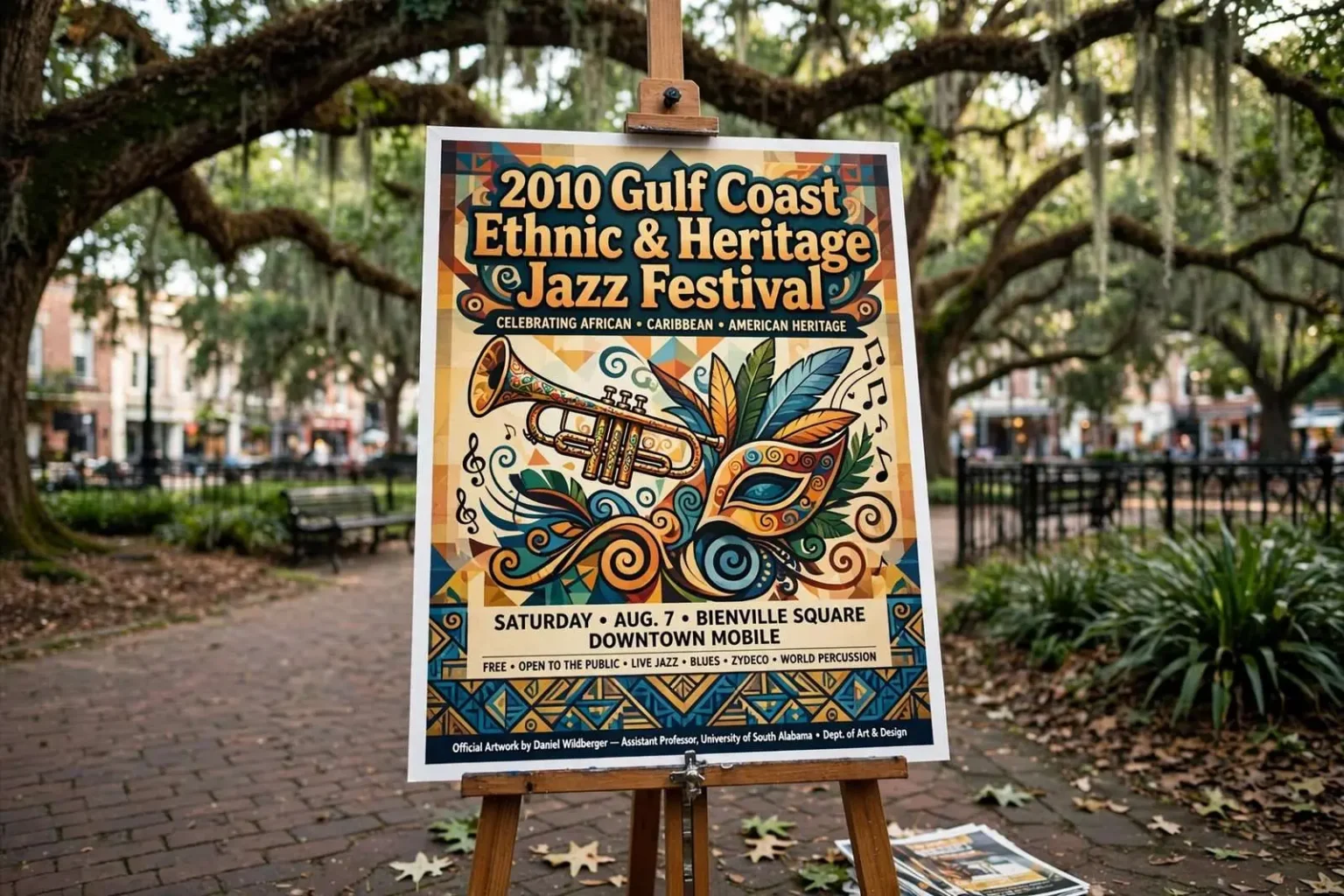
A poster designed by University of South Alabama assistant professor Daniel Wildberger has been chosen as the official artwork for the 2010 Gulf Coast Ethnic and Heritage Jazz Festival, set for Saturday, Aug. 7 in Bienville Square in downtown Mobile. The selection puts Wildberger’s design on the festival’s promotional materials for the summer, and it links a free public celebration of jazz to the work of one of the newer members of Mobile’s design community. Wildberger, a graphic designer and art director originally from Salvador da Bahia, Brazil, is one of a growing number of international artists who have settled in Mobile and shaped its creative community.
Bienville Square, the park where the festival unfolds, has long served as a gathering place for downtown events, its live oaks shading a block of Main Street just blocks from the government and office buildings that empty out each evening. A jazz festival in that setting draws a broad cross-section of the city — office workers at lunch, families in the evening, and the musicians and enthusiasts who follow the regional jazz scene from festival to festival.
For the University of South Alabama’s art department, having a faculty member’s work chosen as the face of the festival is a visible reminder that the university’s creative programs reach beyond the campus. Festival posters occupy a special place in design; the best of them become collectibles, and the designer’s name travels with the event long after the last note fades.
From Brazilian advertising to Cannes
Wildberger began his design career about a decade ago working in advertising agencies in Brazil, where he built a portfolio while learning both the creative and business sides of the industry. Salvador da Bahia, his home city, sits at the heart of Brazil’s Afro-Brazilian culture, a place where music and visual art permeate daily life — a background that resonates with the jazz festival that now carries his artwork.
He has described 2004 as the turning point in his career, the year he did graphic design work for props and set pieces on the Brazilian feature film “Cidade Baixa” (released internationally as “Lower City”). The film went on to win several Brazilian and international awards, including the Prix de la Jeunesse at the Cannes Film Festival, and it was the project that convinced Wildberger his design work could do more than sell products — it could help tell a story.
That shift from advertising to storytelling has defined his path since. Film design asks for something different from commercial work: imagery that serves a narrative, sets a mood, and honors a director’s vision rather than a client’s sales goals. Wildberger has said the Cannes recognition attached to “Cidade Baixa” taught him that design made for the screen could reach audiences around the world. The credit also opened doors in an industry where a festival award carries more weight than any portfolio page, and it set the pattern of alternating between commercial commissions and film work that he still follows today.
A move to Mobile
Also in 2004, Wildberger and his wife, filmmaker Isabel Wildberger, relocated to the United States after she won a Fulbright Scholarship to study film at the University of Iowa. Wildberger’s professional background helped him gain admission to the university’s MFA program in design, where he worked as a graduate teaching assistant and discovered a passion for teaching. The discovery would eventually carry the couple south, from Iowa City’s academic atmosphere to the Gulf Coast.
Two years ago he joined the University of South Alabama as an assistant professor, teaching in the university’s art and design program. For Mobile’s arts community, the arrival of a designer with Brazilian agency experience, international film credits, and an MFA from a major research university added a distinct voice to a scene that has long punched above its size for a city of Mobile’s population. The university’s art programs serve students from across the Gulf Coast, and faculty who bring working-world credentials give those students a bridge from the classroom to careers in design, advertising, and the film industry.
Since arriving in Mobile, Wildberger has stayed active as both an educator and a working artist. He produced, edited and handled image design and graphics for his wife’s first feature-length documentary, “Rootsy Hip,” which premiered at the inaugural South Alabama Film Festival. The festival gave local filmmakers a hometown stage for their work and introduced the Wildbergers to the region’s growing independent film community.
He has also designed movie title sequences and posters for two more Brazilian productions: the short film “Prince Charming,” which screened at the Museum of Modern Art’s Premiere Brazil! Film Festival in New York, and the feature “Quincas Water Yell,” which opened nationally in Brazil and is expected to be released in Europe. Few designers anywhere can claim both a MoMA-adjacent festival credit and a national theatrical release in a foreign market, and the combination gives his classroom work a professional weight students respond to.
Closer to home, he designed the cover art for a new album from Mobile band BlueyedSoul, a project that connected the professor to the city’s own music scene. The local album work and the jazz festival poster now bracket his Mobile portfolio: both pieces of design made for music, and both made for audiences in the city where he teaches.
Building his own studio
Wildberger recently launched Wild Inc., a one-person design studio built around his work in visual communication. He said he has several poster concepts sketched out, exploring themes of pop culture and social and environmental responsibility, that he plans to finish as time allows. The studio gives him a vehicle for the kind of personal projects that teaching and client work often leave no room for, and poster art — the format that now graces the jazz festival — is where he plans to devote the first spare hours he finds.
He also has two more Brazilian film productions in pre-production for which he’ll contribute design work, keeping the transatlantic thread of his career intact. Maintaining working relationships with Brazilian directors from a studio in Mobile is the kind of balance more creative professionals are striking in a connected economy, and Wildberger’s dual-market portfolio has become part of what he brings to his students.
Isabel Wildberger, meanwhile, is developing a short documentary about the late Mobile writer Eugene Walter and Southern cuisine, with a focus on gumbo. Walter — novelist, poet, playwright, and chronicler of Mobile’s eccentricities — remains one of the city’s most celebrated cultural figures, and a film examining him through the lens of Southern food ties the couple’s creative life ever more closely to their adopted city.
The couple also plans to reassemble much of the “Rootsy Hip” team for a future project, this time collaborating with filmmakers Gideon Carson Kennedy and Marcus Rosentrater, who previously made the short film “Clandestine.” The plan signals that “Rootsy Hip” was a beginning rather than a one-off, and that the independent film network the couple joined on arrival in south Alabama has become a working community rather than a casual acquaintance.
The festival and the poster
The Gulf Coast Ethnic and Heritage Jazz Festival takes place Aug. 7 in Bienville Square, with Wildberger’s poster serving as the visual centerpiece of this year’s event. The festival’s name captures its dual mission: celebrating the jazz tradition and the ethnic heritage — African, Caribbean, and American — whose currents meet in the music. Festivals of this kind have long served double duty as concert and classroom, presenting the history of the music alongside live performance.
August in downtown Mobile brings heat and humidity, but it also brings the season of outdoor cultural events that the city has built its summers around. Bienville Square’s location puts the festival within walking distance of downtown offices and hotels, giving visitors and locals alike a low-cost evening of music under the oaks. For the organizers, the official poster is the first impression most people have of the event — printed on flyers, posted around town, and shared online in the weeks before the first set.
Wildberger’s selection continues a pattern in which Mobile’s festivals have drawn on the area’s designers and artists for their signature images, keeping the visual identity of local events in local hands. For an assistant professor two years into his university career, the commission is both recognition and welcome: the city he moved to has, through its oldest cultural institutions and its newest design community, asked him to help tell its story — one poster at a time. If the couple’s documentary plans and the growing independent film network around them bear fruit, this summer’s festival poster may be remembered as an early marker of a career that took root in Mobile the way so many creative paths have before it.