University of South Alabama Mobile County
USA Health Equips Rural Alabama Hospitals With Maternity, Newborn Emergency Kits
USA Health delivered fully stocked maternity and neonatal emergency carts to three rural Alabama hospitals in May, part of a growing effort to support mothers and babies as rural labor and delivery units close.
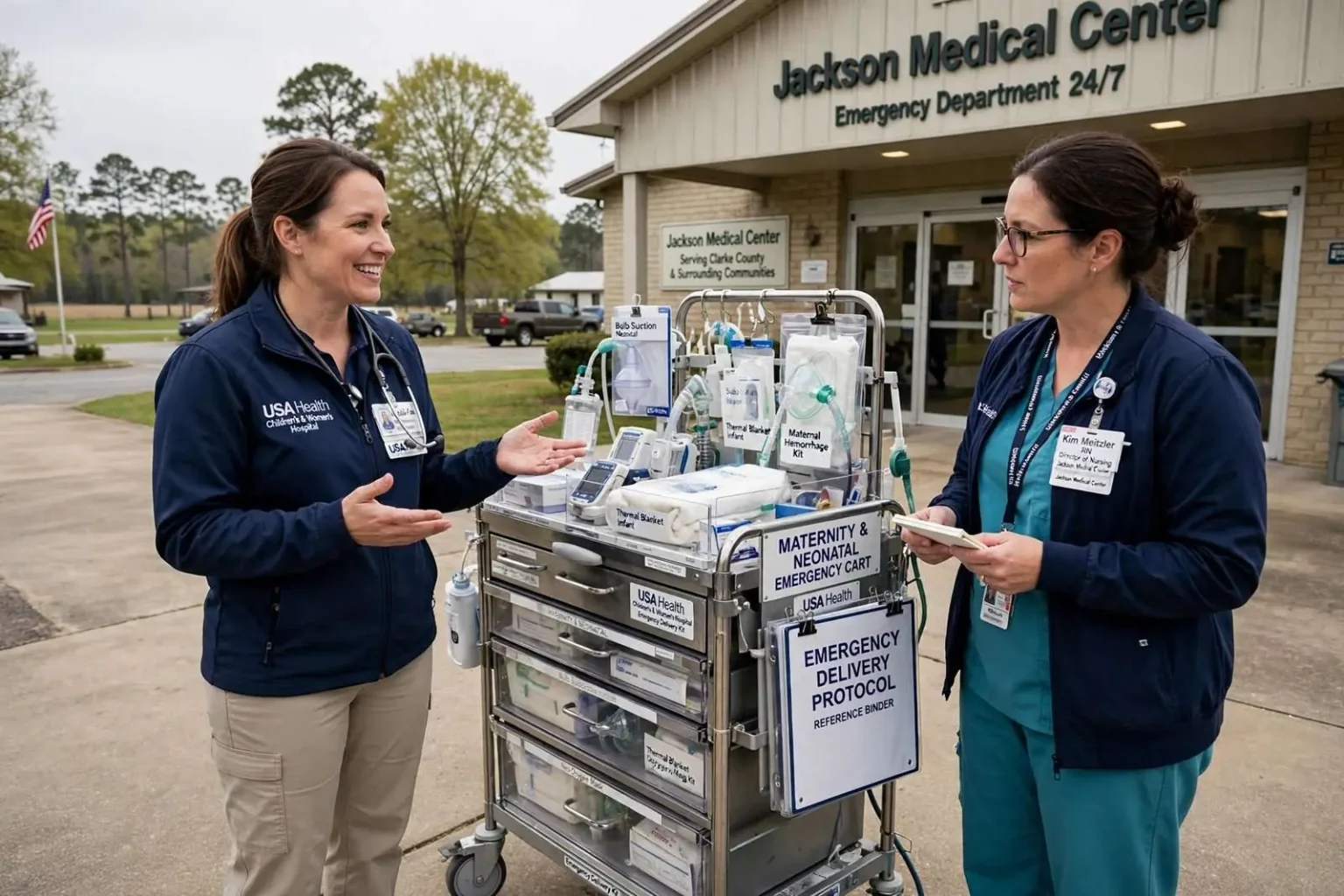
USA Health, the academic health system tied to the University of South Alabama, has begun outfitting rural hospitals across the region with fully stocked maternity and neonatal emergency carts, part of a broader push to protect expectant mothers and newborns in communities that have lost local labor and delivery services. The program brings specialized equipment and hands-on training to small hospitals that must now be prepared, sometimes years after closing their obstetric units, for a mother in labor to arrive at their emergency department without warning.
Rural areas of Alabama, like many parts of the country, have increasingly become “maternity deserts” as small hospitals close their obstetric units, often citing cost and staffing pressures. Maintaining a labor and delivery service requires around-the-clock staffing by nurses and physicians with specialized training, and for hospitals delivering only a handful of babies a month, the economics became impossible to sustain. The trend has left some expectant families driving long distances for prenatal care and delivery, and has raised the odds that a baby could be born unexpectedly at a hospital with no dedicated OB/GYN team on hand.
For families in Clarke, Monroe, Washington and other rural counties across south Alabama, the loss of local delivery services has turned what was once a short drive to the county hospital into a journey of an hour or more to Mobile or Pensacola. Prenatal visits multiply over the course of a pregnancy, and every one of them now requires time away from work, money for fuel and a reliable vehicle — burdens that fall hardest on the patients least able to bear them.
In May, staff from USA Health Children’s & Women’s Hospital delivered the specialized carts to three rural Alabama hospitals that no longer operate labor and delivery departments. Rather than simply dropping off supplies, the team spent time on-site walking nurses and other hospital staff through how to use the equipment in an emergency delivery. Within a week of one of the deliveries, a baby was safely born at that hospital using the new cart.
Months of Work Behind the Carts
Natalie Fox, DNP, chief executive officer of USA Health, said the program reflects months of work by the Children’s & Women’s Hospital and OB/GYN teams, from producing a training video to designing the carts themselves. She said the effort is already paying off for rural hospitals and the mothers and infants they serve across south Alabama. The carts are not improvised collections of leftover supplies; they were designed specifically for the scenario rural staff feared most — an unexpected delivery with no obstetric team in the building.
The push to build the carts followed a wave of labor and delivery closures at rural community hospitals in south Alabama. While some of those units have been gone for decades, others have shut down more recently, prompting nervous calls from hospital leaders asking Children’s & Women’s Hospital staff for guidance on how to safely manage a delivery if one occurs without warning. Those conversations turned into a broader action plan that paired the emergency carts with additional training tools and protocols.
The calls revealed a common thread: rural nurses are highly capable generalists, but few had recent hands-on experience with childbirth, and none wanted to be improvising in the moment. By turning scattered requests for advice into a structured program, USA Health converted a one-off consultation service into durable infrastructure that any of the region’s small hospitals can draw on. The design process drew directly on the day-to-day experience of the Children’s & Women’s Hospital teams, whose staff handle high-risk deliveries regularly and know exactly which instruments, medications and supplies an emergency birth requires — knowledge that does not sit in every rural supply closet.
Kim Meitzler, director of nursing at Jackson Medical Center in Jackson, Alabama, said the support from the USA Health team has been consistent and responsive whenever her staff has needed help. Meitzler said the delivery cart and its accompanying reference binder have made a noticeable difference in how her hospital prepares for births. Having every needed supply organized in a single, easily accessible location means staff are not left searching for equipment in the middle of an emergency, she said, which reduces stress and helps the team respond more efficiently.
Jackson Medical Center serves as the primary hospital for a broad swath of Clarke County and the surrounding rural region, and its emergency department is often the closest point of care for expectant mothers in communities that no longer have an alternative nearby. In an emergency delivery, minutes matter — both for the mother and for a newborn who may need immediate warmth, suction or resuscitation. A cart that consolidates those resources, with a binder that walks staff through each step, turns a chaotic scene into a checklist.
Training That Travels to the Hospitals
A key piece of the initiative is a maternity and neonatal emergency training video produced by USA Health staff. Workers at rural hospitals can complete the training at no cost and earn continuing education credit as part of the health system’s broader education mission. The credit-bearing format matters for small hospitals with thin training budgets, because it turns mandatory continuing education hours into preparation for the specific emergency those nurses are most likely to face.
The remote format also fits the reality of rural staffing. Nurses at small hospitals cannot easily leave their units for a day of training in Mobile, and backfilling a single shift can strain a department with a dozen employees. Delivering the instruction by video, free of charge, means a night-shift nurse in Jackson or Monroeville can complete the same coursework as a counterpart at the academic medical center.
The rural outreach has also drawn on state support, including Rural Health Support funding USA Health receives and backing from the Alabama Department of Public Health. State public health officials have documented persistent gaps in maternal care across Alabama’s rural counties, where the loss of hospital obstetric units and a shrinking supply of family physicians and OB/GYNs have compounded one another. Programs that equip the remaining rural hospitals for emergencies have become a stopgap against the worst outcomes while longer-term workforce solutions remain out of reach.
A Broader Rural Health Push
In recent years, the health system’s women’s services division has also rolled out programs such as HERO4MOM, which helps new mothers track their blood pressure after childbirth, a period when serious complications can develop quickly and sometimes go unnoticed without regular monitoring. Postpartum hypertension and related conditions can escalate in the days and weeks after a mother leaves the hospital, often before a scheduled follow-up visit. Remote monitoring programs like HERO4MOM give clinical teams a way to catch danger signs early, even for patients who live far from the nearest specialist.
USA Health also runs three mobile clinics that extend health care access into rural communities, made possible in part by a $1.5 million state grant used to purchase and equip the vehicles. The mobile units are outfitted with medical equipment as well as audio and video capabilities, allowing them to provide clinical care, virtual consultations and community health outreach in areas of greatest need throughout the region. For residents of towns without a physician’s office, the mobile units bring primary care, screenings and specialty consultations to church parking lots and community centers close to home.
The mobile clinics and the maternity carts share a common logic: extend the academic medical center’s reach into communities that have lost the services they once took for granted. Rather than waiting for rural patients to make the drive to Mobile, the health system has pushed equipment, training and clinicians out along the same rural highways its patients travel. Each piece of the program addresses a different link in the chain — prenatal care, emergency delivery readiness, postpartum monitoring and everyday access to a clinician — and together they form a support network that did not exist for rural mothers even a few years ago.
Officials with USA Health said the broader goal behind the maternity carts and related outreach programs is to strengthen the support system available to rural health care providers, helping them extend specialty services to residents who might otherwise have to travel far from home to receive them. The early results — a training program rural nurses can complete without leaving their communities, and at least one baby safely delivered with the help of a cart that arrived only days before — suggest the approach is working. For the rural hospitals still standing watch in towns that have lost so much of their medical infrastructure, the program offers a simple assurance: if a mother arrives in labor, they will not face it alone.