USA Health Launches Two New Monthly Cancer Support Groups in Mobile and Fairhope
USA Health's Mitchell Cancer Institute has started two new monthly cancer support groups, one in Mobile focused on colorectal cancer and a general group in Fairhope, to help patients and families.
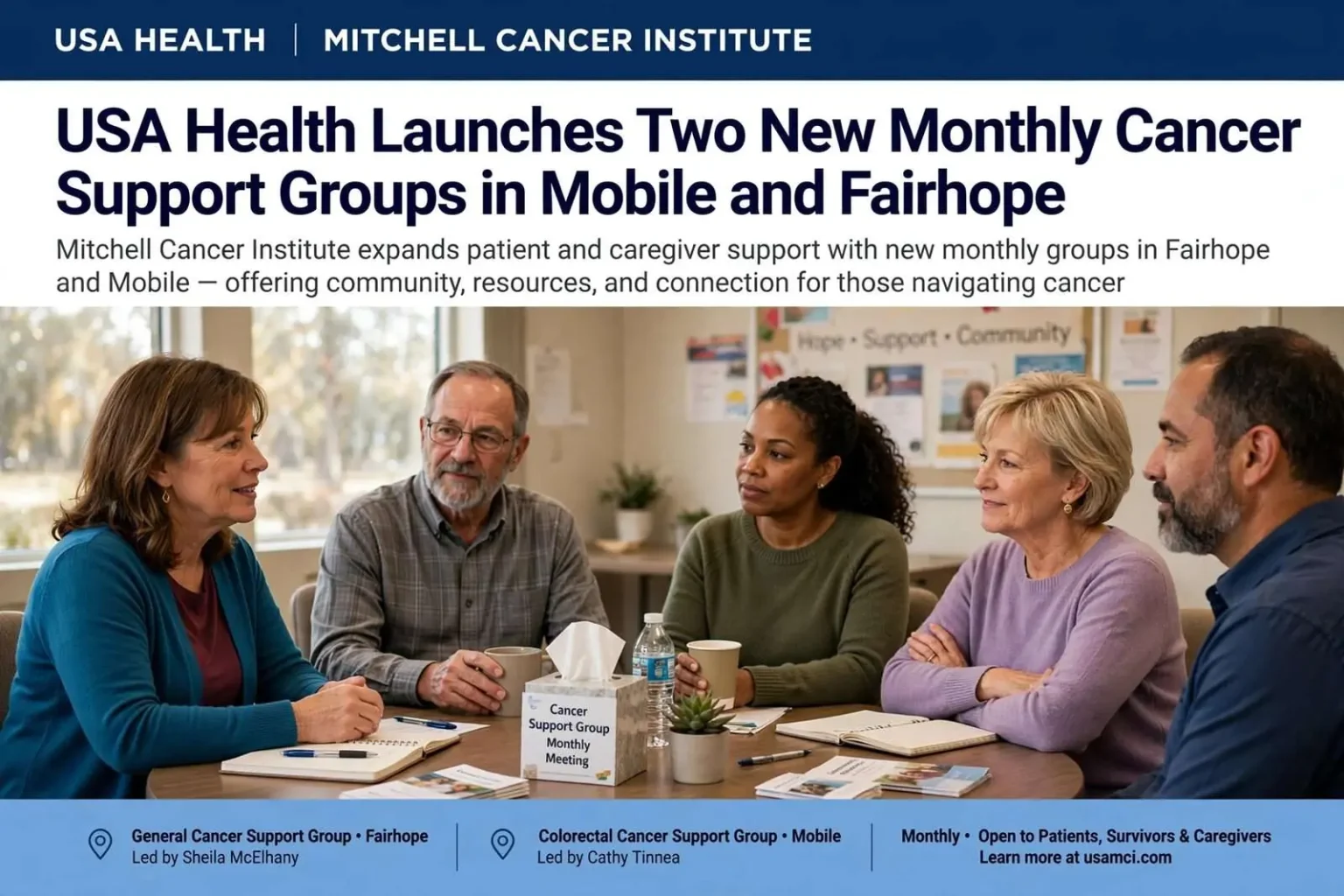
Patients and families across South Alabama now have two additional monthly resources for cancer support, as USA Health’s Mitchell Cancer Institute has launched a pair of new support groups meeting once a month in Mobile and Fairhope. The groups give patients, survivors and caregivers structured settings to talk through the realities of a cancer diagnosis — treatment decisions, side effects, finances, fear and hope — with others who are living through the same experience.
The General Cancer Support Group meets in Fairhope and is led by Sheila McElhany, while a Colorectal Cancer Support Group meets in Mobile under the leadership of Cathy Tinnea. Both women recently discussed the groups in a local television appearance, explaining why gatherings like these matter so much for patients, family members and loved ones navigating a cancer diagnosis. Their message centered on a simple observation: medical treatment addresses the disease, while support groups address everything else that surrounds it.
Why Support Groups Remain a Staple of Cancer Care
Support groups have long played a role in cancer treatment and recovery, offering patients and caregivers a space to share experiences, ask questions and connect with others facing similar challenges. Decades after they became a fixture of comprehensive cancer care, the format continues to fill needs that clinical appointments cannot: the practical tips patients swap about managing treatment days, the honest conversations about setbacks, the reassurance a newly diagnosed patient gets from someone five years past the same diagnosis.
The groups also serve the people around the patient. Family members and caregivers often carry their own uncertainty — how to help, what to say, how to manage their own exhaustion — and support groups give them a place to work through it among people who understand. Cancer centers that offer family-inclusive support consistently find that caregivers come away better equipped to help with treatment decisions and daily care.
Two Groups, Two Different Needs
By splitting the offerings into a general group and one focused specifically on colorectal cancer, the Mitchell Cancer Institute is aiming to meet patients where they are, whether they are looking for broad community support or want to discuss issues specific to their diagnosis. The general group in Fairhope is open to patients and families dealing with any type of cancer, while the Mobile group gives colorectal cancer patients a setting built around the particular questions their disease raises — screening and surveillance, treatment pathways, ostomy and digestive health concerns and the experience of a cancer that is increasingly diagnosed in younger adults.
Disease-specific groups have become more common as cancer care itself has become more specialized. Patients facing colorectal cancer often want to talk with people whose treatment sequence looks like theirs, and the details that matter in those conversations rarely come up in a general setting. The Mitchell Cancer Institute’s two-track approach lets patients choose the room that fits, and to move between them as their needs change over the course of treatment and survivorship.
Bringing Support Across the Bay
The addition of a Fairhope-based meeting also expands access for Baldwin County residents who previously would have had to travel to Mobile for similar support services, reflecting a broader effort by USA Health to extend its cancer care resources across both counties it serves. The location matters in practical terms: a patient finishing treatment, or a caregiver juggling work and appointments, is far more likely to attend a monthly meeting that does not require a drive across Mobile Bay. Baldwin County’s population growth over recent decades has made that reach an increasingly important part of the region’s health care planning.
Fairhope’s growth as one of the Eastern Shore’s largest communities has brought more medical services across the bay in recent years, and the support group’s placement there follows that pattern. For older residents — the population most affected by cancer diagnoses — the shorter drive removes one more barrier at a time in life when transportation and fatigue are real constraints. The monthly schedule keeps the commitment manageable while maintaining the continuity that gives support groups their value.
How to Take Part
Those interested in learning more about either group or other services offered through the Mitchell Cancer Institute can find additional information at usamci.com. The institute’s staff can answer questions about meeting times, locations and what to expect at a first session — questions that newcomers almost always have before walking into a room of strangers about something as personal as a cancer diagnosis.
First-time attendees are typically encouraged to come as they are: patients in treatment, survivors years past it, spouses, adult children and friends. There is no requirement to speak, and many participants spend their first meetings listening. Facilitators like McElhany and Tinnea guide the conversation, keep the group a safe space for honest discussion and connect participants with the institute’s broader resources when a need goes beyond what the group itself can address.
A Wider Safety Net for South Alabama
The two new groups join a network of support services that cancer patients and families in the region rely on alongside their medical care. Comprehensive cancer treatment has come to mean more than surgery, chemotherapy and radiation — it includes navigation through the health system, financial counseling, nutrition support and the peer connection that groups like these provide. Health systems across the country have expanded those services as evidence has mounted that psychosocial support improves patients’ quality of life through treatment and beyond.
For South Alabama, the launch reflects both need and capacity. Cancer touches a large share of families in Mobile and Baldwin counties, and the Mitchell Cancer Institute sits at the center of the region’s response as the Gulf Coast’s academic cancer center. Each new monthly meeting in Fairhope and Mobile adds one more layer to that safety net — a place where patients and the people who love them can find out they are not navigating the disease alone.
The Mitchell Cancer Institute’s Role in the Region
The Mitchell Cancer Institute serves as the Gulf Coast’s academic cancer center, combining patient care with research and education as part of USA Health, the University of South Alabama’s health system. Its reach extends well beyond its Mobile campus: patients come from across southwest Alabama, the Mississippi Gulf Coast and the Florida Panhandle for treatment options that are otherwise hours away, and its outreach programs carry screening and education into the communities where patients live. Support services like the new groups are an extension of that mission — the recognition that a cancer center’s responsibility to patients does not end when a treatment appointment does.
The institute’s position in Mobile also shapes the kinds of programs it builds. The region it serves is spread across two states and dozens of small communities, which means access — not just quality — determines whether patients actually use its services. Locating a support group in Fairhope, across Mobile Bay from the main campus, follows the same logic that has driven the health system’s broader growth on the Eastern Shore: bring the care to where the patients are.
What Happens in a Support Group Meeting
Newcomers often arrive unsure of what a support group actually is. In practice, a monthly meeting looks less like a therapy session and more like a structured conversation among people who share a difficult experience. A facilitator opens the gathering, members talk through whatever the month has brought — a scan that came back clear, a treatment change, a spouse’s exhaustion, a question about a doctor’s recommendation — and the group responds with its own experience. Information travels in both directions: veterans of treatment pass along practical knowledge, and facilitators flag concerns that deserve a call to a physician or a nurse navigator.
The consistency matters as much as the content. A monthly rhythm gives patients and caregivers a fixed point on the calendar — a date when the topic can be cancer with people who get it, so that the rest of the month does not have to be. Long-term participants often describe the group as the one place where they do not have to explain themselves or manage anyone else’s discomfort about the disease.
Looking Ahead
The institute has not indicated whether the two new groups will multiply into further disease-specific offerings, but the model leaves room for it. Support programs tend to grow along the lines of demand, and the colorectal group’s focus on one of the most commonly diagnosed cancers gives it a broad potential base. In the meantime, the two meetings give South Alabama patients and families a concrete new option: a general group in Fairhope, a colorectal group in Mobile, both monthly, both led by facilitators who recently took the time to explain on local television exactly why they matter.
For a patient or family member deciding whether to attend, that television appearance carried the essential message: the hardest parts of cancer are rarely confined to the hospital, and no one has to carry them alone. The information at usamci.com is the practical starting point, and the first meeting is the only real test of whether a support group fits. For many who have sat down in one, the surprise is how quickly a room of strangers becomes a room of people who understand.