USA Health Program Trains Mobile Educators, Police on Restorative Justice
The USA Health Center for Healthy Communities hosted a Building Safer Spaces Workshop training educators, police and community organizations in restorative justice and trauma-informed care.
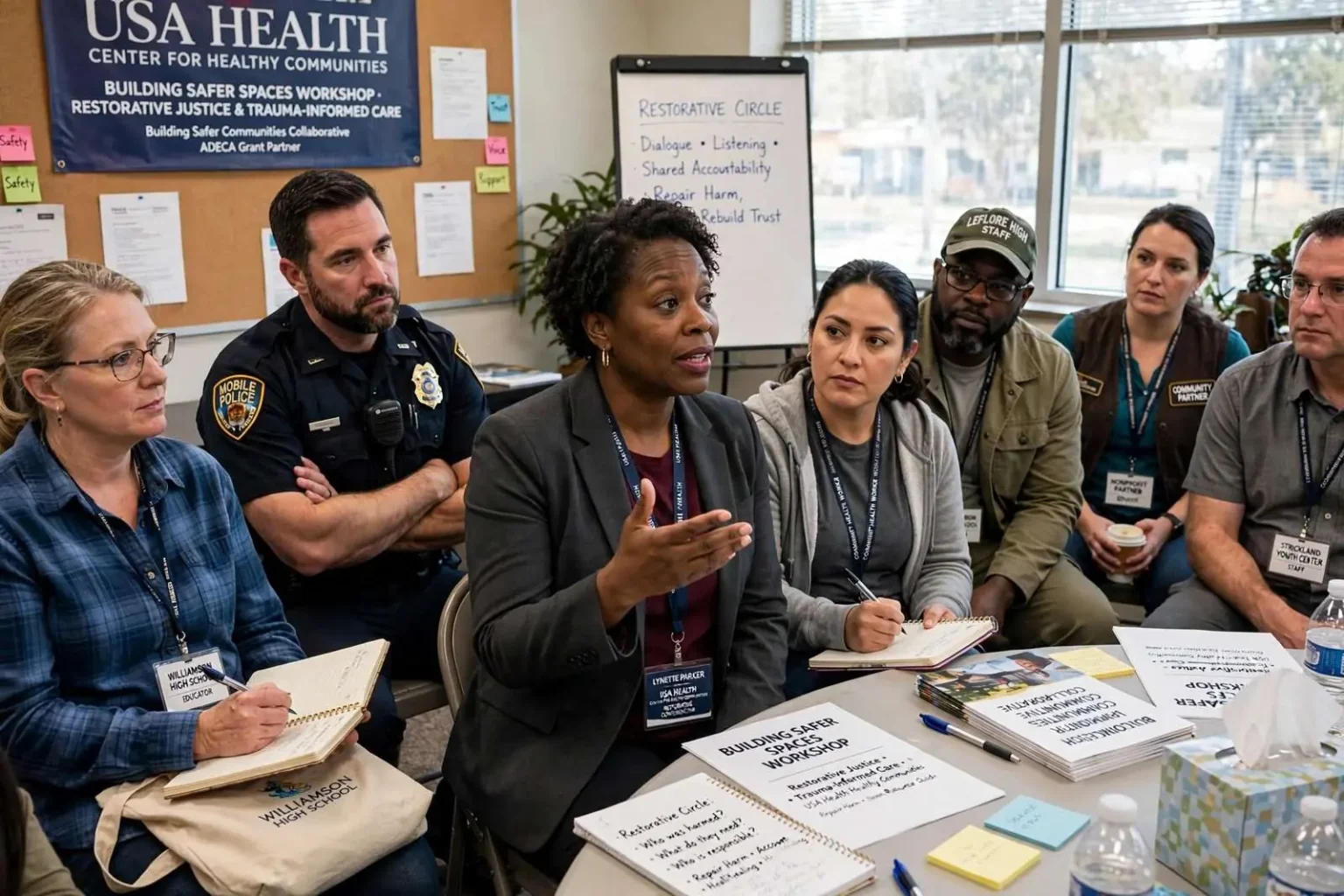
MOBILE — Educators, law enforcement professionals and community organizations recently came together for the USA Health Center for Healthy Communities’ Building Safer Spaces Workshop, a three-hour interactive training focused on restorative justice and trauma-informed care. The session brought people who rarely sit in the same room — school staff, police officers and nonprofit workers — into a shared conversation about how adults in Mobile can respond to youth wrongdoing in ways that repair harm instead of simply punishing it.
The workshop was part of the Building Safer Communities Collaborative, an initiative funded through a grant from the Alabama Department of Economic and Community Affairs. ADECA, the state agency that channels federal and state funding into community development, law enforcement support and youth programs, has made violence-prevention and intervention grants a recurring part of its portfolio, and the collaborative uses that support to connect young people in the juvenile justice system with services designed to keep them from reoffending.
The program serves youth referred through the Strickland Youth Center who are on informal probation, pairing them with community health workers who identify their needs, connect them and their families with services, and develop individualized plans aimed at long-term success. Strickland, which serves as Mobile County’s juvenile detention and court-services facility, handles young people at a pivotal moment in their lives, and informal probation offers an alternative track that allows eligible youth to avoid formal adjudication if they comply with conditions and services. The collaborative’s model treats that moment of referral as an opening to address the underlying needs — school struggles, family instability, unmet health needs — that often sit behind a young person’s first brush with the law.
Restorative justice in practice
Lynette Parker, a research manager for the Center for Healthy Communities and an experienced restorative conferencing facilitator and trainer, led the restorative justice portion of the training. Participants learned principles centered on repairing harm, accountability and giving people affected by wrongdoing an active role in resolving conflict. Rather than asking only what rule was broken and what penalty applies, restorative practice asks who was harmed, what they need, and whose obligation it is to meet those needs — questions that reframe accountability as something a young person does, not just something done to them.
They also practiced a restorative process known as the Restorative Circle, which encourages dialogue, understanding and collaborative problem-solving. Circles bring together the person who caused harm, those affected and supporting adults in a structured conversation led by a trained facilitator, with speaking order and ground rules that keep the exchange productive. The format has been used in schools, courts and neighborhoods across the country as an alternative to exclusionary discipline and formal prosecution, and training people to facilitate circles well is considered essential to making the process work rather than turn adversarial.
“I’ve seen the relief, validation and healing that someone who has been harmed by a criminal act can experience when they have the opportunity to tell their story, see the understanding from the one who caused that harm, and have a voice in how they want to move forward,” Parker said. Her point underscored a central premise of the training: that victims of wrongdoing are often left out of conventional justice processing entirely, and that giving them a voice serves both their healing and the accountability of the person who harmed them.
Building a trauma-informed network across the city
One of the collaborative’s central goals is building a trauma-informed network of stakeholders who can help keep youth at high risk of victimization or gun violence involvement safe. Attendees included representatives from community-based organizations, Williamson High School, LeFlore High School and the Mobile Police Department. The mix was intentional: a young person’s day moves between school hallways, neighborhood streets and, for some, police encounters, and the collaborative wants the adults in each of those settings to recognize trauma’s effects and respond in ways that de-escalate rather than compound it.
The schools represented at the workshop are two of Mobile County Public School System’s storied institutions, and both have long histories with the city’s west and north side communities. Educators trained in trauma-informed approaches learn to read behavior that looks like defiance as a possible response to adversity, to build relationships that give struggling students a trusted adult, and to connect families with resources before small problems become expulsions or court referrals. Pairing school staff with police officers and community workers in the same training means those groups leave speaking a shared language.
“All of society has a role to play in helping youth feel safe,” Parker said. “The program partners with local community organizations to provide volunteer and prosocial experiences for the justice-involved youth in the program.” Prosocial experiences — structured activities, volunteering, mentorship and community events — are a deliberate part of the collaborative’s design, because research on youth development consistently finds that young people with meaningful connections and constructive activities are less likely to reoffend and less likely to be victimized themselves.
Why trauma-informed care matters for justice-involved youth
The workshop also featured trauma-informed care training led by the Center’s Community Health Worker team, teaching participants strategies for recognizing the effects of trauma and responding in ways that foster safety, trust and resilience. Community health workers serve as the connective tissue of the program: they are trusted local staff who meet families where they are, navigate them to services, and stay with a case long enough to see plans through, a role that clinical providers and probation officers are rarely staffed to fill.
Parker said justice-involved youth may have experienced violence, family instability, food or housing insecurity, and other challenges that can affect their ability to cope and self-regulate. The science behind trauma-informed care holds that chronic adversity can shape a young person’s stress responses, making fight-or-flight reactions more likely in ordinary conflicts, which is why adults who understand the roots of that behavior can interrupt cycles that discipline alone does not reach.
“They express the need for safe places where people help them process what they are experiencing and guide them to recognizing their truths,” she said. That observation, drawn from the young people the program serves, is a concise statement of what the collaborative is trying to build: spaces across Mobile — in schools, community centers and neighborhoods — where a young person in trouble is met with structured support rather than a dead end. Through the Building Safer Communities Collaborative, community health workers continue building those safe spaces while connecting youth and families with resources aimed at strengthening relationships, building conflict-resolution skills and addressing social needs.
A model rooted in the Gulf Coast community
The Center for Healthy Communities has spent years working at the intersection of health and community conditions in Mobile, running programs that treat neighborhood safety, education and family stability as public health issues. Its research staff bring evaluation and training capacity that most local nonprofits cannot maintain on their own, which is why the collaborative’s model pairs that institutional backbone with the street-level trust of community health workers. The approach reflects a broader shift in public health thinking: violence is understood not only as a law enforcement problem but as a preventable health outcome shaped by environment, opportunity and connection.
The Building Safer Spaces Workshop series is designed to be repeated and expanded, training successive waves of school staff, officers, mentors and volunteers so that trauma-informed and restorative practices spread beyond a single program into the everyday institutions young people encounter. Each three-hour session builds both skills and relationships — attendees leave with techniques they can use the next day and with contacts they can call the next time a young person on their caseload, in their classroom or on their beat needs help.
What informal probation offers, and what it requires
Informal probation occupies a delicate space in the juvenile justice system. It allows young people referred to the court to avoid a formal delinquency record while still answering to conditions set by the court, and its success depends heavily on the support system wrapped around the youth. A teenager on informal probation who is connected to a community health worker, enrolled in constructive activities and surrounded by trained adults has a fundamentally different path than one who is simply told to stay out of trouble and sent home to the same circumstances.
That is the gap the Building Safer Communities Collaborative was designed to close, and the recent workshop showed its machinery in motion: ADECA funding supports the program, USA Health’s Center for Healthy Communities provides the research and training infrastructure, Strickland Youth Center supplies the referrals, and schools, police and community organizations supply the trained adults who carry the work forward. For Mobile, the model represents a practical answer to a question every city confronts — what should happen to a young person between their first mistake and their last chance — and the answer being built here is a network of safe spaces, one workshop at a time.