USA Health Water Safety Push Reaches Over 1,150 Kids, Hands Out 565 Life Jackets
A USA Health outreach program fitted more than 565 free life jackets and taught drowning-prevention skills to over 1,150 children and families across Mobile and Baldwin counties this summer.
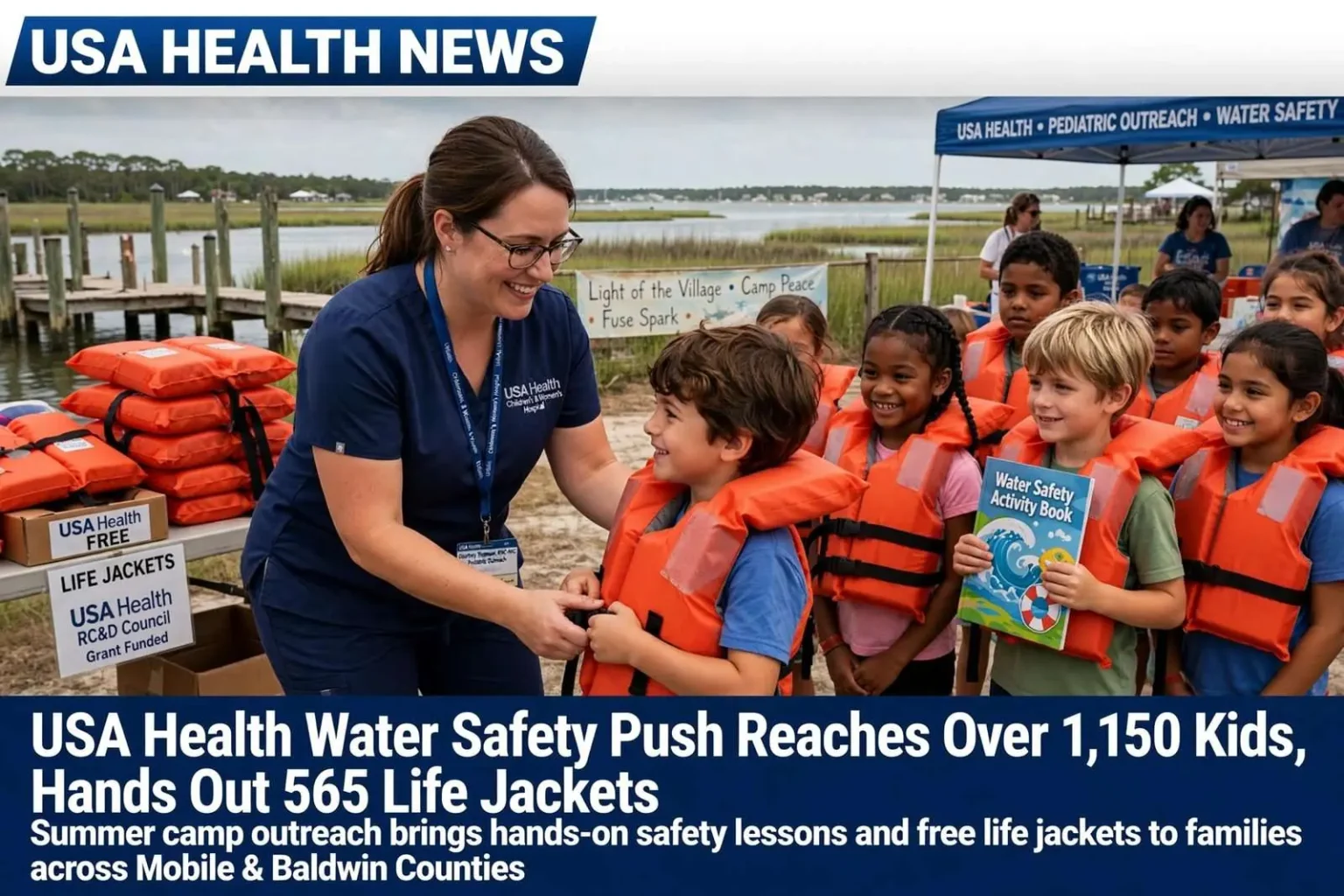
A summer-long water safety campaign led by USA Health reached more than 1,150 children and families across the Mobile and Baldwin county area, pairing hands-on education with the distribution of more than 565 free life jackets to help prevent drownings. The effort was organized by the pediatric outreach education team at USA Health Children’s & Women’s Hospital and was funded through a grant from the Gulf Coast Resource Conservation & Development Council.
Organizers focused the program on communities along the bays and bayous of the Alabama Gulf Coast, where waterways are woven into daily life. From the Mobile-Tensaw Delta north of the city to Mobile Bay’s shoreline and the sugar-white beaches of Baldwin County, children in this region grow up with a boat ramp, a fishing pier or a swimming hole within a short ride of home. That access is part of what makes coastal living attractive, and it is also why local health systems treat water safety as year-round pediatric work rather than a seasonal afterthought.
The stakes behind the effort are significant. The Centers for Disease Control and Prevention estimates roughly 4,000 unintentional drowning deaths and another 8,000 non-fatal drownings happen nationwide each year. Non-fatal drownings can leave survivors with serious, lasting injuries, including brain damage from prolonged oxygen loss. Because a child can drown in as little as an inch of water, health officials stress that constant, close supervision remains the single most important safeguard — buckets, ponds, pools and bathtubs all pose risks, not just open water.
Bringing Lessons to Summer Camps
As part of the outreach, hospital staff visited several area summer camps, including Light of the Village, Camp Peace, and the Fuse Spark program at Florence Howard Elementary School. Using interactive skits, staff walked campers through core water safety habits: walking rather than running near the water, always swimming with a buddy, staying within sight of a trusted adult or lifeguard, and getting out of the water immediately when severe weather rolls in. Gulf Coast summers bring fast-building thunderstorms, and knowing to clear the water at the first rumble is a lesson that applies on the beach, at the lake and in the backyard pool alike.
Children also learned to recognize rip currents, understand what the different colored beach warning flags mean, and know how to call for help in an emergency. Rip currents are the leading hazard on the Gulf beaches, and Alabama’s public beaches fly a standard flag system — with green signaling calm conditions, yellow caution, red high hazard and double red meaning the water is closed. Knowing that system before wading in can make the difference between a safe swim and a dangerous one.
Every participant went home with a water safety activity book, and caregivers received “water watcher” lanyards meant to designate one adult as the dedicated lookout during swim time. The water watcher concept addresses a well-documented gap: when several adults are present, each assumes someone else is watching. Assigning one person at a time, with a physical marker to make the duty visible, closes that gap. Kids were also fitted for life jackets bearing the hospital’s logo, so the equipment each child takes home actually fits and gets used.
A Clinician’s Perspective
Courtney Thomson, RNC-NIC, who leads the hospital’s pediatric education outreach efforts, said the initiative gave staff a rare chance to engage with families before an emergency happens rather than after. “It was a lot of fun getting staff involved in this community initiative. We spend most of our time helping at the hospital when something bad happens in the water. This initiative allowed us to get involved in the community and teach safety skills in a fun way that got the kids excited about water safety.”
That shift from response to prevention reflects a broader approach in pediatric medicine, where injury prevention programs have become a standard part of children’s hospital outreach. Nurses, therapists and other clinicians who ordinarily work in emergency departments and intensive care units bring hard-earned perspective to a classroom or camp session — they have seen what happens when supervision lapses or a life jacket is missing, and that experience makes the lessons land differently for parents.
Beyond the Camps
The summer camp visits were just one piece of a broader push. The team also held child safety days in both Mobile and Baldwin counties, led story times at Mobile County libraries, took part in community baby showers, and ran a specialized water safety session for neurodivergent children at the USA Regional Autism Network Disabilities Fair.
Each setting reaches a different audience. Child safety days put the hospital’s experts in front of parents and caregivers at community events, where conversations about pool fences, supervision and flotation gear can happen one family at a time. Library story times reach toddlers and preschoolers at an age when simple rules — never swim alone, always find an adult — can be taught through repetition. Baby showers connect the hospital with first-time parents who may not yet know that drowning is a leading cause of death for young children, and that supervision starts long before a child ever swims.
The specialized session for neurodivergent children addressed one of the starkest statistics in drowning prevention: children with autism are at dramatically elevated risk of drowning, and wandering toward water is one of the most common dangers families face. Adapting lessons for neurodivergent children — with clear routines, visual cues and repeated practice — ensures the campaign’s most vulnerable audience actually absorbs the material rather than sitting through it.
The grant from the Gulf Coast Resource Conservation & Development Council underwrote the campaign’s scope, from staff time to the life jackets themselves. Councils of this kind channel federal conservation and development resources into local projects across multi-county regions, and water safety along a coastline speckled with bays, bayous and beaches fits squarely in that mission. Free life jackets remove the cost barrier that keeps some families from owning properly fitted flotation gear at all, and a jacket that fits is the difference between a device that works and one that slips off in the water.
The campaign also built connections that can carry into future seasons. Camp directors who hosted the skits now have a trained relationship with the hospital’s outreach team, library staff know whom to call for a water-themed story time, and families who picked up life jackets at a child safety day know where the pediatric experts sit. Prevention work compounds through exactly these kinds of repeated, local touchpoints, and a single summer of visits often becomes the first installment of a much longer relationship between the hospital and the communities it serves.
Why the Gulf Coast Needs This Work
South Alabama’s geography makes water safety education a public health necessity rather than a seasonal nicety. Mobile County alone wraps around Mobile Bay, the Mobile River and the Mobile-Tensaw Delta — one of the largest river deltas and wetland systems in the country — while Baldwin County’s Gulf frontage draws hundreds of thousands of swimmers to Gulf Shores and Orange Beach each summer. Add backyard pools, neighborhood ponds and the fishing piers that line both counties, and almost every family in the two-county area has water within minutes of home.
Children’s & Women’s Hospital, part of the USA Health system anchored by the University of South Alabama in Mobile, is the region’s dedicated children’s hospital, and its outreach team treats education as an extension of clinical care. Programs like this one typically measure success not just in attendance numbers but in whether the families reached change behavior: whether the water watcher lanyard gets used at the next pool party, whether the fitted life jacket actually goes on the child at the boat ramp, whether a camper remembers to clear the water when the sky turns dark.
Keeping the Momentum Going
With summer swimming season still underway, organizers say the free life jackets and safety lessons are intended to keep the momentum going well past the camp calendar, giving Gulf Coast families tools they can use at the pool, the beach, or the bayou for years to come. The material is designed to outlast the program itself — the activity books stay on the shelf, the flag-color knowledge stays with the child, and the life jacket hangs by the door long after the summer ends.
For parents and caregivers who missed the campaign’s events this summer, the core takeaways remain simple enough to start using immediately: designate a responsible adult as a water watcher whenever children are in or near water, make sure every child wears a properly fitted life jacket in open water, keep children within arm’s reach in pools and at the beach, and learn what the beach warning flags and rip current signs mean before the next trip to the coast. More than 1,150 families now have those tools in hand — and with 565 new life jackets in circulation across Mobile and Baldwin counties, the region’s children are measurably better equipped for the waterways that surround them.