University of South Alabama Fairhope
USA Volleyball’s Win Streak, Soccer Awards and a Softball Legend’s Hall of Fame Moment Headline Jaguars’ Week
South Alabama's volleyball team extended its win streak to seven matches, the soccer program swept a slate of Sun Belt honors, and former softball ace Farish Beard-Collura was inducted into the school's athletic Hall of Fame, while area high schools sent runners to this week's state cross country meet.
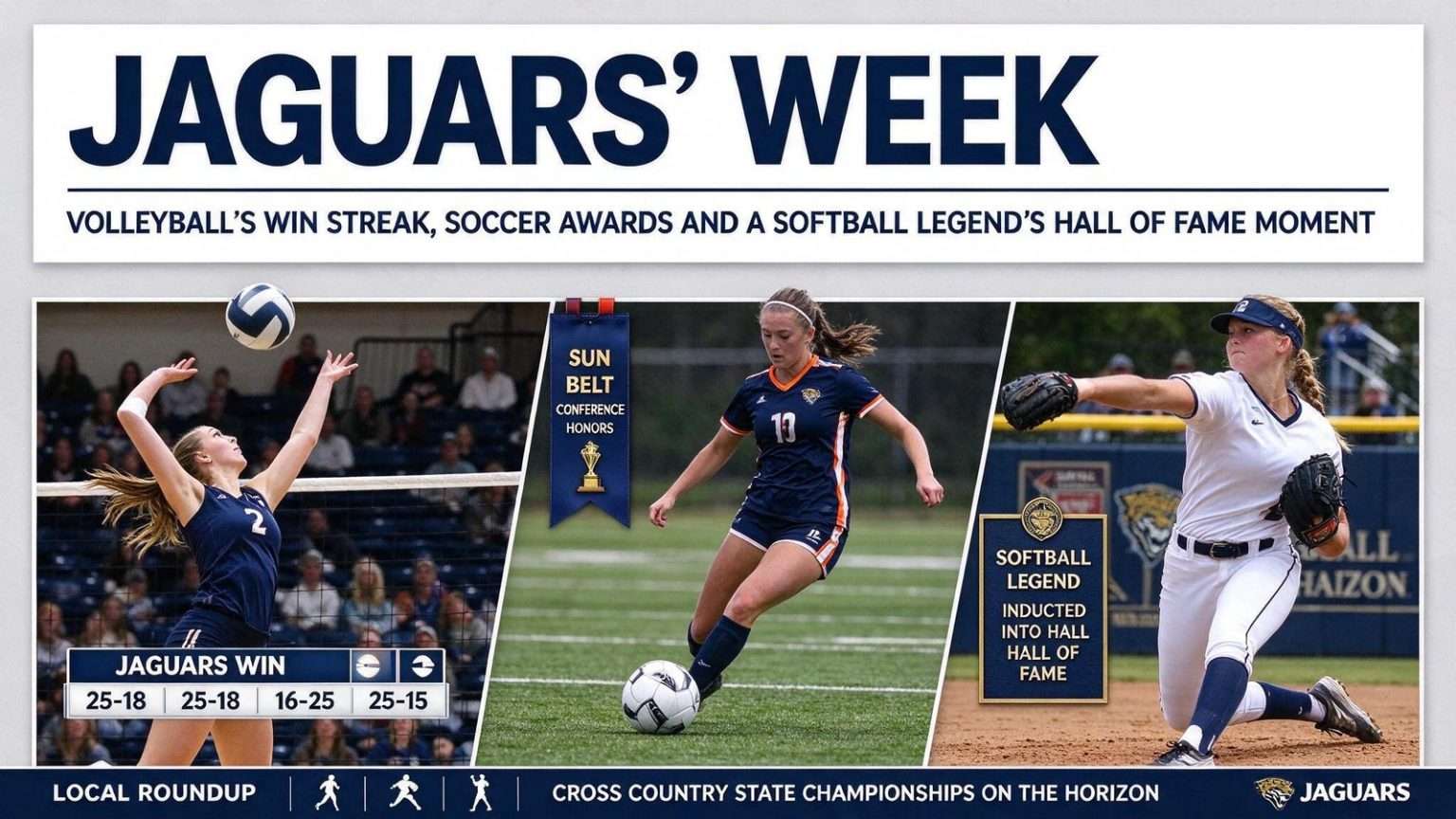
The University of South Alabama athletic department had plenty to celebrate this week, with the Jaguars’ volleyball team riding a seven-match win streak, the soccer program collecting a haul of Sun Belt Conference honors, and a former softball standout earning a place in program history.
South Alabama’s volleyball team knocked off Coastal Carolina in four sets at Jaguar Gym, winning 25-18, 25-18, 16-25, 25-15 in a Sun Belt Conference East Division showdown. The victory pushed the Jaguars to 19-6 overall and 12-1 in conference play, stretching their winning streak to seven matches and their home win streak to a dozen games. It was also the program’s first-ever win over Coastal Carolina at Jaguar Gym and gave South Alabama a two-and-a-half-game cushion over the Chanticleers atop the East Division standings. The Jaguars hit a season-best .394 as a team, the eighth-highest single-match figure in the program’s rally-era history and its best mark since a .386 outing at Northwestern State back in September 2019. The 12 conference wins also tied the 2017 squad for the most in a single season in program history. Outside hitter Maddie Soboleski credited the team’s preparation and serve-receive execution for the win, along with setter Kailey Keeble’s ball distribution, saying the Jaguars had been looking forward to the rematch all season. South Alabama returns to action Saturday at 6 p.m., hosting Troy at Jaguar Gym in another East Division match.
On the soccer pitch, the Sun Belt Conference tournament kicked off this week at the Foley Sports Tourism Complex, with South Alabama earning the No. 2 seed and a first-round bye. The Jaguars were set to open tournament play Wednesday at 1:30 p.m. against the winner of a first-round match between Little Rock and Louisiana, with the Sun Belt quarterfinals also scheduled for that day. The semifinals were slated for Friday, with the championship match to follow on Sunday.
The soccer program also collected a wave of individual honors when the conference announced its postseason awards. Junior Gracie Wilson was named Sun Belt Player of the Year and Offensive Player of the Year, the first time she has claimed either award. Teammate Sydney Ham was named the league’s Newcomer of the Year. Wilson, Morgan Cross and Gabrielle Gayle were all named first-team all-conference selections, while Jaidy Gutierrez Campos picked up a second-team nod, the first all-conference recognition of her career. It marked a second consecutive first-team selection for Wilson and the first for both Cross and Gayle. A preseason all-conference pick, Wilson led a nationally ranked South Alabama offense with 10 goals, 10 assists and 30 points this season, ranking in the top five in the Sun Belt in five separate offensive categories and in the nation’s top 10 in both total assists and game-winning goals. The Jaguars finished the regular season second in the country in scoring offense and third in points per game. In the regular-season finale, Wilson delivered a corner kick that Ham converted for the game-winning goal in a 3-2 double-overtime win over Georgia Southern. Cross, the 2020 Sun Belt Tournament Most Outstanding Player and also a preseason all-conference selection, ranked among the conference’s top five in goals, assists and points during league play this season.
Former South Alabama softball standout Farish Beard-Collura was honored during homecoming weekend as this year’s inductee into the South Alabama Athletic Hall of Fame, recognized on the field during the first half of the Jaguars’ football game against Arkansas State. A Fairhope native, Beard pitched for South Alabama from 2012 through 2015, helping the softball program to a 171-53 record over four seasons and four NCAA tournament appearances. She remains the program’s all-time leader in career earned run average (1.57), opponents’ batting average (.148) and strikeouts per seven innings (9.28), while ranking third in career wins (63) and shutouts (21) and fourth in career strikeouts (603) and innings pitched (454.2). Her sophomore season alone included a perfect 23-0 record in the circle. Beard-Collura, who is married to former Jaguars baseball player Bid Collura, becomes the third softball player inducted into the South Alabama Athletic Hall of Fame, joining former teammates Hannah Campbell and Brittany Fowler.
Reflecting on the honor, Beard-Collura said it was humbling to join the list of Jaguars greats already enshrined. Asked what stood out most from her playing days, she pointed to her freshman and sophomore seasons, when South Alabama won back-to-back conference tournament titles and hosted an NCAA regional for the first time in program history, calling those years the foundation for everything that followed. She said she still looks back fondly on the record-setting numbers the program produced during her career alongside fellow pitcher Hannah Campbell, describing it as an honor to have helped build the team’s winning culture. Beard-Collura, now a mother, said returning to campus to watch the current Jaguars compete is special, both for the changes to the university and the softball facility and for watching a new generation of players build their own memories.
On the prep side, the Alabama High School Athletic Association’s cross country state championship meet is set for Saturday in Moulton, with the top four teams and top six individuals not on qualifying teams from last week’s sectional meets punching their tickets to the state finale. Locally, the Section 1 meets in Class 7A, Class 6A and Class 4A were held in Loxley, hosted by Bayside Academy. In the Class 1A-2A boys race, Bayshore Christian, Orange Beach, St. Luke’s and Holy Spirit finished as the top four teams, led individually by Orange Beach’s Xander McLaughlin; the Class 1A-2A girls race saw Bayshore Christian, University Charter, St. Luke’s and Holy Spirit advance as team qualifiers, with Orange Beach’s Claire Atkins and Perry Webb qualifying individually. In Class 3A, Providence Christian topped both the boys and girls team standings, with Cottage Hill Christian, Wicksburg and Houston Academy rounding out the boys’ qualifying teams and Houston Academy, Cottage Hill Christian and Mobile Christian joining the Eagles on the girls’ side; Flomaton’s Cooper Turner was among the individual finishers in the boys race. Bayside Academy won both the boys and girls Class 4A team titles, with LAMP, St. Michael and St. James also advancing among the boys and Booker T. Washington, St. Michael and St. James joining Bayside among the girls’ qualifying teams.
In Class 5A, UMS-Wright and Faith Academy split the boys and girls team titles, with Pike Road and Montgomery Catholic also advancing in both races; Satsuma qualified several individual runners on both the boys’ and girls’ sides, including Will Chadwick, Wyatt Rigsby and Matthew Denton for the boys and a half-dozen Satsuma girls, led by Izzy Riddick and Makenzie Nelson. The Class 6A meet saw McGill-Toolen sweep the boys and girls team titles, with Spanish Fort, Gulf Shores and Saraland also advancing among the boys and Saraland, Robertsdale and Spanish Fort joining McGill-Toolen among the girls; Robertsdale and Baldwin County high schools each sent multiple individual qualifiers, including Robertsdale’s Tyler Stevenson and Baldwin County’s Byron Rodriguez on the boys’ side and several Baldwin County and Gulf Shores runners advancing individually for the girls. In Class 7A, St. Paul’s won both the boys and girls team titles, with Fairhope, Foley and Baker also advancing among the boys and Fairhope, Baker and Davidson joining St. Paul’s among the girls; individual qualifiers from the area included Alma Bryant’s Joseph Jones and Jacob Auld, Daphne’s Chase Tews and Thomas Walding, and Davidson’s Ian Westerfield and Seth Mosley on the boys’ side, along with Foley’s Audrey Sullivan, Katy Smith and Mya Stewart, Daphne’s Sophie West and Chloe Glass, and Alma Bryant’s Trinity Page for the girls.
About the state cross country meet
The AHSAA state cross country championships are run at Oakville Indian Mounds Park in Lawrence County, near Moulton. Teams and individuals qualify through the sectional meets held the week before.