
UWF Argonauts Celebrate Historic Jump to NCAA Division I With Kickoff Rally
The University of West Florida celebrated the start of its first NCAA Division I season with a kickoff rally, as coaches and athletes described the move as a major step for the Argonaut athletic program.
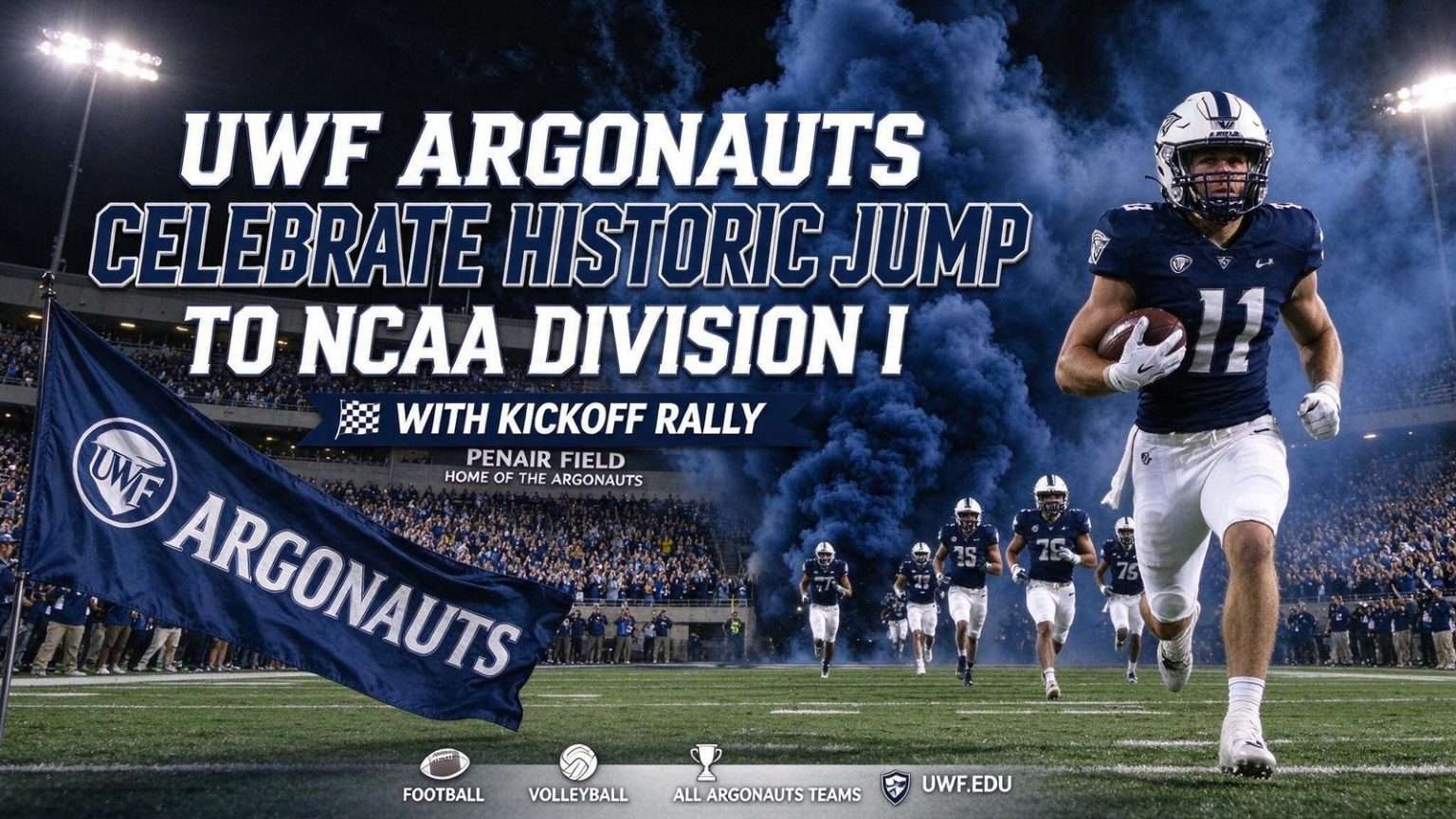
The University of West Florida is entering a new era in Argonaut athletics, launching its first season as an NCAA Division I program after years of competing at the Division II level. UWF marked the milestone with a kickoff rally Wednesday night as its teams prepare for a new slate of opponents and challenges this fall. The rally gave fans, student-athletes, and staff a moment to take stock of a transition that changes nearly everything about how Argonaut athletics operates — schedules, opponents, travel, recruiting, and the level of competition itself.
For a university whose athletic program is young by any measure, the leap to Division I is the most significant competitive decision in its history. UWF’s teams will now face scholarship-rich programs from across the region and the country, and the university’s athletes will spend the coming months adjusting to the pace, size, and depth that separate the NCAA’s top division from the level where the Argonauts built their reputation.
“We’re super excited to get new competition, to travel to new places, and see some new faces on the other side of the court,” said Emily Breazeale of UWF volleyball. She added that Division I play will mean more travel and tougher competition: “We’re going to be traveling a lot further. And just the size of the girls. The division one players are a lot bigger, taller, stronger, so I think that’s going to be the biggest difference that we see across the net.”
Breazeale’s assessment captures the adjustment every UWF roster faces this season. Volleyball and other non-revenue sports will find opponents whose programs are resourced differently, whose athletes were recruited through a different pipeline, and whose conferences span larger geographic footprints — a shift that begins with longer bus rides and ends with a noticeably different caliber of opponent.
Football at the center of the move
Argonaut football head coach Kaleb Nobles said the move to Division I raises UWF’s national profile and should help with recruiting and roster retention. “So I don’t think we’ve seen the full effects of recruiting just because of the transfer portal windows. But it will help in the future and help right now,” Nobles said. “And retaining players, we didn’t lose many players after we made the announcement when that Division II portal window was open because they’re trying to go Division I. So they’re staying.”
Nobles’ point about retention is quietly significant. In an era when the transfer portal allows players to leave programs annually, the promise of competing at the highest level became a retention tool in its own right — athletes who might otherwise have tested the market chose to stay because the program they joined was about to become a Division I program. That stability, in a sport where continuity of roster often determines competitive progress, gave the coaching staff a foundation other transitioning programs have not always enjoyed.
Recruiting, too, changes character at Division I. Prospects who would not have considered a Division II school now evaluate UWF alongside established D-I programs, and the coaching staff can sell the chance to play at the top level of college football within a program young enough for early playing time to be realistic.
Athletic director Dave Scott said the transition has been months in the making and was driven in part by shifting football conference alignments. “Our conference had reduced down to four football schools and we were needing to find a way to really create a good schedule for our student athletes,” Scott said, adding that the university also wanted to align with peer institutions. “At the same time, the institution felt like we needed to look at schools that look more like us as far as profile academically and who we are. So it made a lot of sense.”
Scott’s comments outline the two engines behind the move: necessity and ambition. A conference that had shrunk to four football-playing schools could no longer generate a workable schedule, forcing UWF to find a new competitive home regardless — and in looking, the university chose alignment with institutions that resemble it in academic profile and identity, rather than simply the closest available fit.
New conferences, new opponents
UWF football will compete in the United Athletic Conference, while the university’s other sports programs will compete in the Atlantic Sun Conference. The split arrangement — one league for football, another for everything else — is a common structure for D-I programs whose football situation requires a different competitive home than their Olympic sports, and it gives each program a conference schedule built around institutions at its own level.
For fans, the conference change redraws the map of Argonaut competition. Instead of the Gulf South Conference’s familiar axis of regional rivals, UWF’s teams will face programs scattered across the Southeast and beyond, with the travel and variety that Breazeale described. Home schedules at Pensacola will rotate new visitors through town, and road trips will take Argonaut teams into markets and facilities they have never competed in.
Football player Ty Conze called the move a major step for the program. “It’s a very exciting feeling for the entire team. Really transitioning from D2 to D1 is a step in every aspect of the program,” Conze said. “We’ve known this change has come or has been coming in the past. So we’ve been preparing throughout the entire off-season for this change and for the new challenges to come.”
Conze’s reference to a long-awaited change speaks to how the transition arrived — not as a sudden announcement but as a realignment players could see forming across multiple seasons, giving coaches an entire off-season to install schemes, adjust strength programs, and prepare rosters for opponents whose film looks different than anything on the old schedule.
The opener sets the tone
The Argonauts’ football team will host Southern Illinois on Thursday, Aug. 27, at PenAir Field, with kickoff set for 6 p.m. The opener is a statement game by design: a home night contest under the lights, against a Division I opponent with a substantive football history, on a weeknight national audience slot that few programs of UWF’s age ever get to fill.
PenAir Field, the on-campus stadium that has hosted the program since football arrived at UWF, will operate as the stage for the university’s formal arrival at the top division. The program’s rise has been unusually fast by college football standards — from a start-up roster to a national championship contender within its first seasons at the Division II level — and the opener against Southern Illinois represents the next rung on a climb that has repeatedly outpaced expectations.
First seasons at a new level rarely produce perfect records, and the coaching staff has been careful to frame the year as a foundation-laying campaign. But the opportunity structure is real: every game is a chance to establish the program’s credibility in its new division, and a strong showing in the opener would immediately change how opponents and recruits evaluate the Argonauts.
What Division I means for the university
The athletic move carries institutional weight beyond the field. Division I membership changes a university’s national visibility, its recruiting conversation, and its standing among peer institutions — benefits that academic and enrollment leaders weigh alongside the athletic department’s competitive goals. For UWF, which has grown its enrollment and regional profile steadily over recent decades, the athletic reclassification functions as a statement about the university’s ambitions overall.
Student-athletes across all sports will feel the transition most directly, in training standards, scheduling, and the competition they face weekly. Volleyball players adjusting to taller, stronger opponents, as Breazeale noted, are part of the same adjustment Conze described in football — a program-wide step up that touches every roster, every coach, and every road trip on the fall calendar.
The logistics behind the leap
Behind the rally and the opener sits a reclassification process that reshapes an athletic department from the inside. Division I membership brings stricter scholarship structures, compliance obligations, and academic progress requirements, and departments in transition typically spend years upgrading facilities, staffing, and budgets before the competitive clock even starts. UWF’s announcement that the move had been “months in the making,” as Scott described it, reflects only the final stretch of a process that touches every corner of the program.
Travel alone becomes a logistics operation at Division I. Olympic sports that once bused across the Gulf South now fly or make long road trips to conference opponents, and the department must balance class schedules, missed academic time, and budgets against a far larger geographic footprint. Volleyball, basketball, and the other Atlantic Sun programs will absorb that change immediately, in their first seasons of conference play.
Revenue expectations shift as well. Division I programs operate on larger budgets, draw more of their income from ticket sales, sponsorships, and conference distributions, and face fundraising demands that Division II models rarely generate. The university’s decision to step up implies a commitment to resource the program at that level — a commitment administrators weighed against the academic profile Scott referenced when he spoke of finding schools that “look more like us.”
A program built for quick climbs
What distinguishes UWF among transitioning programs is the speed of its competitive ascent. The football program’s early-year success at Division II — including a national championship run that announced the Argonauts to the college football world — established a culture of expecting to win rather than merely to compete, and that culture now transfers to Division I with rosters and staffs who have never experienced a losing standard.
The challenge of the new level is real: opponents will be deeper, faster, and better resourced, and early seasons may feature results the previous standard never produced. But the program’s history argues for patience measured in seasons rather than years, and the retention Nobles described — a roster that stayed because the players wanted to be part of Division I — suggests the locker room understands both the opportunity and the adjustment.
The kickoff rally that celebrated the transition was, in that sense, less a party than a starting line. The Argonauts enter their first Division I season with rosters that stayed, coaches who planned for the move, and an opener at home under the lights — the beginning of an era the university intends to compete in, not merely visit.