
Vacant House Fire on Eagle Drive Ends With No Injuries in Birdville
Crews wrapped up at a vacant house fire on Eagle Drive in Mobile's Birdville community; no injuries reported and no cause announced.
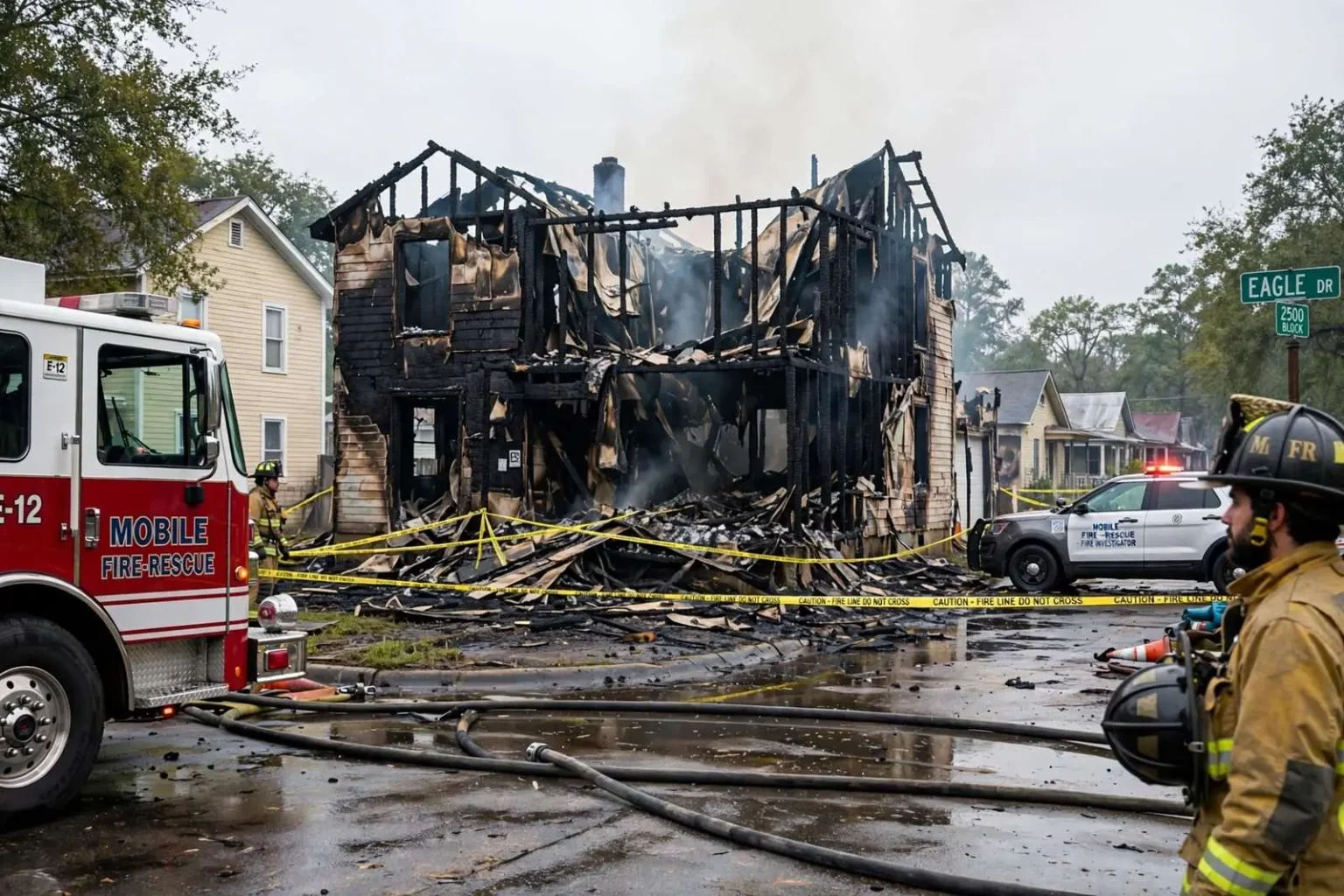
Fire crews wrapped up Friday morning at the scene of a vacant house fire in Mobile’s Birdville community, closing out a response to a blaze that gutted an unoccupied home on Eagle Drive and left investigators with the question every structure fire poses: what started it.
The fire broke out at a home on Eagle Drive, and officials had not determined a cause as crews cleared the scene. Because the house was unoccupied, no injuries were reported — the one piece of good news in a morning that otherwise followed the pattern of Mobile’s summer fire calls.
Fire in the Birdville community
Birdville sits in northwest Mobile, a community of older neighborhoods where the housing stock dates back decades and where the combination of aging structures and the Gulf Coast’s summer climate makes structure fires a recurring hazard. The area’s homes — many of them wood-frame houses built in the middle decades of the last century — present the kind of fire loads that modern construction does not: older wiring, aging utility connections, and building materials that burn fast once fire gets a foothold.
Eagle Drive runs through that landscape, and the fire drew the standard response from Mobile Fire-Rescue, the department that protects the city with stations positioned across its neighborhoods. Crews arriving at a vacant house fire face a different calculus than a fire in an occupied home: there are no lives inside to search for, but there may be squatters, transients, or children who entered the property despite its condition, and crews cannot assume the structure is empty until they have accounted for it.
Vacant structures also burn differently. Without occupants, small problems go unreported — a sparking outlet, a leaking gas connection, a smoldering attic — and by the time smoke shows, the fire has often been burning unnoticed long enough to compromise the building. Fire officials have long noted that vacant houses frequently reach the flashover stage before the first engine arrives, because no one called for help while the fire was still small.
The damage such fires leave is visible from the street: burned-out shells that remain on their lots for months or years afterward, boarded and tax-delinquent, part of the blight landscape that northwest Mobile and similar neighborhoods across the city have worked to reduce.
What investigators consider
With no immediate word on what sparked the blaze, investigators were left to sort through whether the fire originated from utilities, weather or something else entirely. That short list reflects the standard categories of fire origin, and each carries its own investigative path.
Utilities are a leading consideration in older vacant homes. Electrical systems that have sat unused, damaged, or improperly modified can fail when power is still connected to the property — or when scavenged wiring and stripped copper leave dangerous conditions behind. Aging service connections, water heaters, and HVAC equipment that kept running in an empty house are the kinds of sources fire investigators examine first.
Weather is the second consideration, particularly in a Gulf Coast summer. Lightning strikes during the thunderstorms that build over Mobile on summer afternoons are a documented cause of structure fires, and the season’s heat compounds every other hazard. Investigators will look at whether storms had passed through the area and whether the damage pattern is consistent with an outside ignition source.
The third category — something else — is where the investigation’s hardest questions live. Fires in vacant buildings are frequently human-caused, whether by accident or by arson, and Mobile fire investigators, with support from the state fire marshal’s office when warranted, treat every undetermined fire in a vacant structure as a potential crime scene until the evidence says otherwise.
The timing of the call also shapes what investigators can recover. A fire reported early, while still small, leaves a legible scene; a fire that has burned through the roof and floors before crews arrive destroys the very evidence the cause determination depends on. That is why fire departments everywhere press the same message on the public — call it in the moment you see it — and why the first callers to a vacant house fire often provide the single most useful piece of evidence: what the scene looked like before the fire department arrived.
The challenge of vacant structures
Vacant structures pose particular challenges for firefighters, who must battle flames that may have burned unnoticed before anyone called for help. The delay between ignition and the first call is the central problem: a fire that starts in an empty house at 2 a.m. might burn for an hour or more before a passing driver or a neighbor notices, and by then the building’s structural integrity is often in question.
Crews respond to that uncertainty defensively as well as offensively. Fire commanders decide quickly whether to send crews inside or to fight the fire from outside, and in a vacant structure with visible floor compromise, collapse indicators, or heavy fire on arrival, the choice is usually the latter. Fighting from outside is safer for crews, but it means the building is generally lost — an acceptable trade when the structure is unoccupied and the priority is keeping the fire from spreading to neighboring homes.
That spread risk is the other reason vacant house fires draw full responses. In established neighborhoods like Birdville, houses sit close together on their lots, and a fire that breaks windows and burns through exterior walls throws embers and radiant heat onto the homes next door. The first-arriving companies position not only to attack the fire but to protect the exposures, wetting down neighboring roofs and siding while the main fire is brought under control.
The hazards inside a vacant structure go beyond fire itself. Abandoned homes accumulate the debris of vacancy — furniture, dumped garbage, stripped materials — that increases the fuel load and hides floor openings. Firefighters have been injured and killed across the country in vacant building fires, and the lessons from those losses are written into the decision-making that commanders apply on scenes like Eagle Drive.
The neighborhood’s vulnerability
The Birdville area sits in northwest Mobile, where older housing stock and summer heat combine to make structure fires a recurring hazard during storm season. The community, like others in the city’s northwestern quadrant, has watched the interaction of vacancy, disinvestment, and fire for years: each abandoned structure that burns adds to the neighborhood’s inventory of ruined properties, and each ruined property raises the risk of the next fire.
City agencies track that cycle. Structures that burn are added to the list of properties that code enforcement monitors for demolition, and vacant lots left behind by demolition change a neighborhood’s character again — sometimes reducing the fire risk, sometimes creating the overgrown parcels that attract dumping and trespassing.
For residents of Eagle Drive and the surrounding blocks, the Friday morning fire was a familiar scene: engine companies, ladder trucks, and the smoke column visible across the neighborhood before dawn, followed by the aftermath of a house that will not be coming back.
Mobile Fire-Rescue’s summer workload
The response came during the stretch of the year when Mobile’s fire department handles its heaviest structure fire workload. Summer in the Gulf South concentrates fire risk in specific ways: air conditioning units and electrical systems run at maximum load for months, afternoon lightning storms arrive with regularity, and the heat itself stresses both equipment and the crews wearing heavy gear in 90-plus-degree conditions.
Fighting a structure fire in a Mobile summer is as much an endurance event as a tactical operation. Companies rotate through rehabilitation on scene, medics monitor crews for heat exhaustion, and the duration of an aggressive interior attack is measured against the conditions outside the burning building. A morning fire like the one on Eagle Drive allows crews to work in cooler hours — a factor that matters for both firefighter safety and the speed of the knockdown.
The department’s investigators, meanwhile, begin their work as soon as the flames are out. The cause determination process involves examining the burn patterns, tracing the origin point, interviewing whoever called in the fire and anyone familiar with the property, and checking utility records for the address. In vacant structure cases, investigators also track the property’s ownership and recent history, because the condition of a building’s systems and the circumstances of its vacancy are part of the evidence.
What happens next on Eagle Drive
The determination of a cause, when it comes, will decide what follows. A fire traced to utilities closes with an insurance or property-owner question; a fire traced to weather closes as an act of nature; a fire determined to be arson turns the scene into a criminal case, with the fire department’s investigators working alongside police.
Until then, the house on Eagle Drive joins the region’s inventory of fire-damaged vacant properties — secured, monitored, and waiting on the decisions of owners and city government. Neighborhood associations in northwest Mobile have pushed for faster demolition of burned structures, citing the hazards they hold for children and the toll they take on surrounding property values.
For now, the outcome officials could report was the one that mattered most: no injuries. Vacant house fires injure and kill firefighters and trespassers with regularity across the country, and a Mobile morning fire that consumed an empty home and hurt no one is the version of this recurring event that the city’s fire service will take.
Fire officials’ advice to residents in neighborhoods like Birdville is the standing one: report smoke or flames immediately rather than assuming someone else has called, and report vacant structures that show signs of occupation or deterioration before they become the next Eagle Drive.


