
Veteran Bikers Launch ‘Operation Overload’ to Fight Weeds at Mobile’s Oaklawn Cemetery
American Legion riders and fellow veterans launch Operation Overload, clearing weeds at Oaklawn Cemetery where 2,000 veterans are buried.
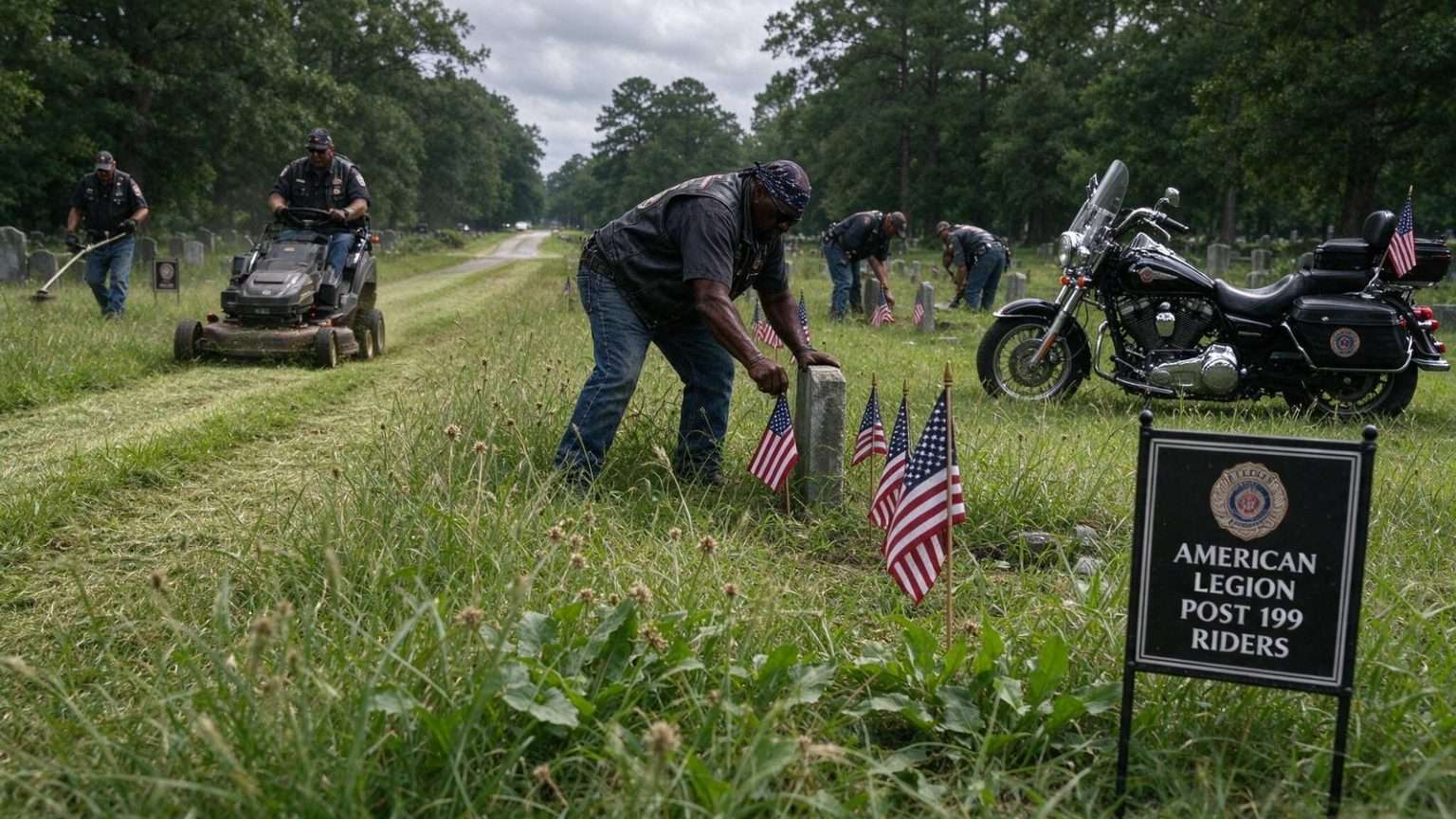
A group of bikers who are also military veterans has declared war on the weeds overtaking a historic Mobile cemetery, mowing through waist-high grass to reach the graves of the service members buried there. The effort, dubbed “Operation Overload,” has a simple mission: plant a flag at the gravesite of every veteran at Oaklawn Cemetery while drawing attention to what the group calls deplorable conditions at the burial ground. Members of the American Legion Post 199 Riders were out with mowers this week after recent rains left the grass especially high, posting photos of their progress as they worked.
Finding those graves is itself a challenge — tall grass and weeds have swallowed many of the markers, some of them small and others worn by decades of weather. The riders’ method is straightforward: cut, clear, and search section by section, marking each confirmed veteran’s grave with a flag as they go. The photos they posted from the mowing showed the scale of the task, with equipment disappearing into growth well above knee height. According to the group, roughly 2,000 veterans from conflicts spanning the 20th century — World War I, World War II, Korea, Vietnam and the Gulf War — are buried at the cemetery, a number that makes the flag-planting goal a matter of weeks of sustained work rather than a single weekend.
The protest element of the operation is inseparable from the labor. By mowing, photographing, and publicizing the conditions, the riders are making an argument that is hard to dismiss: a burial ground that holds two thousand veterans should not be allowed to disappear under growth. Cemetery maintenance is an unglamorous line item in any municipal budget, and historic African American and older city cemeteries across the South have too often borne the consequences when that line item slips. The riders’ answer is to do the work themselves — and to make sure the public sees exactly what neglect looks like when it accumulates.
The Riders and Their Mission
The American Legion Post 199 Riders are the motorcycle arm of an American Legion post, part of a national program in which Legion family members combine their enthusiasm for riding with veteran service projects. Legion Riders chapters across the country raise money for scholarships and veterans’ charities, escort military convoys, and participate in memorial rides — but the Oaklawn effort belongs to the most hands-on end of that spectrum: physical labor at a site where veterans themselves lie buried. For members who served, the work carries a personal weight. The graves they are clearing belong to men and women who wore the uniform in the same conflicts many of the riders did or their parents did.
The group’s stated goal — a flag at the gravesite of every veteran at Oaklawn — follows a tradition familiar across American cemeteries, where flags mark veterans’ graves on Memorial Day and Veterans Day. What distinguishes Operation Overload is the insistence that every veteran, not only those whose markers remain legible and accessible, deserves the recognition. That requires finding graves the overgrowth has hidden, some of which may have gone unvisited by family for years. Volunteers with knowledge of family plots are the group’s most valuable resource, which is why organizers are asking for volunteers to join the effort, particularly people who may have loved ones buried at Oaklawn and can help locate family plots beneath the overgrowth.
The timing of the first push followed recent rains that left the grass especially high, worsening conditions that had already drawn complaints. Summer growth cycles in Mobile’s climate are relentless — warm temperatures and frequent rain mean a cemetery can go from trimmed to overgrown in a matter of weeks during the growing season. The riders’ week of mowing represented a start, but the group has framed Operation Overload as an ongoing campaign rather than a one-time cleanup, with the flag count as its public measure of progress.
Oaklawn’s Place in Mobile History
Oaklawn Cemetery holds a significant place among Mobile’s burial grounds, established in the mid-20th century as the city grew westward and its older downtown cemeteries filled. As a municipal cemetery, it became the resting place for generations of Mobile families, including a large population of veterans whose service spans the conflicts of the last century. Roughly 2,000 of those service members — from the doughboys of World War I through the Gulf War — are buried on its grounds, a concentration of military history that mirrors the city’s own deep ties to the armed forces. Mobile has always been a military town, home to thousands of veterans and, for generations, a staging area for deployments and a home port community; its cemeteries record that history stone by stone.
The conditions at Oaklawn also connect to a broader pattern that has troubled preservationists across Alabama and the South. Municipal cemeteries that were once meticulously maintained have struggled as budgets tightened and as the families of those buried there aged or moved away, leaving fewer advocates to press for upkeep. Historic burial grounds with large African American sections have been especially vulnerable. When grass goes unmowed for weeks in a Gulf Coast summer, sunken markers disappear from view, and a cemetery can begin to look abandoned even when it remains an active burial place with descendants still visiting. Photographs like the ones the riders posted do the work of making that decline visible to people who will never drive through the gates.
The Legion Riders’ approach — public labor, public photos, a concrete goal — is designed to change that calculus. Cleanup efforts at neglected cemeteries succeed when they become recurring community commitments rather than one-day events, and the group’s call for volunteers, especially families with relatives buried at Oaklawn, aims to build exactly that base. Descendants who help locate family plots this week are likely to come back to maintain them; volunteers who spend a Saturday mowing tend to notice what else needs doing.
How the Community Can Help
Organizers are asking for volunteers to join the effort, and the needs go beyond strong backs with mowers. Locating veterans’ graves under heavy growth requires records, family knowledge, and patient searching — a person who knows where a grandfather is buried can save a search party an hour of wading through grass. Flag placement, photographing markers for documentation, and basic clearing around headstones are all tasks volunteers without equipment can perform. For the group, each confirmed grave brings the mission closer to its goal of a flag at every veteran’s gravesite at Oaklawn.
The deeper purpose of Operation Overload extends past the cemetery’s fences. By naming the conditions “deplorable” and publicizing the work, the riders are pressing for a permanent fix — maintenance standards that keep Oaklawn presentable year-round, not just when veterans’ groups take up the slack. Cities across the country have faced similar reckonings at their historic cemeteries, with outcomes that range from restored municipal funding to nonprofit partnerships that assume perpetual care. Mobile’s burial grounds hold the remains of generations who built the city and defended the country, and the image of veterans on riding mowers cutting waist-high grass off the graves of fellow service members makes the case for better care more forcefully than any petition could.
In the meantime, the work continues one section at a time. The flags going into the ground at Oaklawn mark more than individual graves; they map the scale of the commitment — roughly 2,000 veterans, five 20th-century conflicts, and a community that has decided its honored dead will not remain hidden. The riders who started Operation Overload set out to clear grass and plant flags; what they are really doing is reclaiming a piece of Mobile’s history for the families who thought it had been lost to the weeds.
The American Legion itself carries weight in this story. Founded in 1919 by veterans of World War I, the organization has spent a century as the country’s largest wartime veterans service organization, and its posts across Alabama serve as community anchors — hosting memorial ceremonies, sponsoring youth programs, and acting as advocates for veterans’ benefits. The Riders program adds a modern dimension to that mission, mobilizing members around causes that range from scholarship fundraising to POW/MIA remembrance. A post riding group that takes on a cemetery cleanup is acting well within that tradition: caring for the graves of fallen and departed veterans is one of the Legion’s oldest obligations, written into the rituals that posts perform at funeral services and memorial observances year after year.
The five conflicts represented at Oaklawn trace the arc of the American century through Mobile families. The World War I generation buried there belonged to the first Mobile contingency shipped overseas in 1917 and 1918; the World War II section reflects the city’s wartime boom, when shipyards and airfields filled the area with service members and defense workers. Korea and Vietnam followed, drawing the next generations, and the Gulf War graves are recent enough that many of those veterans’ families are still active visitors. A flag planted at each of those graves is a small gesture, but repeated two thousand times it becomes a survey of the city’s 20th-century military history.
The riders’ dual identity — veterans and bikers — is worth noting because it explains both the capability and the visibility of the operation. Legion Riders chapters bring exactly the kind of equipment and persistence a cleanup requires, along with a communications network that spreads photos and calls for help quickly across the region’s veteran community. And the sight of motorcycles and mowers outside a cemetery gate draws attention that a silent volunteer day would not. The group has used that visibility deliberately, letting the photos of buried markers and waist-high grass make the argument for them.
A Call That Families Are Best Positioned to Answer
The group’s request for relatives of those buried at Oaklawn deserves emphasis, because family knowledge is the one resource no city record can fully replace. Burial ledgers age, section maps go missing, and stone inscriptions weather past legibility, but a daughter who remembers visiting her father’s grave every Memorial Day can walk a search team directly to the spot. Every family that answers the call does two things at once: it recovers a specific grave from the overgrowth, and it strengthens the case that the cemetery remains a place people care about — the strongest argument a burial ground can have in any budget discussion.
For volunteers without family connections at Oaklawn, the work is no less needed. Clearing grass around sections, helping carry flags, documenting markers with photographs for later identification, and simply walking the grounds to spot sunken stones all speed the mission along. The riders have posted their progress publicly as they work, which gives prospective volunteers a picture of the conditions and a benchmark for what remains. The mission’s arithmetic is unforgiving — roughly 2,000 veteran graves against a handful of riders with mowers — and it is the reason the group has framed Operation Overload from the start as an invitation rather than a solo effort.
What happens at Oaklawn in the coming weeks will say something about Mobile beyond the cemetery gates. Cities are judged, in part, by how they tend the grounds where their founders and defenders lie, and the condition the riders found there has already told one story. The flags they are planting tell a better one: that when the city’s veterans’ graves went dark under the weeds, the veteran community noticed, showed up with equipment, and started cutting — and asked the rest of the city to join them.


