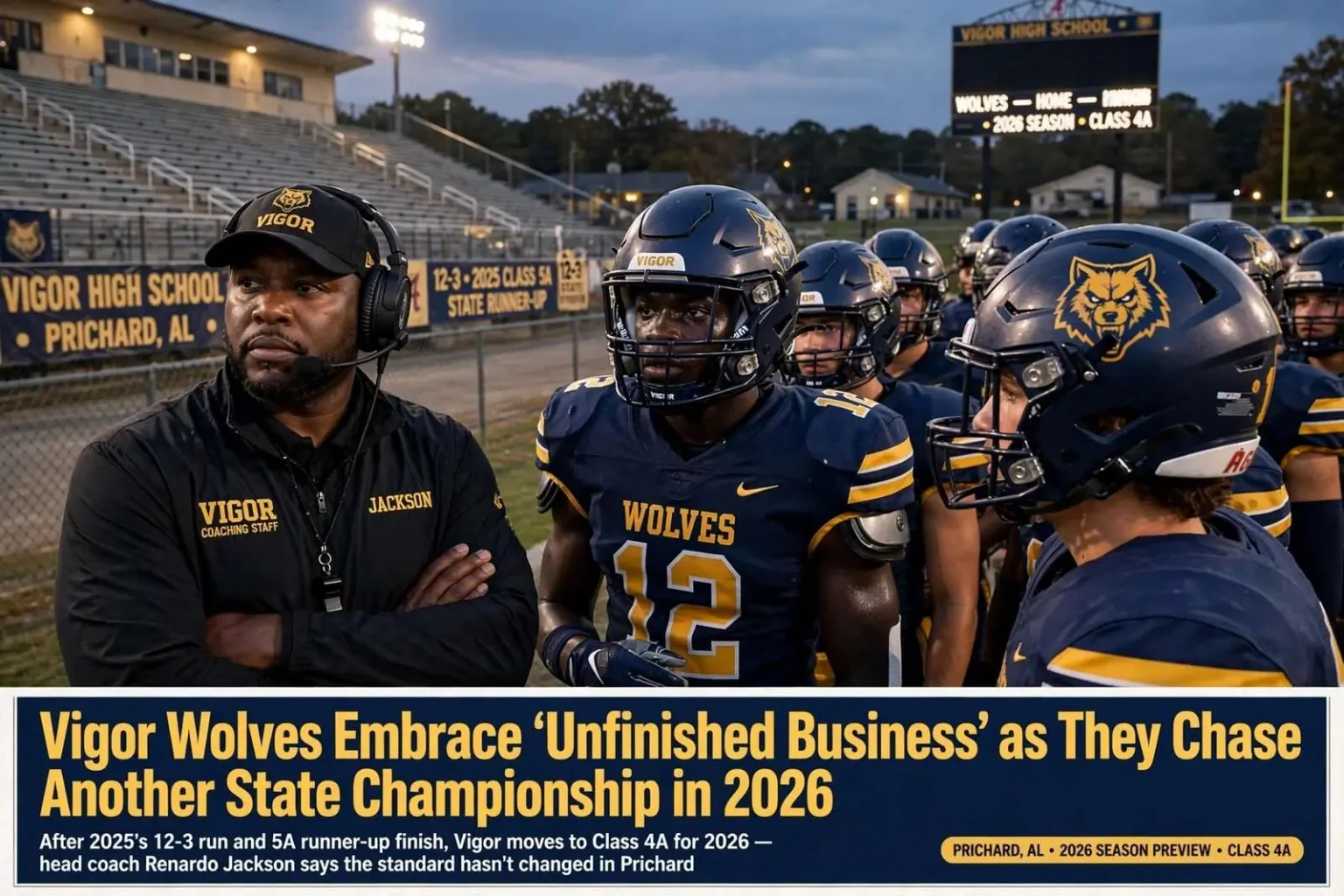
At Vigor High School in Prichard, success isn’t measured by playoff appearances — it’s measured by championships, and after last season’s near miss, the Wolves say the standard hasn’t changed. Vigor added another chapter to one of Alabama’s most storied football traditions in 2025, finishing 12-3 and advancing to the Class 5A state championship game before falling to Moody. Now, after moving into Class 4A for 2026, head coach Renardo Jackson says the expectations remain exactly where they’ve always been.
The move down in classification has done nothing to soften the program’s ambitions. If anything, the “unfinished business” framing that has taken hold around the team this offseason treats the 2025 runner-up finish as evidence of a job left incomplete rather than a season to be satisfied with. A 12-3 record and a state title game appearance would mark a career-defining year at most schools; at Vigor, it reads as a step in a longer pursuit, and the players returning for 2026 will carry the memory of the championship game loss into a new classification with new opponents.
Reclassification itself reshapes the road ahead. Dropping from 5A to 4A changes the regions the Wolves will compete in during the regular season and the playoff bracket they will face in November, matching them against schools with smaller enrollments from across south and central Alabama. The competitive math favors programs with Vigor’s tradition — depth, coaching continuity and a roster accustomed to big games — but history across the AHSAA has shown that classification changes guarantee nothing. Champions have to be earned again every season, in whatever class a team lands.
Jackson’s job this year is as much about managing expectations as X’s and O’s. In a program where the standard is a championship, an early-round playoff exit is treated as a failure, and the pressure that comes with that culture can weigh on a roster filled with teenagers. The head coach’s public message — that the expectations remain exactly where they’ve always been — is both a warning against complacency and a shield for his players: the standard is the program’s, not any individual’s burden alone.
Friday Nights Across South Alabama
The story is one of many that play out across high school campuses from Mobile to Baldwin County each year, where athletics and academics together shape a community’s sense of itself. Public schools across Mobile and Baldwin counties compete under the Alabama High School Athletic Association, with regular-season and postseason play organized into regions and classes. The state championships are held at venues around the state each year and are one of the biggest events in Alabama high school sports, drawing crowds and media attention that few other states can match at the prep level.
Friday night football in particular remains a fixture across south Alabama, where the Saraland Spartans, the Fairhope Pirates, the Daphne Trojans, the Foley Lions, the McGill Toolen Jackets, the Murphy Panthers, the Blount Leopards, the Baker Hornets, and a host of other programs each field teams that draw thousands of fans to their home stadiums during the fall. The rivalries between these schools — divided by the bay, by classification, and by decades of playoff meetings — form a calendar that many families organize their autumns around, from scrimmage nights in August to semifinal Fridays in November.
Prichard, the city Vigor calls home, is a working-class community in north Mobile County, just north of downtown Mobile across Three Mile Creek. It is one of the older communities along U.S. Highway 45 and is part of the Mobile metropolitan statistical area. Like many of Alabama’s older industrial suburbs, Prichard has seen its share of economic hardship and population loss over the decades, which is precisely why the football program’s sustained success matters so much to the city’s identity: on Friday nights in the fall, Vigor’s stadium is where the community gathers, and the team’s fortunes are a shared civic experience that cuts across every other division the city knows.
High school football’s role in places like Prichard goes beyond entertainment. For generations of players, the sport has been a route to college rosters and the discipline that comes with them, and for the neighborhoods surrounding the school, a winning team is a visible counterpoint to the city’s struggles. The Wolves’ runs through the playoffs in recent seasons have given Prichard something to rally behind, and the 2025 title game appearance — a season that ended one win short — has become the baseline for what this group of players is expected to pursue.
The local economy along the upper Gulf Coast is built on a mix of long-standing industries, retail, and tourism that drives hiring and traffic across the region. The Mobile area’s economy includes major employers in aerospace, steel, shipbuilding, logistics, healthcare, education, and the port, alongside a broad base of small businesses that serve residents and visitors. Mobile and Baldwin County together form a single regional economy, with commuters, students, and shoppers moving daily across the bay, and with shared concerns about transportation, schools, public safety, and growth that play out in both counties’ public meetings and local news coverage.
That regional economy shapes the schools, too. The districts that Vigor’s rivals come from — and Mobile County Public Schools and the Baldwin County Public Schools system among them — are among the largest employers in the region and are a focus of ongoing community attention, particularly around school construction, teacher staffing, and student performance. Athletic budgets, stadium improvements and coaching staffs all sit within those same budget conversations, which means the fortunes of football programs like Vigor’s are connected to the same tax bases and school boards that decide everything else about public education in south Alabama.
The Season Ahead
The 2026 season will answer the questions every reclassified contender faces. How does the roster replace the production and leadership that graduated after a state title game run? How do new regional opponents change the weekly grind of the regular season? And does the drop to 4A translate into a longer playoff run, or simply a different set of obstacles standing between the Wolves and the championship they believe is owed to them?
Jackson and his staff will spend the offseason and preseason working those answers out on the practice field, where every program’s real season is decided. The Wolves’ returning players know the standard as well as anyone in the state, and they know that in a championship-oriented program, a runner-up trophy is remembered as motivation rather than an accomplishment. The 2025 season proved Vigor could reach the last game of the year in Alabama’s fifth-highest classification. The move to 4A for 2026 presents a fresh bracket, a fresh region, and the same expectation that has defined the program for decades: finish the job.
For fans across the region, the Wolves’ climb adds another storyline to a south Alabama football scene already rich with them. Saraland’s rise to consistent contention, the Eastern Shore programs’ annual playoff pushes, and the city rivals’ meetings across Mobile all feed a high school sports culture that ranks among the most engaged in the state. A Vigor team chasing a championship in a new classification only sharpens the fall calendar, and the region’s fans — the same crowds that fill stadiums from Ladd-Peebles to Foley — will follow every step of it.
Behind the standings, the season also connects to the everyday life of the communities the teams represent. Hurricane and severe-weather preparedness is a recurring topic for residents across the coast, with annual public drills, sandbag distributions, and updates from local emergency management agencies as the Atlantic hurricane season progresses each year — and a storm season that overlaps with football season means every south Alabama schedule is written with an eye on the Gulf. Games get moved, seasons get interrupted, and communities that have weathered evacuations together understand what their teams mean to normal life returning after a storm.
News from across south Alabama frequently highlights the ways in which local decisions in city halls, county commissions, school board meetings, and state offices in Montgomery interact with daily life for residents from Saraland to the Eastern Shore and from downtown Mobile to the Gulf beaches. High school athletics sits squarely in that current: attendance zones, school consolidations, coaching hires and facility spending are all public decisions, made in public meetings, that shape what Friday night looks like in every community from Prichard to Point Clear.
For Vigor, the 2026 season carries all of that context into every practice and every Friday. A program with its history does not rebuild quietly, and a city like Prichard does not follow its team casually. The Wolves move into Class 4A with a 12-3 record behind them, a state championship game loss to avenge, and a head coach telling anyone who asks that the expectations haven’t moved an inch. The only thing left to determine is whether “unfinished business” becomes a championship trophy — and in Prichard, no one expects the pursuit to be anything less than the whole point of the season.