Viral Satsuma Grad Heads to College as USA Program Grows for Special-Needs Students
Two Satsuma High graduates, including one whose acceptance letter video went viral, are the school's first students in USA's Passage USA program.
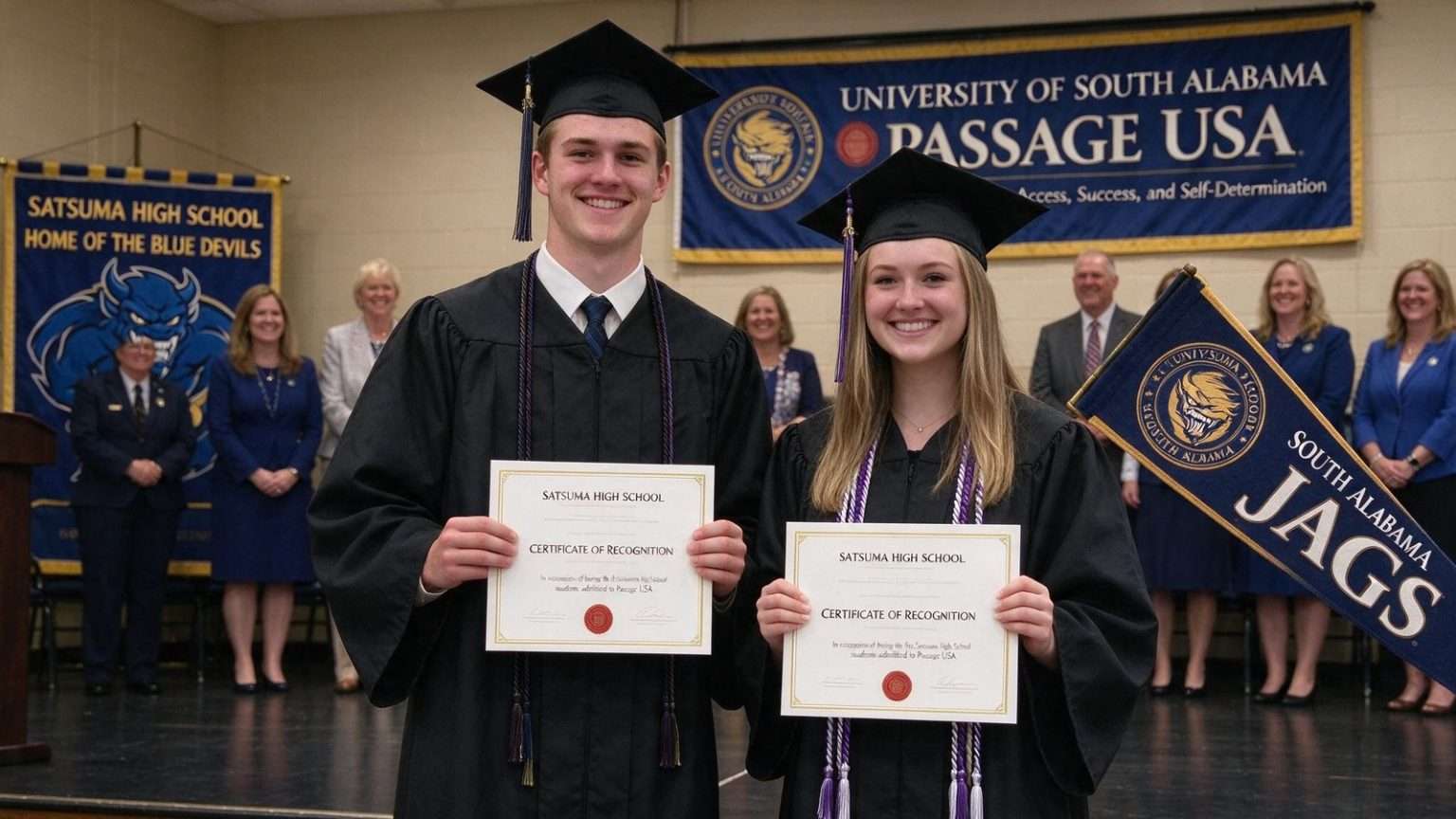
A viral moment is turning into a college career. Two recent Satsuma High School graduates are now the school’s first students admitted to Passage USA, the University of South Alabama’s certificate program for students with special needs, and one of them became a social media favorite after a video of him opening his acceptance letter from the university spread widely online. Keith Griffith and fellow graduate Kaylee Walker were presented with certificates recognizing their place in Satsuma High history as the program’s first two students from the school — a milestone that both the students and their community celebrated as the start of something bigger.
The story began earlier in the year, when Griffith’s acceptance letter video began circulating widely online. The clip, showing the genuine emotion of a young man realizing he had been admitted to a university program, resonated far beyond Satsuma, a small industrial city in Mobile County just north of Mobile along the Interstate 65 corridor. Social media has increasingly played a role in how students with disabilities and their families share milestones that once went unmarked, and Griffith’s video joined a long line of acceptance-letter moments that have drawn attention to inclusive postsecondary education across the country.
What Passage USA Offers
Passage USA — the name is short for Promoting Access, Success, and Self-Determination — admits students who meet its eligibility requirements and focuses on practical job skills, independent living and campus inclusion. Based at the University of South Alabama in Mobile, the program is part of a national movement toward inclusive higher education for students with intellectual and developmental disabilities, a field that has grown substantially since federal legislation began allowing such students access to financial aid for approved programs.
Students in programs like Passage USA typically take a blend of coursework, skills training and supervised work experiences, often shadowing or assisting in real university departments, offices and campus operations. The goal is not a traditional bachelor’s degree but a certificate that documents real-world readiness: the ability to navigate a workplace, manage daily routines, use public transportation and function independently. For families in the Mobile area, having such a program at the regional university means students who once faced a dead end after high school graduation can continue learning close to home rather than relocating to find opportunities.
A Growing Pipeline for South Alabama
The ceremony at Satsuma High marked the latest step in an expansion of the university’s efforts on behalf of students with intellectual and developmental disabilities. The two new students joined the cohort at the start of the week, continuing a story that first drew attention when Griffith’s video went viral. School officials in Satsuma framed the admissions as evidence that students across the spectrum of ability can aspire to postsecondary education, and that the pathway from a small public high school to a university program is real and repeatable.
The timing also reflects broader growth. Inclusive higher education programs in Alabama have expanded in recent years, with the state’s public universities increasingly offering transition programs that serve young adults with disabilities. Educators point out that these programs do more than benefit the enrolled students: they change campus culture, give future teachers and healthcare providers direct experience working alongside people with disabilities, and demonstrate to employers across the region that these young adults are ready to work.
For Satsuma, a city of roughly 6,000 residents whose schools serve the community’s families from kindergarten through graduation, seeing two of its own become university students is a point of civic pride. Griffith and Walker’s certificates commemorate the milestone, but the larger significance may come in the years ahead, as other Satsuma students — and students at high schools across Mobile County — follow the path the two graduates have opened. The University of South Alabama’s program continues to accept eligible applicants, and school leaders expect the pipeline from area high schools to grow as families learn that the opportunity exists.
Satsuma’s celebration carried meaning well beyond one school’s yearbook. The city, tucked along the Interstate 65 corridor in northern Mobile County, just a short drive from Mobile, has long taken pride in a school system that serves its community from elementary grades through high school graduation. For a graduating class to send its first students into a university program designed for students with intellectual and developmental disabilities marks a change in what families in small South Alabama towns can expect after the caps and gowns come off.
For decades, students with significant intellectual and developmental disabilities often aged out of public education with few structured options. Federal law guarantees special education services through the school years — under the Individuals with Disabilities Education Act, students can receive services through age 21 in many cases — but what comes next has historically been a patchwork of day programs and family-managed care. The rise of inclusive postsecondary education programs at public universities has begun to fill that gap, and Alabama’s institutions have joined the movement. These programs give young adults a genuine campus experience: classes adapted to their needs, work-based learning, social life, and the gradual building of independence that their peers take for granted.
The Path Griffith and Walker Opened
Keith Griffith and Kaylee Walker are the first from Satsuma High to walk that path into Passage USA, and the school made sure the milestone was marked. The certificates presented to the two graduates recognize their place in Satsuma High history — the first two, but school officials and families hope far from the last. High school transition programs across Mobile County have increasingly focused on preparing students for exactly this kind of opportunity, emphasizing job skills, communication and daily living skills during the final years of school so that students arrive at programs like Passage USA ready to participate fully.
The viral video of Griffith opening his acceptance letter also illustrates how these moments ripple outward. Families of children with disabilities often say they do not know what is possible until they see another family do it. A video that travels across social media does more than celebrate one student; it tells hundreds of parents across the Gulf Coast that postsecondary education is on the menu for their children too. Teachers and transition coordinators can point to real examples — a graduate of a nearby high school, attending a program an hour away or closer, building toward a working life.
What the Program Means for the Region
The University of South Alabama’s investment in Passage USA reflects both mission and pragmatism. USA is the major public university for the Gulf Coast region, and its programs in education, nursing, medicine and allied health produce the professionals who will serve people with disabilities across the region for decades. Campus programs that include students with intellectual and developmental disabilities give those future professionals daily familiarity with a population they will inevitably work with, while enriching the university community itself.
Employers in the Mobile area, from healthcare systems to hospitality to manufacturing, have also become part of the equation, as inclusive postsecondary programs emphasize competitive work experience. Students who complete programs like Passage USA leave with documented skills, workplace references and, in many cases, job offers from the sites where they trained. For Satsuma’s two pioneers, the start of the week marked the beginning of that journey. For the school and city watching them go, it marked the opening of a door that will not close again — a precedent that changes what every future Satsuma graduate with special needs, and their family, can picture when they think about life after high school.
The recognition ceremony also served a practical purpose for the university program itself. Every school that produces its first admitted students becomes a referral point for future applicants, and the presence of Satsuma on the program’s roster tells other small communities in the region that the program is within their reach as well. Mobile County’s public school districts range from the city system to suburban and rural schools, and inclusive postsecondary education has historically been concentrated in larger metro areas where bigger universities operate bigger programs.
For employers in the Mobile area, programs like Passage USA also matter in practical terms. The region’s economy includes healthcare, aerospace, shipbuilding, logistics and retail sectors, all of which depend on reliable entry-level workers. Graduates of job-skills certificate programs arrive with training, work experience from internships and a documented history of completing a structured program. Businesses that have hired graduates of inclusive postsecondary programs often become repeat employers, which strengthens the case for expanding the pipeline that the two Satsuma graduates have just entered.
The timing of the enrollment, at the start of the week following the ceremony, gave the recognition an immediate follow-through. Rather than a promise of future enrollment, the certificates marked a step that had already been completed — the two graduates were welcomed into the cohort and began their program work as students of the university. Families attending the ceremony could see the full sequence in one place: acceptance, recognition, and enrollment, with the campus and its program staff on hand to greet the new students.
What Families Should Know
Admission to programs like Passage USA depends on eligibility requirements set by the university, and families interested in the program generally begin the conversation during the high school transition planning years. The application process typically involves documentation of the student’s disability, discussions of goals for employment and independent living, and an assessment of whether the program’s structure fits the student’s needs. Because the program is a certificate track rather than a degree track, admissions operates differently from the university’s standard process.
The existence of a local option changes the calculus for families who might otherwise assume that college of any kind is out of reach. Commuting or living close to home lets students build independence while remaining connected to the support systems they already have. That is part of why the university’s expansion of its efforts on behalf of students with intellectual and developmental disabilities carries weight beyond the individual students admitted each year — it signals to every district in the region that the pathway is real and being used.
Satsuma’s two graduates arrived with the benefit of a school community that knew their story. Griffith’s acceptance letter video had already made both students locally famous by the time the ceremony was held, and the certificates formalized what the video had made clear: the community was watching, celebrating, and now following their progress into the university program. That kind of visibility can ease the social transition that any new student faces, particularly one stepping onto a university campus for the first time.
Looking Ahead
The two graduates will spend the coming terms working through the program’s curriculum, and their progress will be watched by families in Satsuma and beyond who are considering whether the same path makes sense for their own students. If the national experience with inclusive postsecondary education holds, the first students from a school rarely remain the only ones for long. The combination of a visible local example, a program within commuting distance, and a school community that has already celebrated the achievement tends to produce more applicants in the years that follow.
For Griffith and Walker, the viral video and the certificates are the prelude. The work that matters now is the same work facing every new student on campus: learning the routines, building skills, and making the most of the opportunity they earned. Their school has already recorded their place in its history. What they do with the program is the chapter that remains to be written.