
Visit Mobile Annual Meeting Celebrates Tourism at the Saenger
Visit Mobile Annual Meeting Celebrates Tourism at the Saenger — a South Alabama News report on Mobile, Mobile County, Visit Mobile, Mobile Saenger Theater.
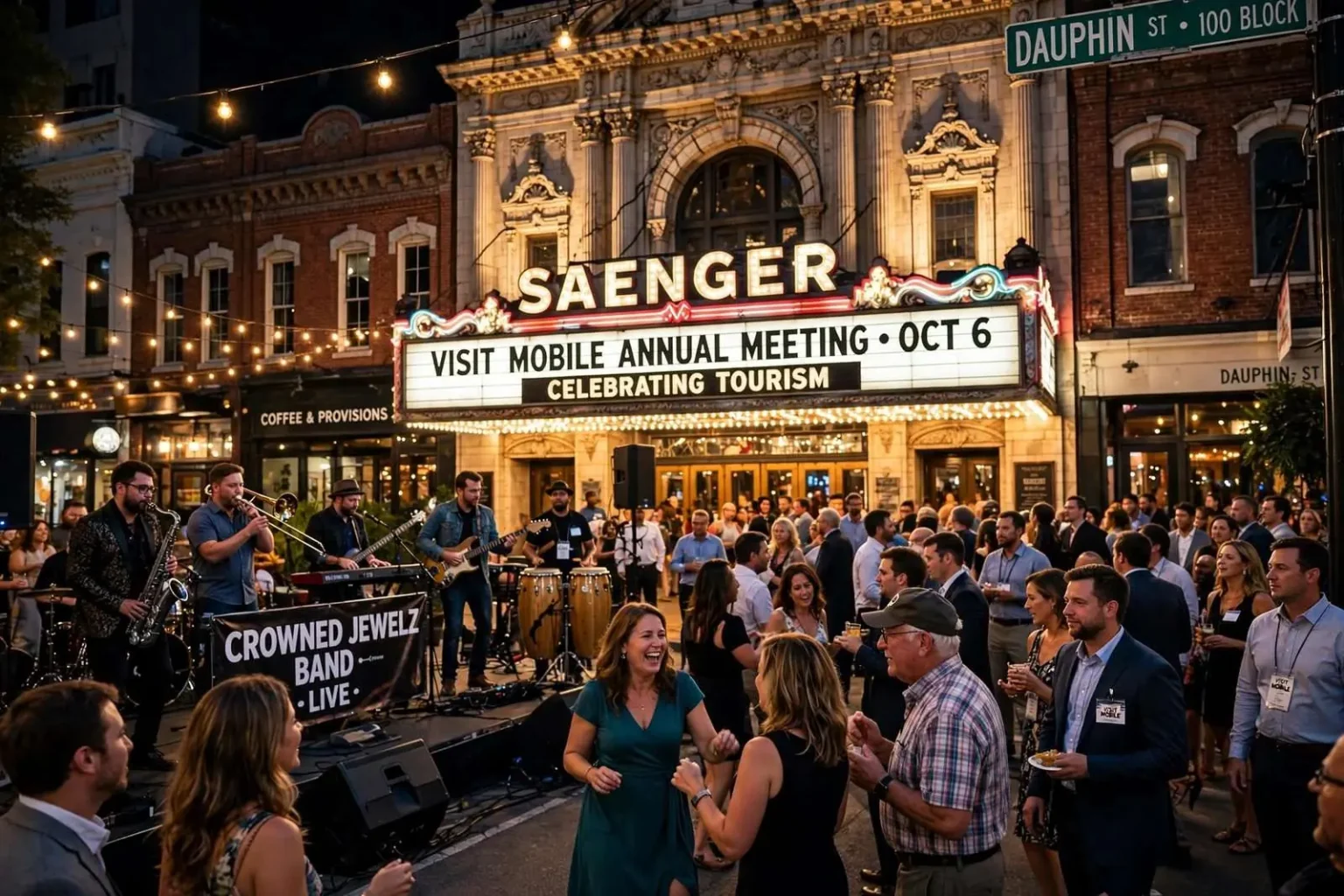
On Oct. 6, a crowd gathered outside the Mobile Saenger Theater for Visit Mobile’s Annual Meeting, an evening set aside to celebrate the organization’s work attracting leisure and convention travelers to the city. Board members, hospitality partners, and invited guests filled the block in the heart of downtown as the historic theater’s marquee glowed overhead. What began as a formal business gathering quickly loosened into something closer to a block party, with the street itself becoming a dance floor as the evening went on.
The music came from the Crowned Jewelz Band, a Mobile group with an unusually wide sound. The band pairs guitar, bass and drums with saxophone, keyboards, trombone and hand drums, giving it a mix of brass punch and rhythm-section groove that doesn’t fit neatly into any one category. That eclecticism proved well suited to an outdoor crowd of mixed ages, and board members and guests danced on the pavement in front of the theater well past the formal portion of the program.
Stacy Hamilton, Visit Mobile’s vice president of marketing, told attendees that the organization first discovered the band at the South Sounds Music Festival, the downtown event that showcases Gulf Coast acts each year. The festival appearance left an impression on the tourism staff, who went looking for a way to bring that energy to the annual meeting. Booking the Crowned Jewelz Band turned out to be that answer, and the group delivered a performance that kept the crowd on its feet.
Band leader Jonesy Jones called the performance “phenomenal” and said the group would love to play that block monthly. His enthusiasm reflected what the evening demonstrated in practical terms: downtown Mobile has public spaces and historic venues that can host events people remember, and local performers are ready to fill them. For a tourism organization whose job is to sell the city, the night outside the Saenger doubled as a live demonstration of the product.
A Historic Stage for a Hometown Showcase
The Mobile Saenger Theater gave the celebration a fitting backdrop. The movie palace opened in 1927 as one of the crown jewels of the Saenger chain, a era when grand downtown theaters anchored commercial districts across the South. Like many of its sister houses, the Saenger eventually fell on hard times as audiences moved to suburban multiplexes, and the building closed before a major restoration returned it to service. Today it operates as a performing arts venue, hosting touring Broadway productions, concerts, comedy acts, and community events in a restored auditorium that seats thousands under its ornate ceiling.
Its location is part of the appeal. The theater sits in the downtown core within walking distance of Bienville Square, the Dauphin Street entertainment district, and a growing collection of restaurants and bars. When an event spills out of the Saenger onto the sidewalk, as the Visit Mobile meeting did, it connects the venue to the street life that downtown revitalization has been building toward for two decades. That connection between historic buildings and active streets is exactly the kind of image a destination marketing organization wants to broadcast.
Choosing the Saenger for the annual meeting also served as a reminder of how much of Mobile’s visitor appeal is concentrated in its historic assets. The city’s tourism story leans heavily on places with deep roots: the theater, the churches and commercial blocks of the historic districts, Oakleigh and its museum complex, and the neighborhoods that grew up around the port. Events that put those places in motion, rather than leaving them as static backdrops, are the ones that tend to generate the word of mouth that brings visitors back.
The annual meeting itself is a fixture of the local hospitality calendar. Visit Mobile, the organization formerly known as the Mobile Bay Convention and Visitors Bureau, uses the gathering each year to report to its stakeholders on marketing efforts, convention bookings, and visitor trends, and to rally the people who work in hotels, restaurants, attractions, and event services around a shared goal. This year’s edition traded some of the usual formality for a party, and few in the crowd seemed to mind.
Turning a Drive-Through City Into a Destination
In a question-and-answer session during the program, Hamilton explained the challenge that shapes much of Visit Mobile’s work: Mobile is often a “drive-through city” for travelers headed somewhere else. Motorists rolling west on Interstate 10 toward the beaches of Florida or on to New Orleans, or running north-south on Interstate 65 toward the Gulf, pass the city’s skyline without stopping. The job of the tourism organization, she said, is to convince those travelers to get off the interstate and spend their time and money in Mobile instead of merely driving past it.
The geography explains the problem. Mobile sits at the southern end of Alabama where the Mobile River meets Mobile Bay, a natural crossroads that put interstate highways, rail lines, and shipping channels through the city. Travelers headed to Gulf Shores, Orange Beach, or the Florida Panhandle from the Midwest and Mid-South routinely route through, as do those making the long haul between New Orleans and points east. Capturing even a modest share of that passing traffic represents a significant opportunity for local hotels, restaurants, and attractions.
Visit Mobile pursues that goal through the usual tools of destination marketing: advertising in key drive markets, hosting meeting planners who might book the city’s convention facilities, working with tour operators, and promoting the city’s signature events. The organization also supports the business community that serves visitors, from the downtown hotels that host convention groups to the attractions that sell tickets. Every traveler who decides to stay a night rather than push through adds revenue that circulates through the local economy.
The city has real products to sell to those travelers. USS Alabama Battleship Memorial Park draws families with its battleship, submarine, and aircraft collection along the bay. The city’s Mardi Gras heritage, older than New Orleans’ celebration, fills downtown each winter and is interpreted year-round at the Mobile Carnival Museum. GulfQuest National Maritime Museum explores the port and the Gulf, Bellingrath Gardens and Home in nearby Theodore offers one of the South’s noted garden attractions, and the historic districts reward visitors who like architecture and walking tours. Sports tournaments, festivals, and a steady calendar of downtown events round out the calendar.
Local Businesses at the Center
During the Q&A, Hamilton stressed that independent, locally owned businesses are central to the city’s appeal. Chain hotels and national restaurants can be found anywhere, but the establishments that give Mobile its character — the locally run dining rooms, music venues, shops, and bars, many clustered along Dauphin Street and in the historic districts — are the things a traveler can’t experience at home. Supporting those businesses, in her telling, is not sentiment but strategy, because they are what distinguishes Mobile from every other exit on the interstate.
That emphasis aligns with broader trends in travel, where visitors increasingly plan trips around food, music, and local culture rather than standard attractions. A traveler who comes for a weekend of Gulf Coast cooking and live music is a traveler who tells friends, posts about the trip, and comes back. The Crowned Jewelz Band’s wish to play that block every month fits neatly into that vision: a downtown where local performers have regular stages is a downtown that feels alive to visitors.
The evening’s program, in other words, carried a message beneath the celebration. Visit Mobile wants residents to see the city the way a first-time visitor would, and to understand that tourism is not an abstract industry but a network of local owners, musicians, cooks, and guides whose livelihoods depend on people choosing to stop. The organization’s marketing brings visitors to the city limits; what happens inside them, at places like the Saenger and the businesses around it, is what makes the pitch credible.
Residents as Ambassadors
Hamilton closed her remarks by urging residents to become ambassadors for Mobile. The invitation was more than a slogan. Every resident who recommends a local restaurant to a visiting friend, talks up the city at a youth sports tournament, or answers a stranger’s question about where to hear live music is doing the work of destination marketing without a budget line. Visitors consistently trust the people they meet more than the advertising they see, and a community that speaks well of itself reinforces every campaign the tourism office runs.
Being an ambassador also means understanding what the visitor economy does for the city. Spending by leisure and convention travelers supports jobs in hotels, restaurants, attractions, and event services, many of them entry points into the workforce for young residents. Lodging taxes and sales taxes paid by visitors help fund city and county services while easing the burden on local households. When residents champion the city, they are in a practical sense supporting their own schools, streets, and services.
The ambassador pitch carries a second, quieter benefit: it keeps locals themselves engaged with downtown. Cities that successfully attract visitors tend to be cities where residents already fill the restaurants, attend the festivals, and pack the theaters. A Saenger block that hosts an annual meeting dance party in October is the same block that hosts movie nights, holiday events, and Mardi Gras parades through the rest of the year. The more often locals use those spaces, the more naturally visitors follow.
For the Crowned Jewelz Band, the night offered a stage in front of exactly the audience most likely to book them again — event planners, business owners, and community leaders. Jonesy Jones’s hope of a monthly engagement on that block would, if it happens, add a regular pulse of live music to the Saenger district, and it would give downtown workers and residents another reason to linger after five o’clock. Local music scenes and local tourism have always fed each other in cities that get this right.
The annual meeting ended the way downtown evenings should, with music still playing and the crowd reluctant to leave. For Visit Mobile, the celebration of its work attracting leisure and convention travelers was also a demonstration of the city’s fundamental pitch: history, music, food, and hospitality, all within a few blocks of the interstate exit. The organization’s task now is the one Hamilton described — turning the thousands of travelers who drive past every day into the next crowd on the sidewalk outside the Saenger.
Residents who want to help have a simple starting point, the one Hamilton laid out from the stage: know the city’s stories, patronize its independent businesses, and share both with anyone passing through. Mobile’s location will always make it easy to drive through. Making it hard to drive past is a job the tourism office cannot do alone, and the crowd outside the Saenger left with a clear picture of why that job matters.


