Vredenburgh man dies days after single-vehicle crash in Monroe County
A 34-year-old Vredenburgh man died days after his 2004 GMC 2500 left the road and overturned on County Road 56 in Monroe County.
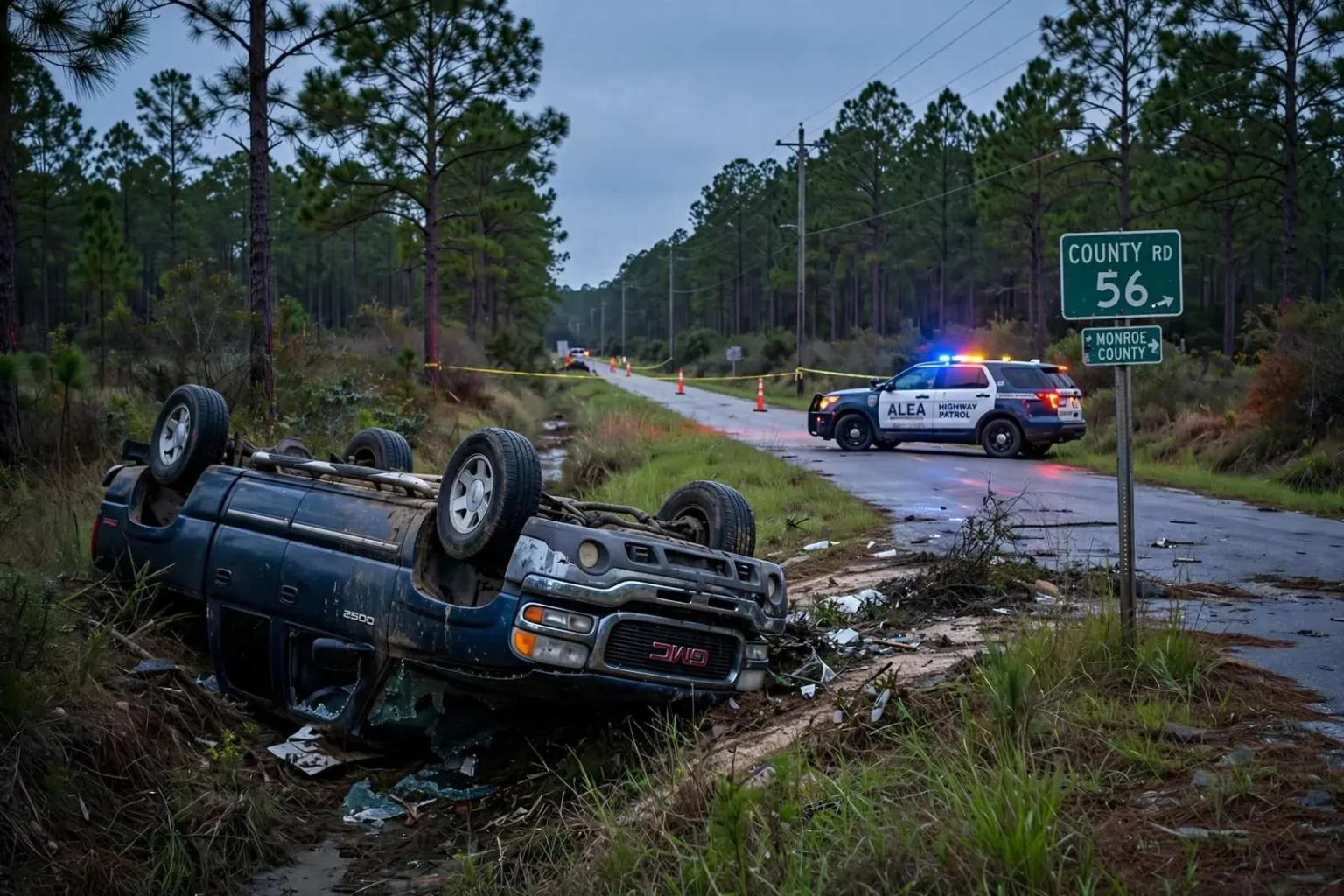
A Vredenburgh man has died from injuries suffered in a single-vehicle crash in Monroe County, the Alabama Law Enforcement Agency reported. ALEA said the crash happened around 7 p.m. on June 18 on County Road 56, about five miles northwest of Beatrice, a small community in the rural western reaches of the county. Investigators determined that 34-year-old Strother Dortch Jr. was killed when the 2004 GMC 2500 he was driving left the roadway and overturned. Dortch, who was not wearing a seat belt, was ejected from the vehicle in the crash.
After the wreck, Dortch was taken to University Hospital in Mobile, the region’s major trauma center, where he died from his injuries on Tuesday, June 23, according to ALEA. The five days between the crash and his death reflect the pattern of rural highway wrecks across Alabama, in which victims with severe injuries are stabilized at the scene, transported over long distances to tertiary care, and treated by trauma teams for days before the outcome is certain. University Hospital, located in downtown Mobile, serves as the tertiary referral center for southwest Alabama, receiving patients by ground ambulance and medical helicopter from counties across the region.
The crash site and the road
County Road 56 runs through the rural countryside northwest of Beatrice in southern Monroe County, an area of pine forests, small farms and low-traffic two-lane roads. Rural county roads like this one account for a disproportionate share of Alabama’s traffic fatalities, a pattern that traffic-safety officials attribute to a combination of factors: higher travel speeds on narrow roadways, longer emergency response times, sparse lighting, and seat belt use rates that lag urban averages. A vehicle that leaves the roadway at speed on such a road can overturn in the soft shoulder and ditch lines that border most of these routes, and ejection greatly increases the likelihood of fatal injury.
State troopers with ALEA’s Highway Patrol Division investigated the wreck, as they do crashes involving serious injury or death across the state. The agency’s crash reconstruction work in rural fatalities typically examines roadway conditions, vehicle mechanics, speed and restraint use, and its public summaries, like this one, consistently list seat belt status because of what the data shows: ejection from a vehicle is among the deadliest outcomes in any rollover, and buckled occupants overwhelmingly remain inside the vehicle during a crash. The 2004 GMC 2500 involved was a heavy pickup, a common vehicle in rural Alabama, where trucks make up a large share of the fleet.
Vredenburgh and the communities affected
Vredenburgh, Dortch’s hometown, is one of Alabama’s smallest incorporated towns, a historic lumber community in western Monroe County with a population measured only in the hundreds. Deaths on the roads around the town reach a close-knit population where nearly every family is connected, and fatal crashes on the county’s rural routes are felt across the community in ways that urban statistics rarely capture. Beatrice, the nearest town to the crash site, sits along the same rural corridor and likewise serves as a hub for the area’s residents.
Monroe County, stretching from its seat at Monroeville into the timber country toward the Alabama River, has long contended with the traffic-safety challenges common to rural Alabama. The county’s roads carry log trucks, farm equipment and commuter traffic on pavement built for far lighter use, and its residents often drive long distances for work, medical care and shopping. Safety campaigns by the state, including seat belt enforcement waves and impaired-driving mobilizations, target exactly the conditions present in crashes like this one, though the rural geography makes sustained enforcement difficult.
The loss of Strother Dortch Jr. at 34, five days after his truck left County Road 56 and overturned, closed a week that began with a wreck in the pine woods northwest of Beatrice and ended with a death notice from a Mobile hospital bed. ALEA’s report records the essentials: the time, the road, the vehicle, the victim and the seat belt that was not worn. Those details join the long statistical record of rural Alabama crashes, and behind them stands a small town in Monroe County mourning one of its own.
Single-vehicle crashes of the type that killed Dortch are the most common fatal crash pattern on Alabama’s rural roads. Unlike multi-car collisions, they typically involve no second party to flag the danger: the vehicle simply departs the lane, whether from speed, distraction, fatigue, a mechanical failure, or an evasive maneuver, and the driver has only seconds to recover. On a narrow county road bordered by ditches and trees, recovery is often impossible, and the wreck that follows is frequently a rollover. Federal and state crash data consistently show that rollover crashes produce a fatality rate several times higher than other crash types, and that unrestrained occupants are ejected in a large share of those deaths.
The seat belt factor in this case deserves particular attention, because it is the single element of the crash most within a driver’s control. Alabama’s mandatory seat belt law makes restraint use a primary offense, allowing troopers to stop a vehicle solely for a belt violation, and the state’s annual Click It or Ticket campaigns concentrate on rural counties where belt use historically trails the national average. Safety advocates note that rural Alabamians face a fatal-crash risk well above urban residents, driven partly by road conditions but compounded by restraint choices, and that the arithmetic of ejection is unforgiving: occupants thrown from a rolling vehicle face the road, the vehicle and the ground with nothing between them and the impact.
How rural fatal crashes are worked
When a wreck in south Monroe County turned fatal, the response chain began with the county’s volunteer-based emergency services and local law enforcement, who secured the scene and called in medical transport. Trauma patients from the region are triaged to University Hospital in Mobile when their injuries exceed local capacity, a trip of well over an hour by ground from the crash site northwest of Beatrice. The hospital, part of the USA Health system, operates the only Level I trauma center serving southwest Alabama, and its surgeons treat patients from a catchment area that extends across the state line in every direction. Patients like Dortch, admitted with severe multi-trauma from a rollover, can spend days in intensive care before their condition is resolved.
ALEA’s investigation of a fatal crash continues after the victim’s death, with the final report folding the hospital outcome into the crash record. That documentation matters beyond the immediate family: it feeds the federal fatality database that guides highway safety funding, it informs county road improvement decisions, and it supports the enforcement priorities that state troopers apply along corridors like County Road 56. Families, for their part, typically wait on the investigative record as they arrange services and settle questions about insurance and the vehicle itself.
The human cost behind the numbers
Behind every ALEA fatal-crash summary stands the community arithmetic of a place like Vredenburgh. The town, once a bustling sawmill settlement along the railroad in the early twentieth century, has contracted for decades like much of rural south Alabama, and its remaining residents share churches, family ties and a long common history. A 34-year-old resident’s death in a crash five miles from Beatrice ripples through those networks immediately, in the way small communities absorb loss: memorial posts, meal trains, and a funeral that draws people from across the county.
Traffic-safety officials use crashes like this one to renew the messages they repeat every year: wear the belt on every trip, however short and familiar the road; expect the unexpected on rural routes where curves, ditches and oncoming log trucks leave little margin; and never assume that a road driven a thousand times is safe from a single lapse. County Road 56 between Beatrice and the surrounding countryside will carry its normal traffic this week, as it does every week, but the wreck that took Dortch’s life stands as the latest entry in the region’s hardest-running tally, the one that counts the rural Alabama drivers who left the road and did not come home.
Monroe County’s rural crash toll fits a statewide pattern that highway engineers and safety planners have documented for decades. Alabama’s fatal-crash rate per mile traveled runs above the national average, and the gap is widest on rural roads, where design standards date to different eras and where a driver in crisis has no shoulder to recover on and no median to protect them. Improvements such as paved shoulders, centerline rumble strips, curve signage and clearing trees back from the right of way have demonstrably reduced run-off-road deaths where they have been applied, but counties with limited road budgets prioritize across hundreds of miles of pavement, and the work proceeds slowly.
Emergency response times compound the risk in places like the stretch of County Road 56 where Dortch crashed. A serious wreck in an urban area brings fire, EMS and law enforcement within minutes; in southern Monroe County, volunteers may drive significant distances to reach the scene, and the helicopter flight to Mobile or Montgomery depends on weather and landing conditions. The survival gap between a crash victim reached in ten minutes and one reached in forty is well established in trauma medicine, and it is part of why rural fatality rates resist improvement even as vehicle safety technology advances.
What the record can and cannot say
The public record of this crash, as reported by ALEA, establishes the fixed facts: a 7 p.m. crash on June 18, on County Road 56 about five miles northwest of Beatrice; a 2004 GMC 2500 leaving the roadway and overturning; a 34-year-old driver from Vredenburgh, unrestrained and ejected; and a death at University Hospital in Mobile on June 23. What the record does not establish is why the truck left the road, a question the full investigation addresses but public summaries generally do not. Absent those findings, the responsible reading of the crash is the one the data supports: a common crash type, on a common road type, with the common deadly outcome of ejection.
For readers in Monroe County and across south Alabama, the practical takeaway is the one safety officials deliver after every such report. Rural roads do not forgive the mistakes that city streets absorb, the distances are longer and the help is farther away, and the seat belt remains the difference between a survivable rollover and a fatal one. The grief in Vredenburgh this week belongs to the community that knew Strother Dortch Jr.; the lesson of the crash belongs to everyone who drives the same pine-lined roads he traveled on the evening of June 18.
Dortch’s death was the 34-year-old’s family’s loss and the small town’s loss, and it was also one more line in the annual count that Alabama keeps, crash by crash, on its county roads. The Highway Patrol will close its file with the same economy it opens them, and County Road 56 will keep its quiet traffic through the summer. The memory in Vredenburgh will be of the man, and the record will be of the wreck, and both are now part of the story of a rural county that knows this kind of news too well.