Walk to End Alzheimer’s Returns to Battleship Memorial Park in Mobile
The fifth annual Walk to End Alzheimer's comes to USS Battleship Memorial Park in Mobile, with registration at 1:30 p.m. and the walk starting at 3:15 p.m.
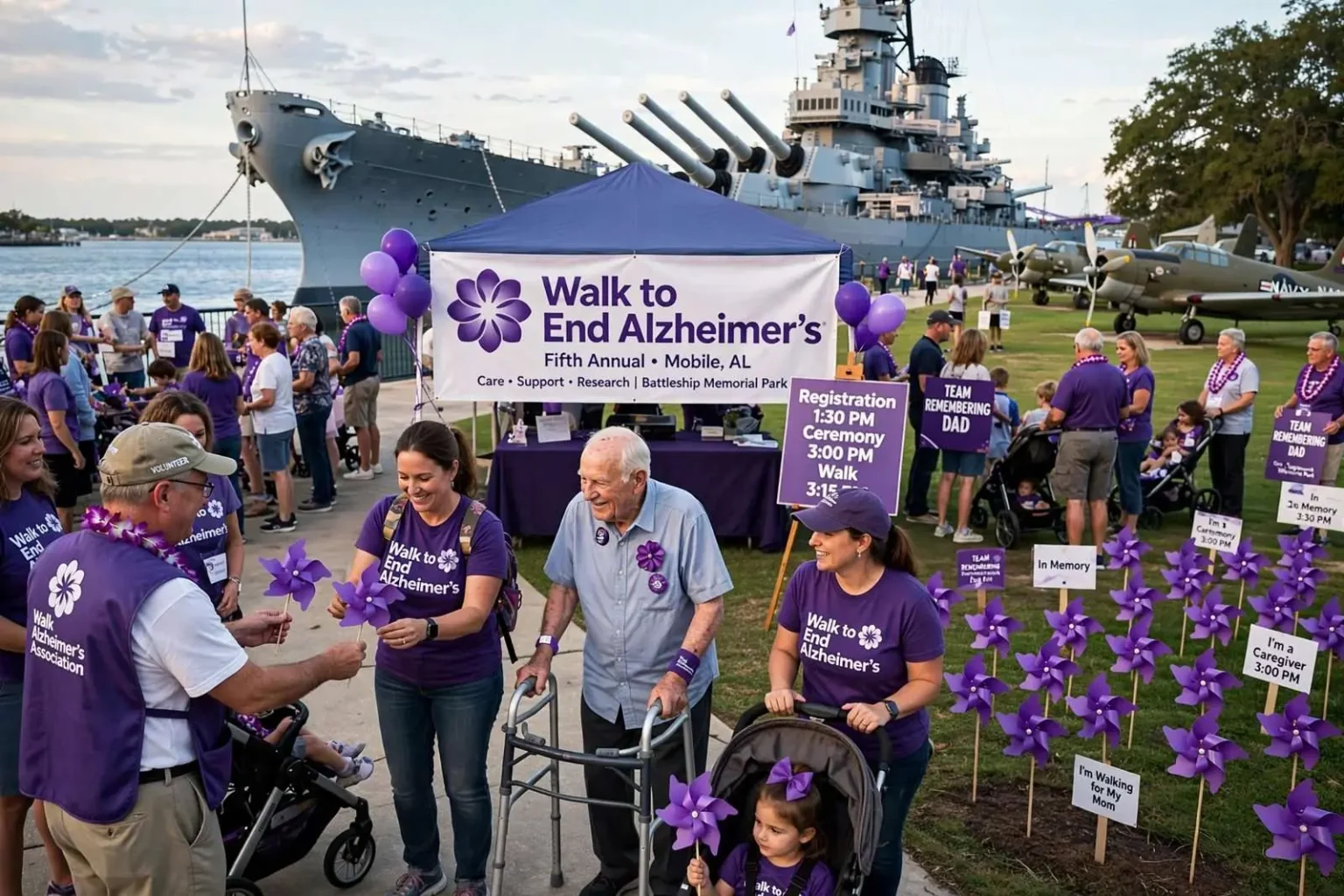
Organizers are gearing up for the fifth annual Walk to End Alzheimer’s, which returns to USS Battleship Memorial Park in Mobile. The event welcomes participants of all ages and abilities for an afternoon aimed at raising both money and awareness for Alzheimer’s care, support and research along the Gulf Coast, and it has quickly become one of the region’s most recognizable charity gatherings since its first Mobile edition.
The Alzheimer’s Association, which stages the walk in more than 600 communities across the country each year, describes it as the world’s largest fundraiser devoted to fighting the disease. Proceeds support care services for local families, educational programs and research toward a cure — dollars that stay close to home in the form of support groups, helpline services, and education for caregivers across south Alabama.
Event Details
Registration opens at 1:30 p.m., followed by a ceremony at 3 p.m. and the walk itself stepping off at 3:15 p.m. at the waterfront park, home of the USS Alabama. The afternoon format lets families arrive together, take part in the opening ceremony’s tribute features, and walk the park’s grounds as a group before the summer heat fades into evening.
Battleship Memorial Park offers a setting few walk events can match. Participants gather in the shadow of the USS Alabama, the World War II battleship that anchors the park along Mobile Bay, with the ship’s decks and the surrounding military exhibits open to visitors who want to make an afternoon of it. The route along the waterfront gives walkers views of the bay and the park’s aircraft displays, and the flat terrain makes the event accessible for strollers, wheelchairs, and walkers of every pace.
Why the Walk Matters Locally
Andy Luedecke of the Alzheimer’s Association discussed this year’s walk during a recent segment of the local program “Mark Your Calendar,” encouraging Gulf Coast residents to take what organizers call “the first step to a world without Alzheimer’s.” The appearance is part of a broader push to reach families who may be facing the disease for the first time and do not know where to turn for services.
Alzheimer’s touches a significant share of families in south Alabama, and caregivers often carry the burden quietly for years before seeking help. The Association’s local services — from care consultations to support groups and education sessions — exist to fill that gap, and the funds raised at the Mobile walk help sustain them. For participants, the walk is also a visible act of solidarity: teams walk in honor of parents, spouses, and friends, many wearing purple flowers and pinwheel markers that tell the story of why each person came.
The Alzheimer’s Association’s National Effort
The Walk to End Alzheimer’s is the flagship fundraising event of the Alzheimer’s Association, the national nonprofit devoted to Alzheimer’s care, support and research. The walks held in more than 600 communities each year funnel support into a nationwide operation that funds research grants, maintains a 24/7 helpline, and advocates for public policies affecting patients and caregivers. In Mobile, that national network shows up in practical terms: local families can call for guidance at any hour, and area education programs are offered at no cost.
The Association describes the walk as the world’s largest fundraiser devoted to fighting the disease, a distinction that has grown as the events have spread from major cities into communities of every size. The Mobile edition, now in its fifth year at Battleship Memorial Park, draws participants from across Mobile and Baldwin counties and beyond, including teams organized by churches, workplaces, senior living communities, and extended families.
How Participants Take Part
Getting involved requires little more than registering and showing up. Participants can walk as individuals or as part of a team, and teams often spend the weeks before the event raising contributions from friends, coworkers, and neighbors. The Promise Garden ceremony that anchors Walk to End Alzheimer’s events nationwide gives each participant a flower whose color reflects their connection to the disease — whether they are living with Alzheimer’s, caring for someone who is, or walking in memory of someone lost.
The 1:30 p.m. registration window gives teams time to check in and gather before the 3 p.m. ceremony, and the 3:15 p.m. step-off keeps the walk itself compact enough for participants of all abilities. Organizers emphasize that no fundraising minimum is required to walk: the event is designed so that anyone affected by the disease can take part, whatever they are able to contribute.
A Tradition at the Park
Battleship Memorial Park has become a familiar home for large community gatherings on Mobile Bay, and the Alzheimer’s walk has used the waterfront setting to build its own tradition over five years. Returning walkers describe the event as both a fundraiser and a reunion — an afternoon when families confronting the same disease find each other among the crowd. With the ceremony at 3 p.m. and the walk stepping off at 3:15 p.m., organizers are inviting Gulf Coast residents to end the afternoon the way the event began five years ago: by taking the first step toward a world without Alzheimer’s.
Alzheimer’s on the Gulf Coast
The disease the walk confronts is a reality for thousands of families across south Alabama. Alzheimer’s is the most common cause of dementia, progressively affecting memory, thinking, and eventually the ability to carry out daily tasks, and it places extraordinary demands on the family members who provide the bulk of day-to-day care. In communities along the Gulf Coast, where many older residents have retired to be near the water and grown children often live hours away, the caregiving strain can fall on a single spouse or sibling with little backup.
That is why the Association’s local presence matters as much as its research funding. Care consultations help families plan for the stages ahead, support groups connect caregivers who understand the daily challenges firsthand, and education programs teach practical skills — from communication strategies to safety planning for wandering, a common and dangerous symptom in later stages. All of those services are sustained in part by the money raised at events like the Mobile walk.
The fifth annual edition also arrives as researchers continue to push toward treatments that can change the course of the disease. Every walk season adds to the national research portfolio funded through the Association, and participants in Mobile are, in a literal sense, contributing to trials and studies underway at institutions across the country. Organizers make that connection explicit during the ceremony, reminding walkers that the afternoon’s effort reaches far beyond the bay.
Marking the Calendar
The “Mark Your Calendar” segment featuring Andy Luedecke is aimed squarely at residents who have meant to participate in years past but never followed through. The message from organizers is consistent: no contribution is too small, no walker too slow, and no family’s connection to the disease too indirect. Friends, neighbors, and coworkers who have never been touched by Alzheimer’s directly are welcome, because awareness — people knowing the services exist before a crisis hits — is half of what the afternoon is designed to accomplish.
For those planning to attend, the sequence is simple: registration at 1:30 p.m., ceremony at 3 p.m., and the walk at 3:15 p.m. at USS Battleship Memorial Park. Participants should plan for a waterfront afternoon — sunscreen, comfortable shoes, and time to linger among the park’s exhibits afterward. Teams are encouraged to arrive early enough to gather for photos before the ceremony, when the Promise Garden flowers fill the staging area with color and the stories behind them.
Five years in, the Mobile walk has grown into a fixture of the area’s charitable calendar, and organizers are betting that the combination of a meaningful cause and one of the most striking venues on the Gulf Coast will keep it growing. Every registration, every team, and every dollar raised goes toward the same goal the Alzheimer’s Association has chased across more than 600 communities this year — the first step to a world without Alzheimer’s, taken one afternoon at a time on Mobile Bay.
Getting a Team Together
For workplaces, churches, and civic groups across Mobile and Baldwin counties, the walk has become an easy first service project of the season. Team captains register a group online, set a modest fundraising goal, and circulate the details — registration at 1:30 p.m., ceremony at 3 p.m., walk at 3:15 p.m. — to members who may already have a family connection to the disease. Senior living communities in particular have turned out teams in past years, bringing residents and staff together for an afternoon along the bay.
First-time participants should not underestimate the ceremony itself. The Promise Garden, the reading of why each walker has come, and the moments held for those living with the disease and those lost to it give the afternoon a weight that stays with people long after the walk ends. It is the reason many first-timers return each year, and the reason organizers keep describing the event not as a race but as a first step — the beginning of a family’s engagement with the care and research community, taken in one of the most meaningful settings south Alabama has to offer.