Wawa Plans 8 Gulf Coast Stores in Mobile, Baldwin and Pensacola
Wawa plans to open more than 40 Gulf Coast stores over the next decade, starting with eight locations in Mobile County, Baldwin County and Pensacola in.
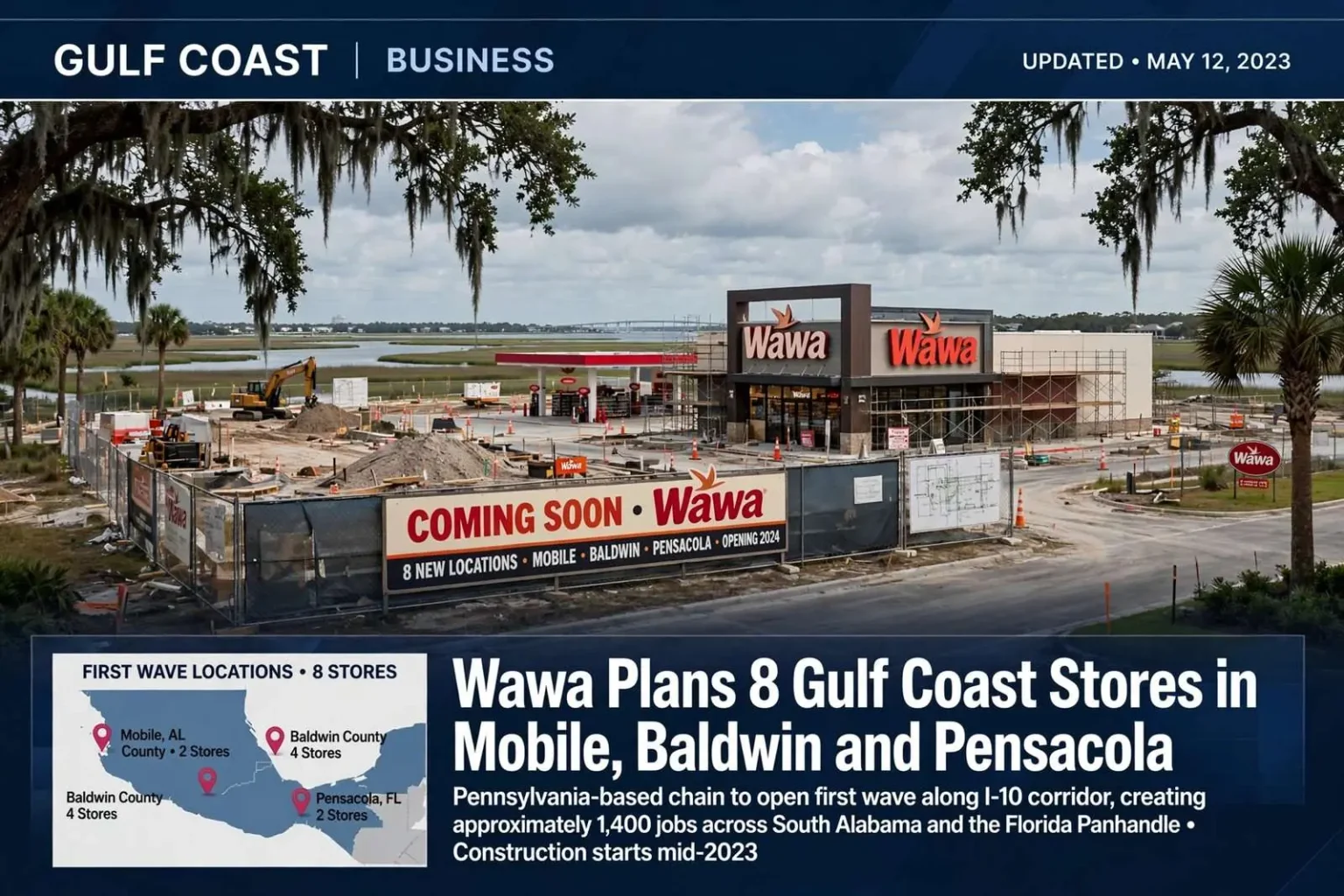
Wawa, the Pennsylvania-based convenience store and gas station chain with a cult following up and down the East Coast, is officially headed to the Gulf Coast. According to the Mobile Chamber, the company plans to open more than 40 stores across south Alabama and the Florida Panhandle over the next eight to 10 years — one of the most significant retail expansions the region has seen in years.
The first wave of the rollout includes two locations in Mobile County, four in Baldwin County and two in Pensacola, giving both sides of the bay and the neighboring Florida market a share of the initial build-out. Construction is expected to begin in mid-2023, with stores opening in 2024, meaning residents should start seeing site work at the first locations within months.
“We are delighted to have Wawa in this area,” said Mobile Chamber President and CEO Bradley Byrne. “It is an affirmation of the economic growth here because they’ve done their market study.”
The expansion is expected to create about 1,400 jobs across the region once the stores are built and operating, with each location employing roughly 35 associates. For a retail sector that has been reshaping itself in the face of online competition, the investment represents a substantial vote of confidence in the Gulf Coast’s population growth and spending power.
“We’re thrilled to be flying into the Florida Panhandle and South Alabama region,” said Robert Yeatts, Wawa’s senior director of store operations.
What Wawa brings to the Gulf Coast
Wawa is not a typical convenience store chain. Founded in Pennsylvania, where the company traces its roots to the 19th century, the chain has built a devoted customer base along the Mid-Atlantic and Florida on the strength of its made-to-order food program — hoagies, breakfast sandwiches, specialty drinks and fresh offerings prepared in-store — alongside standard fuel and convenience offerings. The company’s stores are larger than the average corner market, open around the clock in many locations, and known for a level of food service that has earned comparisons to fast-casual restaurants as much as gas stations.
That reputation explains the anticipation that typically follows Wawa announcements in new markets. In Florida, where the chain has expanded aggressively over the past two decades, store openings have drawn lines around the building and become neighborhood fixtures. Gulf Coast residents who have traveled through the Southeast or Mid-Atlantic have long asked when the chain would cross into Alabama, and the Mobile Chamber’s announcement answers that question.
For the region’s retail landscape, the arrival of a new major player tends to raise standards across the sector. Competing convenience stores and quick-service restaurants will be vying for the same customers, and the 1,400 projected jobs add to the region’s tight labor market with positions ranging from entry-level associates to store management.
The geography of the first wave
The breakdown of the initial locations reflects the region’s growth patterns. Baldwin County, one of the fastest-growing counties in Alabama, drew the largest share of the first wave with four stores, a signal of where the chain sees its early customer base. The county’s population boom along the Eastern Shore and the coast — from Daphne and Fairhope to Gulf Shores and Orange Beach — has made it a magnet for national retail chains in recent years.
Mobile County’s two first-wave locations bring the brand into the city market itself, while the two Pensacola stores establish a Florida Panhandle beachhead. Together, the eight-store first phase gives the chain a corridor presence along Interstate 10 and the coastal highways, with room to fill in additional sites as the eight-to-10-year build-out continues.
Sites for individual stores are typically selected through the kind of detailed market analysis Byrne referenced, weighing traffic counts, population density, growth projections and competition. Specific addresses for the first-wave stores were not part of the announcement, but construction timelines suggest site identification is already well along.
What 1,400 jobs means locally
The employment impact extends beyond the raw number. Each store’s roughly 35 associates include a mix of full-time and part-time positions, with internal promotion paths that the company has long emphasized as a hallmark of its culture. Store managers, food-service leads and shift supervisors at Wawa locations are frequently promoted from entry-level roles, and the chain’s expansion into new markets typically brings transfer opportunities for experienced employees from established regions.
Spread across south Alabama and the Florida Panhandle, the 1,400 projected jobs join a regional economy already adding positions in shipbuilding, aerospace, healthcare and tourism. Retail and food service positions provide entry points into the workforce for students, part-time workers and career changers, and the construction phase itself — dozens of sites built over a decade — supports contractors and trades across the region.
Chamber officials view the announcement as part of a broader pattern. National chains site their stores based on data, and as Byrne noted, Wawa’s decision came after the company’s own market study confirmed what local economic developers have been saying: the Gulf Coast’s population and economy are growing fast enough to support major new investment.
A changing convenience landscape
The Gulf Coast’s convenience store market has been dominated by regional and national chains for years, but Wawa’s model is different in ways that reshape the competition. The company invests heavily in store-level food preparation, with kitchens producing made-to-order sandwiches and bakery items throughout the day. Many locations pair that offering with fuel canopies, ample parking and, in some markets, electric vehicle charging — features aimed at keeping customers on site longer and returning more often.
The chain’s move into south Alabama follows its established playbook in Florida, where expansion proceeded in waves — first the Jacksonville area and the northeastern part of the state, then down both coasts and across the central corridor. The Florida Panhandle and Alabama were the logical next frontier as the chain’s Florida footprint matured, and the eight-to-10-year horizon for the more than 40 planned stores suggests a deliberate, phased build rather than a single burst of openings.
For consumers, the arrival of a new chain in a consolidated market typically means more choices, sharper pricing and upgraded offerings at existing stores. The region’s motorists and commuters stand to see the most immediate effects once the first stores open in 2024.
The road from announcement to opening
Between now and the first store openings, the visible progress will come in stages: site permits, land clearing, the rise of building frames and fuel canopies, then hiring signs in the months before each opening. Construction beginning in mid-2023 puts the first openings on schedule for 2024, though retail timelines can shift with supply chains and permitting.
Hiring for each location generally ramps up several months before opening, with the company recruiting store associates, kitchen staff and management through its careers channels. The roughly 35 associates per store, multiplied across more than 40 eventual locations, is what produces the 1,400-job projection — a number that will build gradually as the chain fills in its south Alabama and Panhandle map.
For now, the announcement itself is the milestone. A Pennsylvania-based chain with a national reputation and a proven expansion record has looked at the Gulf Coast market, run its numbers and committed to a decade of growth here — two stores in Mobile County, four in Baldwin County, two in Pensacola to start, and dozens more to follow as the region keeps growing.
Why national chains are watching the Gulf Coast
Wawa’s decision places the Gulf Coast alongside the fast-growing Sun Belt markets that national retailers have targeted for expansion in recent years. The region’s combination of in-migration, major industrial projects along the Mobile River and the I-10 corridor, and a tourism economy that swells the coastal population every summer makes it attractive to companies that live and die by traffic counts and demographic projections.
Economic development officials have argued for years that south Alabama’s retail offerings lagged behind its population growth, forcing residents to drive long distances or shop online for brands available in Atlanta, New Orleans or Tampa. Each announcement of a new national retailer — grocery, dining or convenience — narrows that gap, and the Chamber has made filling it a central part of its recruitment pitch.
Byrne’s comment about the company’s market study captures how these deals come together. Retailers don’t expand on a chamber’s word; they commission their own analyses of population trends, income growth, vehicle traffic and competitive density. When a chain of Wawa’s size commits to more than 40 stores over eight to 10 years, it is essentially publishing its own forecast for the region’s future — one that other retailers will read and factor into their own decisions.
What customers can expect at a Wawa
For Gulf Coast residents who have never visited one, the chain’s appeal takes some explaining. A typical Wawa combines fuel pumps with a large store built around a food-service counter, where customers order sandwiches, salads and breakfast items that are made while they wait. The menu’s namesake hoagie has a following that borders on regional identity in Pennsylvania and New Jersey, and the chain’s coffee program, snack selection and house-brand products round out the offering.
The stores are also known for cleanliness, staffing and speed — qualities that have made Wawa a frequent fixture in national customer-satisfaction surveys for the convenience store industry. Those ratings matter for the company’s expansion strategy, because word of mouth in a new market is what turns a first visit into a daily habit.
With the first stores still more than a year away from opening, south Alabama and Pensacola residents have time to learn what the fuss is about. Construction beginning in mid-2023, openings in 2024, and a build-out that stretches across the decade ahead: the Gulf Coast’s newest retail arrival is coming, and it plans to stay.