
‘We’re Ready to Get It Picked Up’: Mobile Residents Wait as Sally Debris Cleanup Crawls On
Two weeks after Hurricane Sally, Mobile has collected about a third of its estimated 381,360 cubic yards of storm debris.
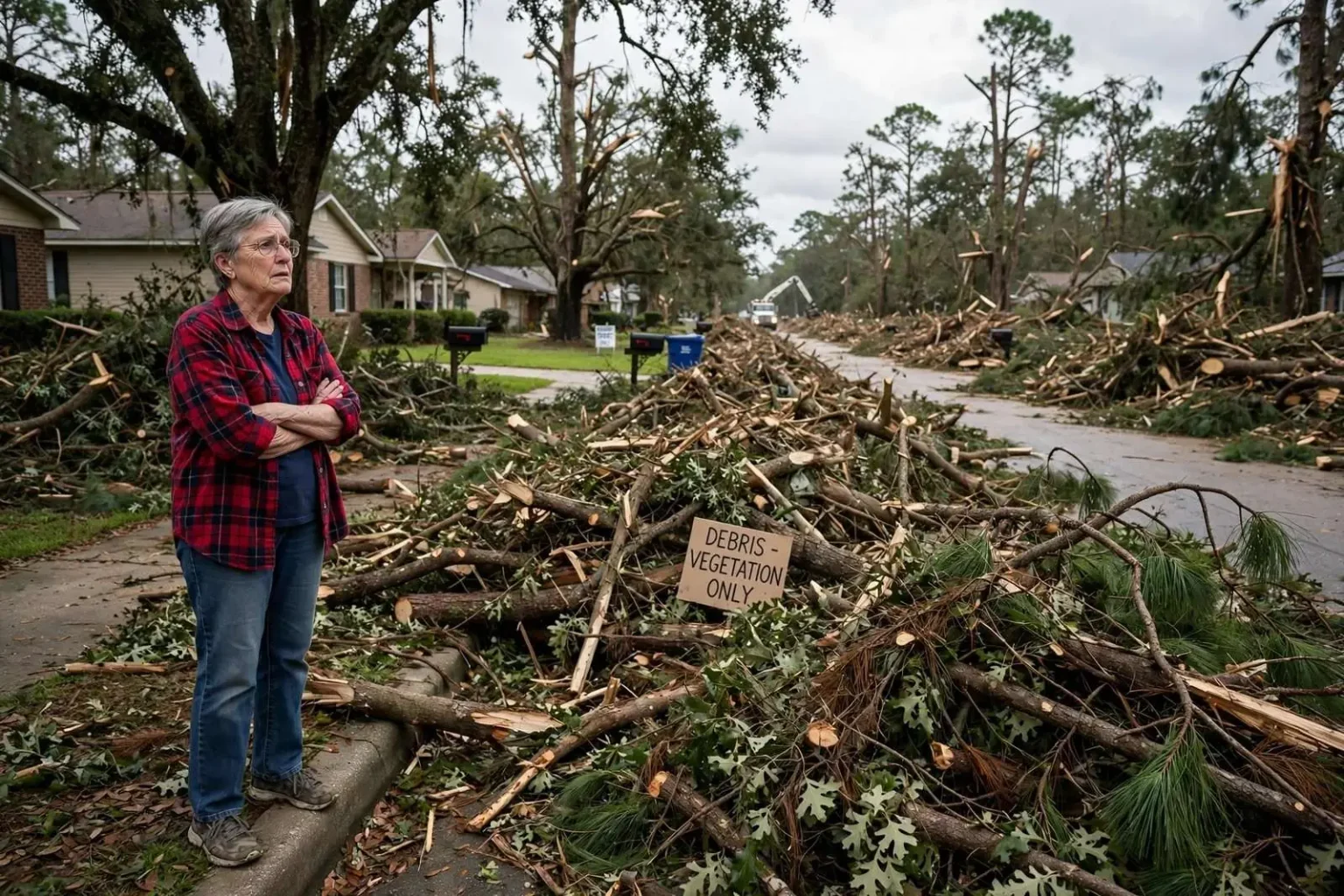
More than two weeks after Hurricane Sally, mountains of storm debris still line the curbs of Mobile neighborhoods, and residents are watching the calendar as closely as the city watches its trucks. The cleanup that followed the September storm has become the defining post-hurricane experience for the city — a slow, truck-by-truck effort to clear hundreds of thousands of cubic yards of limbs, branches, and downed trees from every part of town.
Pat Clark of Spring Hill separated her debris exactly as the city instructed. Now she wants it gone before it attracts unwanted visitors. “If we could do it in a timely manner that would be great because I do worry, especially with grandchildren we might have snakes or rodents,” Clark said. Her concern is a common one in the weeks after a Gulf Coast hurricane: curbside piles of vegetation left in the heat and humidity become habitat quickly, and residents with children and grandchildren give the piles a wide berth until the trucks arrive.
She added that she appreciates crews clearing main thoroughfares first, making roads safer to drive while residential pickup continues. That sequencing — arterials before neighborhoods — is standard practice in storm cleanup, and Mobile’s residents have largely understood it even while their patience wears at the curb. Clearing the main roads restores traffic flow, gives emergency vehicles clear passage, and lets the city’s economy keep moving while the slower neighborhood work proceeds street by street.
About a third of the pile collected
The city estimates Sally left behind 381,360 cubic yards of trash and debris across Mobile. As of this week, crews have collected roughly a third of it — about 32.5 percent — working daily in every council district. The numbers put the scale of the job in perspective: 381,360 cubic yards is enough debris to fill a line of trucks stretching for miles, and collecting a third of it in two weeks represents an operation running at full capacity every day since the storm passed.
Hurricane Sally made its landfall on the central Gulf Coast as a slow-moving Category 2 storm, and its glacial forward speed meant hours of sustained wind across the Mobile area rather than a brief blow. Trees came down by the thousands across the city, falling on homes, roads, and power lines, and the vegetative debris they left behind is what now fills the curbs. Wind damage of that kind doesn’t require flooding to be destructive, and Sally proved it across inland neighborhoods like Spring Hill that sit well away from the surge zone.
The cleanup effort the city organized after the storm is a major municipal undertaking. Debris removal at this scale runs through contracted haulers working alongside city crews, with collection typically organized by debris type — vegetation in one pile, construction and demolition material in another, appliances and household hazardous waste separately — because federal reimbursement rules require the streams to be separated and documented. Residents who follow the sorting instructions, as Clark did, are doing their part to keep the whole process eligible for FEMA reimbursement and moving without delays.
Working daily in every council district means the operation is spread across all seven of Mobile’s districts rather than concentrated where piles are heaviest. That approach spreads the visible progress — every neighborhood sees trucks eventually — but it also means the percentages move slowly, because equipment and crews divide across the entire city instead of clearing one area before moving to the next.
Frustration is simmering in some corners of the city, but many residents like Clark say they’re staying patient as crews work street by street toward them. The mix of emotions is typical of the second week after a hurricane: gratitude that the storm’s damage wasn’t worse, exhaustion with the disruption, and a growing impatience with piles that block sidewalks and parking lanes while everyone waits for their street’s turn.
Storm debris cleanup is slower than it looks from the curb, for reasons that don’t show up in a drive through an affected neighborhood. Each truck makes circuit after circuit through residential streets, loading with grapples, hauling to a designated debris site, weighing in, and returning — and each cycle handles only a few loads’ worth of the city’s total. At 381,360 cubic yards, the arithmetic means the job is measured in weeks and months even with dozens of trucks running daily schedules.
The debris management sites themselves become temporary landmarks in a post-hurricane Mobile — large open areas where mountain-sized piles of vegetation accumulate, get ground into mulch, and eventually leave the region by the truckload. Siting those locations, monitoring them for runoff and traffic, and managing the constant truck traffic is a project of its own running parallel to the collection routes.
For residents, the practical guidance from city officials through this stretch has been consistent: keep debris separated by type, keep it clear of fire hydrants, mailboxes, and storm drains, and leave the piles at the curb until crews get there. Moving or re-piling debris after collection has passed can mean missing a neighborhood cycle entirely, since the trucks don’t return to a street until the next pass. The snakes-and-rodents worry that Clark raised is one officials hear often, and the honest answer is that the timeline depends on the debris volume ahead of each street — the piles go when the trucks reach them, and not before.
Two weeks into the recovery, Mobile’s cleanup had collected about a third of a historic pile, with two-thirds still at the curb. The residents waiting — some patient, some not — are watching the trucks move closer street by street, and the city’s percentage will keep climbing one route at a time until the last of Sally’s debris leaves the curbs of Mobile.
The scale of Sally’s debris footprint comes into focus when compared with what a normal storm season leaves behind. A summer thunderstorm might knock down scattered limbs across a few neighborhoods; a tropical system dropping eight inches of rain over a city’s tree canopy in a day produces a volume that municipal brush collection could never absorb on its normal schedule. That is why hurricanes trigger the emergency debris contracting system — pre-arranged haulers, temporary sites, and monitoring crews that a city activates when its own trucks are overwhelmed.
The monitoring matters because the money depends on it. Federal disaster reimbursement requires that every load of storm debris be accounted for — where it was picked up, what type of debris it was, where it was taken, and how much it weighed. Monitors ride with the trucks and work the sites, documenting loads, which is slower than a private hauling job but is what makes the federal cost share possible. A city that cuts corners on documentation risks losing millions in reimbursement, so the careful pace is part of the financial architecture of recovery.
Spring Hill, where Clark waited with her sorted piles, sits among the older and more heavily treed parts of Mobile, which made neighborhoods like hers both more beautiful and more damaged when Sally came through. Mature oaks and pines that define the area’s character became the storm’s debris field when the sustained winds arrived, and the oldest neighborhoods in the city produced some of the largest curbside mountains the cleanup crews encountered.
The city’s estimate of 381,360 cubic yards was itself a moving number early on. Initial assessments after a hurricane are rough calculations based on aerial surveys and sampling, refined as actual collection data accumulates. The figure officials cite two weeks in reflects a better picture than the first-pass estimate, and it will ultimately be superseded by the final total once the last truck empties the last route.
For the crews themselves, the work is physical and repetitive under a Gulf Coast sun. Grapple trucks, knuckle-boom loaders, and dump trailers run dawn-to-dusk shifts, and the contractors supplement local municipal crews with out-of-town operators who follow hurricane seasons across the Southeast. The work goes fastest where piles are consolidated at the curb and slowest where debris is scattered, tangled in fences, or mixed with construction material — which is why the sorting instructions residents receive are repeated so often.
Residents watching the percentage climb also learned the rhythm of post-storm collection cycles. The city’s approach — arterials first, then a systematic pass through every council district — means each neighborhood’s wait is determined by where its streets fall in the rotation. A street missed in the first pass goes into the second, and communication about the schedule becomes the city’s most urgent public information task once the initial emergency phase ends.
Two weeks after landfall, the city had moved roughly 124,000 cubic yards of Sally’s 381,360 — about a third of the total — with every district seeing daily work. The remaining two-thirds still at the curb represented weeks more of grinding progress, and for residents like Pat Clark, the wait continued until her street’s turn came.


